Classroom Seating Arrangements: Pros, Cons & How to Choose
Setting up classroom seating can feel like solving a giant puzzle. You have to think about which students work well together, who needs fewer distractions, who needs to be close to instruction, and whether you can actually move between all those desks once they’re in place.
Before you even start assigning seats, though, there’s a bigger decision to make: How should you arrange the desks?
Rows, pairs, groups, U-shapes, and combination layouts all work well for different purposes. The best classroom seating arrangement isn’t necessarily the one that looks best on Pinterest. It’s the one that supports the way your students need to learn.
Below, you’ll find seven common classroom seating arrangements, including the pros, cons, and situations where each one tends to work best.
There isn’t one classroom seating arrangement that works best for every class. The right setup depends on your students, the type of instruction you do most often, and how much interaction your class can successfully manage.
A seating arrangement that works beautifully with one group of students may create constant distractions with another. You may even find that the best setup changes during the year as your students become more independent.
Here’s a quick way to narrow down your options:
If you want to…
Consider…
Reduce talking and distractions
Traditional rows or stadium seating
Make partner work easy
Pairs
Encourage whole-class discussion
U-shape
Combine discussion with more structure
Double horseshoe
Support frequent cooperative learning
Table groups or pods
Fit more students into a limited space
Table groups or stadium seating
Meet several different needs at once
Combination seating
Think about how students spend most of their day. If your lessons involve frequent collaboration, arranging every desk in isolated rows probably creates unnecessary transitions. On the other hand, if your current class struggles to stay focused when facing several classmates, table groups may make your job much harder than it needs to be.
The goal is not to find the most attractive classroom setup. It is to choose an arrangement that makes the learning and behavior you want easier.
How does your seating arrangement affect learning for students?
You probably aren’t surprised to read that the seating arrangement has an impact on student learning. Studies have shown that students who are in the front rows are typically more attentive than those in the back. They are more likely to ask questions and actively participate.
However, few elementary classrooms offer open seating, where students self-select their desk. Instead, we select students that need close proximity to maintain attention or get adequate support to sit in the front rows. Our goal is to improve those students’ time on task and learning through our consistent interaction.
While you probably already knew that front row seats encourage engagement, did you know that your seating arrangement has also been shown to impact how you communicate with your class and how they communicate with peers? This makes it critical that we create seating arrangements that align with our instructional goals and activities so we can maximize student learning.
The Pros & Cons of Common Classroom Layouts
As you begin to consider your seating chart for this year, check out the pros and cons of several popular classroom seating arrangements. Hopefully, this will help you decide what is right for you, your students, and your classroom.
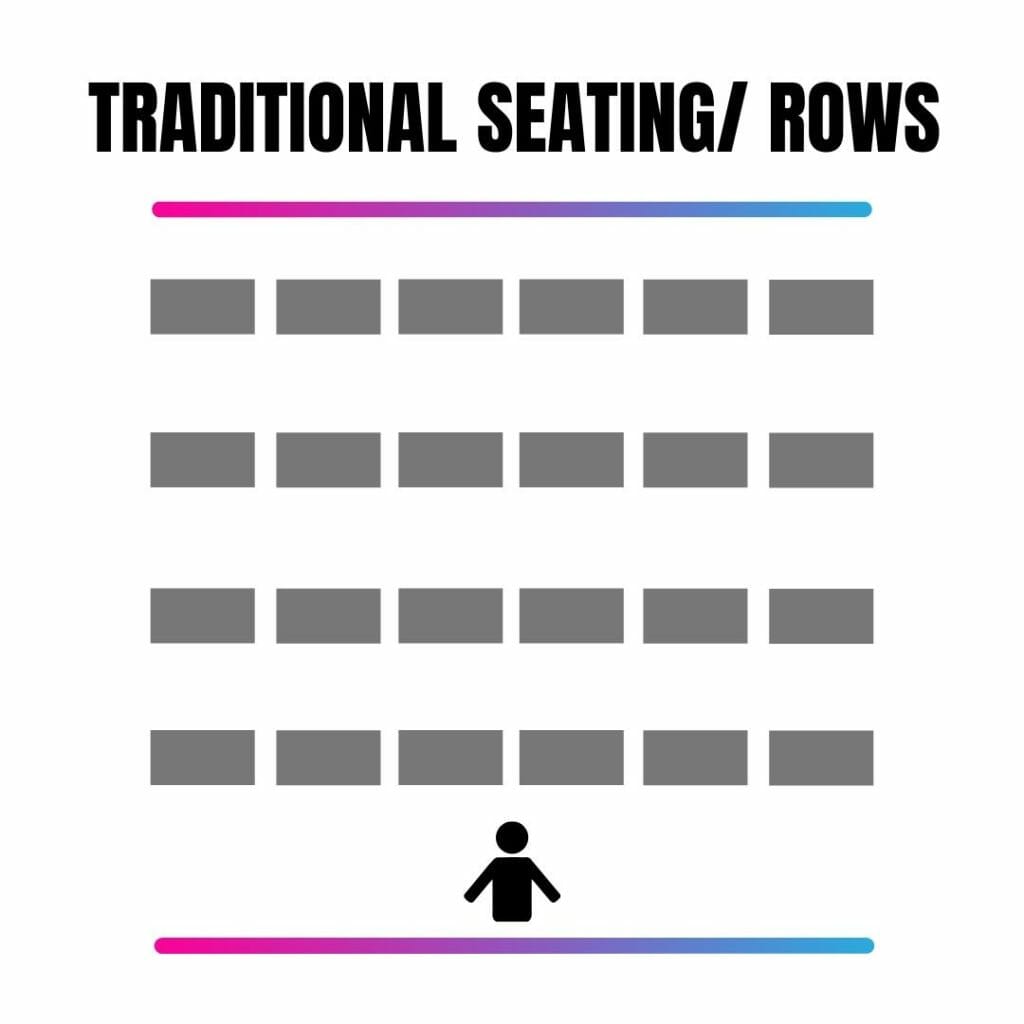
1. Rows/ Traditional Seating
This arrangement likely needs little explanation. It was designed for a lecture, where students sit facing the instructor with their backs to one another.
Students in the front rows have the highest rates of engagement while back rows tend to be less engaged.
This style of seating can also be done on an angle, often called stadium seating. In this layout, the desks are in angled rows and may or may not touch.
Pros of Rows:
Rows work well if you have lots of space and there is little expectation for group or partner work at desks.
This set up also encourages less talking during instruction. With all students facing you, they are easily able to see the board.
Cons of Rows:
Most classrooms are not spacious, meaning that you’ll most likely need to do a modified version of this (like stadium seating) or choose a different seating arrangement.
Rows are not conducive to cooperative learning or group work, and they can be challenging when it comes to classroom management unless you have a small class. Once you have three or more rows, it can be challenging to see and keep all students on task.
These cons were a reason my classroom was very seldom in traditional rows outside of state testing. Occasionally, we would do modified rows or stadium seating if the group was having difficulties staying on task and listening. However, cooperative learning and discussion is a huge part of my teaching so the cons of this format majorly outweighed any benefits for me.
2. Stadium or Angled Rows
Stadium seating is a variation of traditional rows where desks are angled slightly toward the center or teaching area rather than facing straight ahead.
I liked this arrangement when I wanted the structure of rows without making the classroom feel quite so rigid. Students still faced the primary instructional area, but the slight angle helped create a more connected feel during class discussions.
It can also improve sight lines, particularly in classrooms where students need to see a board, projector, or demonstration area at the front of the room.
Best for: direct instruction, independent work, assessments, and classes that benefit from clearly defined personal space.
Pros of stadium seating
Most students have a clear view of the instructional area.
Students have fewer classmates directly in their line of sight.
It can reduce some of the social distractions that happen with groups.
Teachers can usually move between rows fairly easily.
The angled setup feels slightly more conversational than perfectly straight rows.
Cons of stadium seating
Collaborative work usually requires students to move or turn their desks.
Students may still have difficulty working with anyone beyond the person beside them.
It can take up more room than standard straight rows depending on the angle.
Students seated toward the back may still feel removed from instruction.
Stadium seating can be a useful middle ground when traditional rows feel too restrictive but your class is not ready to manage table groups successfully.
3. Pairs
The pair arrangement can be done with desks or tables, and allows the teacher to move around the room between pairs.
Two students can sit at a single trapezoid table, if your classroom has tables instead of desks.
Alternatively, two desks can be pushed together to create a pair.
Pros of Paired Seating:
This is a great classroom seating arrangement for controlled conversations and partner work. Since you’ve selected the pairs, you can purposefully partner students who may work well together.
I loved using this arrangement later in the year, once I got to know my students and their personalities a little better because it allowed me to purposefully partner students in a way that allowed both partners to shine and lift one another up, academically. The partnerships often led to very rich discussions, which could then be shared in the larger class discussion.
This arrangement typically uses slightly less floor space than traditional rows, and it creates an environment where partnership and cooperative learning is expected.
Cons of Paired Seating:
Sitting in pairs also has some downsides. Since students are in partners, it can be more difficult to stop talking or off-task behavior. You may find that 1-2 students need to be “islands” and sit separated from a partner to do their best learning and maintain focus. Depending on how you present this, it can be stigmatizing for a student to have to sit alone.
I found that it was really important to explain why the student was becoming an island when I made this move. I also made sure to explain what he or she needed to do to become part of a pair again.
Depending on the parent, I also communicated this adjustment to parents to let them know why their child had been placed away from peers, making sure to discuss the benefits for their child and his or her learning rather than the idea of this being a punishment.
The arrangement also tends to still take up quite a bit of classroom space, so it can be difficult to pull off with large classes or in small rooms. You may also need to make a trio if you have an odd number of students.
4. Semi-circle or U-shape
This is a modification of a round-table format, where students and teachers share one large table area (or desk area) for discussion.
The traditional round-table arrangement is uncommon in classrooms due to the number of students and space needed to accommodate the arrangement. Therefore, it is not included in the layouts discussed.
For the semi-circle or u-shape arrangement, participants face each other, but the teacher has space to move around the room.
This arrangement has also been referred to as a horseshoe, and there is a modified version called the double horseshoe that involves an inner and outer semi-circle
Classroom Seating Arrangements: Pros, Cons & How to Choose 12Classroom Seating Arrangements: Pros, Cons & How to Choose 13
Pros of U-shape seating:
This layout is great for classrooms that want to encourage discussion between the students and teacher. Students can still see anything projected onto the board, which makes it great for classroom conversations.
The double horseshoe layout, which has the inner and outer semi-circles, offers a slightly more restricted format for conversation. This can be a good alternative if you need some additional control of student interaction or in cases where you have a large number of desks in a small space.
I loved the double horseshoe those years that I had a rambunxious group where several students were able to set off peers because I could still make sure the students were seated in a way that reduced their likelihood of interactions. I could also have the kiddos who needed extra support closer to the front without the distractions from the entire class.
Cons of U-shape seating:
There are several major cons to this arrangement, but there are also a few fixes that I will share. This was an arrangement I used in my room regularly, but I had to find some adjustments.
The U-shape format requires lots of room, which means most classrooms will need to use a double horseshoe layout to make this work. One negative of the double horseshoe is that students often turn around and get chatty with peers behind them.
One of the biggest cons of this arrangement, however, is that kids move! When they move their desks tend to move with them.
Since my students sat on yoga balls, this was likely a bigger issue in my class than I would’ve seen with traditional desks and chairs, but we were constantly having to push desks back into their U-shaped format. I occasionally debated about using zip-ties to keep the desks together, but never actually went that far.
Another con was the fact that it was harder to get to the students in the outer U when I did the double horseshoe format. I solved this by leaving a space in the center of each so I could quickly and easily access all of my students if they needed help or had questions during work times. Here’s what the layout looked like with that modification:
5. Double Horseshoe Seating
A double horseshoe uses two U-shaped rows, with one smaller horseshoe positioned inside a larger one.
I found this arrangement particularly useful when I wanted students facing toward instruction but still wanted a classroom setup that supported discussion.
It also gave me considerably more control over where students sat than traditional table groups. When I had a class that was especially social, the double horseshoe made it easier to separate students who tended to distract one another without completely giving up opportunities for interaction.
Best for: class discussions, teacher modeling, classes that need more structure, and rooms where a single U-shape cannot accommodate every student.
Pros of a double horseshoe
Most students face the center or front of instruction.
It supports whole-group conversation and discussion.
You have more flexibility when separating students who should not sit together.
Students generally have fewer peers directly facing them than they would in pods.
The center space can be used for demonstrations, discussions, or movement.
Cons of a double horseshoe
It requires a fair amount of classroom space.
Some students may have their backs partially toward classmates in the other horseshoe.
Partner and small-group work can require students to turn or move.
Traffic flow can become tight if there is not enough space between the two rows.
If your class needs more structure but you still value discussion and interaction, the double horseshoe can be a great compromise.
6. Table Groups
Finally, table groups are a common arrangement in many classrooms. Depending on how many students you have and whether you use desks or have tables in your room, you can create groups of 4-5 students.
Since this is one of the most common classroom layouts, I won’t spend too much time digging into what it looks like. Instead, let’s talk about the pros and cons of this classroom seating arrangement.
Pros of Table Groups:
This type of classroom seating arrangement is amazing for group work and cooperative learning.
This was typically how I started my school year because I wanted to encourage students to get to know one another.
This arrangement is great for large classes or small classrooms because it saves space.
Classroom Seating Arrangements: Pros, Cons & How to Choose 14
By purposefully planning your groups, you can build upon student strengths and use the format as a part of your behavior management plan. Table points were a great way to build some friendly competition in my classroom, and they were great for encouraging on-task behavior.
Cons of Table Groups:
Remember how I mentioned that I liked to start the year in table groups? Well, we never stayed there for long. Here’s why –
Classroom Seating Arrangements: Pros, Cons & How to Choose 15
This classroom seating arrangement is great for cooperative learning, but it is TERRIBLE for keeping talking to a minimum.
After the first few weeks, I typically had to move my students out of this arrangement because it was becoming a barrier to their learning.
Facing peers promotes off-task behavior for many students, and with groups, it can be challenging to separate behavior issues or chatty friends from one another. There are just too few places to keep them apart.
This is why I typically moved my students’ desks into a double horseshoe layout for the middle chunk of the year. As they matured we were able to transition back into groups or table teams (like below) to finish up the year.
The table teams were the closest I could come to a round-table format, and they really encouraged some interesting discussion. However, they were definitely much harder to manage.
7. Combination Seating
You do not have to arrange every desk in your classroom the same way.
Combination seating uses two or more arrangements within the same classroom. You might have several pairs, one small group of four, and a row of individual desks. Another class might use mostly table groups while keeping a few desks positioned separately.
This is one of the most flexible options because it allows you to think about what individual students need instead of forcing everyone into the same setup.
Best for: differentiated classrooms, classes with varied attention or behavior needs, and teachers who frequently use different instructional formats.
Pros of combination seating
You can match seating arrangements to individual student needs.
Students who need fewer distractions can have more personal space.
Students who benefit from peer support can sit with partners or groups.
It provides flexibility without requiring you to rearrange the entire classroom.
You can adjust portions of the room as student needs change.
Cons of combination seating
The classroom may not look as symmetrical or visually uniform.
Planning traffic flow can take more thought.
Students sometimes view certain seating locations as more desirable than others.
You need to be intentional about making sure seating differences do not feel punitive.
Combination seating worked especially well for me when I stopped worrying about whether every desk arrangement matched.
Sometimes one student genuinely needs to face forward with fewer distractions while another works better beside a supportive peer. Those students do not need identical seating arrangements in order to receive equally effective instruction.
The classroom should work for the students in it, not the other way around.
What Is the Best Seating Arrangement for a Talkative Class?
If you have a particularly social class, your seating arrangement can make a noticeable difference in how often you have to redirect conversations.
Table groups are often the hardest arrangement for a talkative class because students may spend much of the day directly facing three or more classmates. Even students who are trying to stay focused have constant opportunities to make eye contact, whisper, or react to something happening across the table.
Pairs can be a good first step if you still want students to have easy access to a partner. Each student has one nearby peer rather than several, and you can be strategic about which students sit together.
For classes that need even more structure, traditional rows, stadium seating, or a double horseshoe can make it easier to separate students who tend to distract one another while still allowing you to bring students together when collaboration is actually part of the lesson.
That does not mean a talkative class has to stay in rows all year.
Seating arrangements can change as students develop stronger routines and self-control. You might begin the year with more structured seating and gradually introduce pairs or groups once students demonstrate that they can handle the additional interaction.
And sometimes the opposite happens. A class that handled groups well in September may need a reset after winter break.
Changing the seating arrangement is not a failure. It is simply another classroom management tool you can adjust based on what your students need.
“Best for” lines to add to your existing sections
For Traditional Rows:
Best for: independent work, direct instruction, assessments, and students who need fewer peer distractions.
For Pairs:
Best for: partner work, turn-and-talk activities, peer support, and classes that can manage moderate interaction.
For U-Shape or Horseshoe:
Best for: whole-class discussion, presentations, demonstrations, and lessons where students benefit from seeing one another.
For Table Groups or Pods:
Best for: cooperative learning, projects, hands-on activities, and classrooms where students frequently work in small groups.
That gives you the full seven-arrangement structure without having to unnecessarily rewrite the strongest existing sections.
How can I improve my classroom arrangement?
As you can see, there is no one-size-fits-all solution to a classroom seating arrangement. You’ve got to take into account a number of factors to find what is best for you.
There are so many variables to consider, and you don’t need to feel like a failure of groups don’t work for you. (This was a feeling I often struggled with when I reached the point that I needed to move my desks from the table groups they began the year in.)
Instead, consider your classroom layout as a piece of your classroom management system. You use different classroom seating arrangements to serve different purposes and to keep your classroom on-task and learning.
If you are like me, you see grouping as the ideal seating arrangement and feel like you’ve somehow failed when you’re not able to keep your students in groups and still keep everyone on task. I’m giving you permission to let yourself off the hook. Being a great teacher does NOT mean a one size fits all seating plan. Every year is different, and it’s okay for the seating plan to change as well.
That being said, here are some ways you can improve your classroom seating arrangement.
Align your classroom seating arrangement to the activities you use most often.
When you plan your classroom seating arrangement, consider the goals of your instruction and the activities you commonly use.
If you’re working through a unit that will have lots of whole group discussion, you may want to use a horseshoe or double horseshoe arrangement.
Working on some cooperative projects, table groups might be perfect!
There is no hard-and-fast rule about how often you should re-arrange your seating assignments, so you can make these adjustments as needed throughout the year. If your class is really on top of it, you can even practice transitioning between 2 different seating arrangements so your students can make a quick change to better meet the needs of the learning experience.
Take the classroom flow into account.
No matter how badly you might want to do a certain arrangement, if it impedes the flow of your classroom, it just isn’t going to work.
Make sure that you’ve got adequate space for any arrangement you decide to try. This means that desks aren’t too close to your small group space or classroom library.
It also means making sure you’re easily able to reach all students to address questions or needs.
Don’t be afraid to go your own way.
Consider a combination configuration if your classroom or students need it. By mixing and matching the arrangements described above you can find a way to meet the needs of all students.
There is no rule that says you can’t create your own layout, so don’t be afraid to play with your seating arrangement until you find a format that works for you. For example, the layout below is great if you have some students who are able to focus in groups, but others that need to fewer distractions or can only handle being partnered during instruction.
The reality of choosing a classroom seating arrangement
Your seating arrangement may seem like a small thing, but it is an important part of creating an effective classroom. Deciding on a good seating arrangement isn’t easy, and you might discover the great ideas you thought you had are a total mess. There are also so many factors that come into play with your decision.
For example, I once worked with a principal that dictated classroom set-up, right down to the seating arrangement.
While I strongly believe that your seating arrangement should be determined by the individual teacher based on personality, teaching style, and the needs of the current class, there was only so much I could do in that situation so we spent a lot of time out of our desks.
Seating arrangements can certainly be changed throughout the year as students become more independent, more comfortable with each other, or as the needs in your room change.
Some years my team had a running joke that if you wanted to find me, listen for the movement of desks because I strongly believe we should all play around with seating arrangements until we find the one that works best for our class.
This might look different every few weeks as student friendships and maturity grow and change or we move into different units with new activities and goals. That’s okay!
I’ve rarely had students care about the fact that the seating arrangement is changing because I do my best to be upfront about the reasons for the change. Sometimes it is to increase focus or separate chatty friends. Other times I make moves to help students work with someone new.
Quite honestly, my more introverted students are relieved when they can have their own space to work in peace and quiet so many of my moves work out better for everyone in the end.
Don’t be afraid to get creative when it comes to classroom seating arrangements.
If you enjoyed this article, here are others you’ll love, too!