The Complete Guide to Sub Plans: Binders, Behavior, and Staying Sane When You’re Out
Every teacher has been there. It’s 2 AM, your child is sick, your alarm goes off in four hours, and somewhere in the back of your mind you’re calculating how long it would take to write sub plans before the school day starts.
Good sub plans shouldn’t feel like a second job. And they don’t have to.
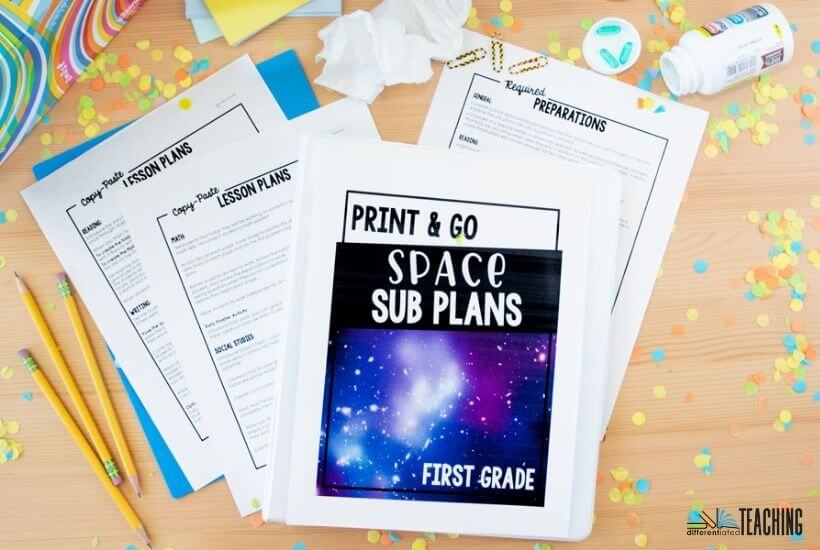
This guide pulls together everything you need to prepare for a substitute teacher confidently — whether you’re planning ahead or scrambling at the last minute. You’ll find a step-by-step framework for building your sub binder, writing plans that actually work, keeping your classroom behavior on track while you’re away, and setting yourself up with emergency plans that are always ready to go.
Part 1: Build Your Sub Binder
A sub binder is the single most time-saving thing you can put in place as a teacher. The first time you build it, it takes effort. Every time after that, you update a few pages and you’re done.
The idea is simple: everything a substitute teacher needs to run your classroom for a day — or a week — lives in one place. No scrambling to remember student names, allergy lists, or bathroom pass policies at 6 AM when you’re running a fever.
What goes in a sub binder?
A well-organized sub binder typically contains four categories of information:
- Classroom basics — your daily schedule, class roster, seating chart, and bathroom/hallway policies
- Student information — any medical needs, allergies, IEP accommodations, or behavioral notes your sub needs to know about specific students
- Classroom management — your behavior system, incentives, and what to do if things go sideways
- Emergency information — fire drill procedures, lockdown protocols, the location of your first aid kit, and who to call if something goes wrong
Beyond the basics, you might also include:
- Early finisher activities that require no explanation
- A “worst case scenario” page (your most challenging student, what triggers them, what helps)
- A note about which students can be trusted to help the sub find things
- Any special schedule notes for that specific day (library, PE, specials times)
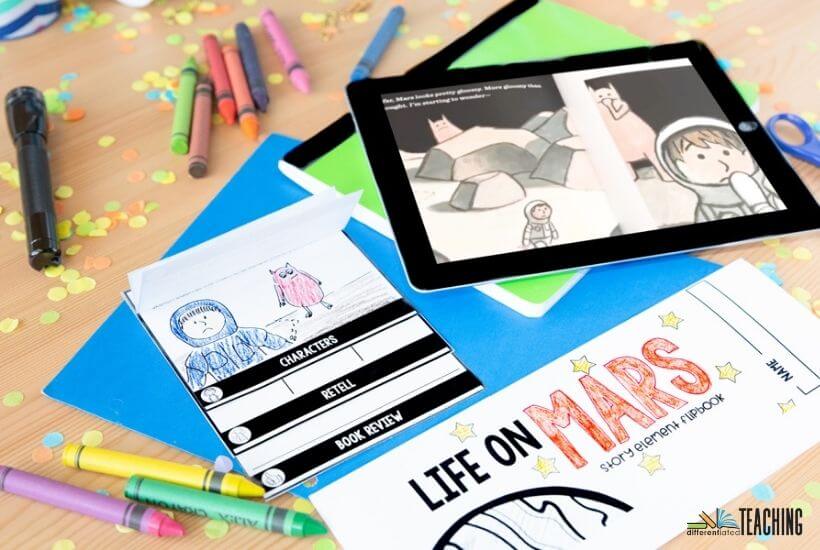
Sub binder vs. sub folder: what’s the difference?
A sub folder is a lighter version — typically just the day’s lesson plans and a basic class roster. It works for a single unexpected absence but doesn’t give a sub much to work with beyond the day’s plans.
A sub binder is a permanent reference tool. You build it once, update it a few times a year, and it’s always ready. For teachers who are out more than once or twice a year, a binder pays for itself in prep time saved almost immediately.
Long-term sub binder considerations
If you know you’ll be out for an extended period — maternity leave, a medical situation, or a longer absence — your sub binder needs more detail. Include:
- Weekly lesson plan templates or unit overviews (not just daily plans)
- Grading expectations and where to record grades
- Parent communication protocols — what to respond to, what to pass along
- Information about your grade-level team and who to go to with questions
- Notes on upcoming school events, assessments, or deadlines
Grab the free fillable sub binder template in Google Slides so you can update it each year without starting from scratch. Get the free sub binder template →
For the complete breakdown of what to include and how to organize each section: Substitute Prep 101: What to Include in Your Sub Binder →
Part 2: Write Sub Plans That Actually Work
The biggest mistake teachers make with sub plans is writing them for themselves instead of for a stranger.
You know that “math rotations” means three groups cycling through three stations with specific materials in specific drawers. Your sub does not. If your plans require institutional knowledge to execute, they’re going to fall apart.
Good sub plans are written for someone who has never been in your building before, doesn’t know your students’ names, and got the call 45 minutes ago.
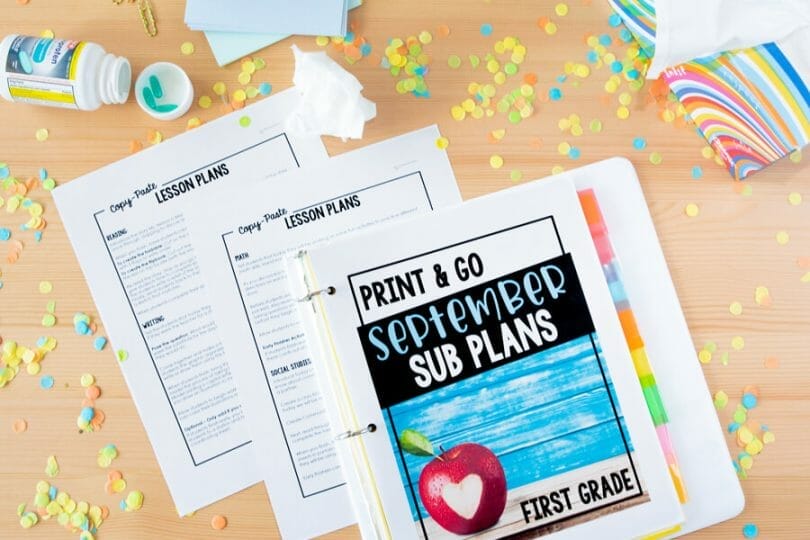
The core framework for sub plans that work
Every sub plan, regardless of subject or grade, should answer six questions:
- What should students be doing at every moment of the day? (Include exact times and transitions.)
- Where are the materials? (Be specific — “top drawer of the blue cabinet by the door” not “in my desk.”)
- What do students do if they finish early? (Have a clearly labeled early finisher activity that requires zero explanation.)
- What is the behavior system and how does it work? (Your sub can’t enforce a system they don’t understand.)
- Who are the two or three students who might need extra support? (Name them. Be honest.)
- Who should the sub contact if they have a question or problem? (A specific name, not just “the office.”)
If your plans answer all six of these, your sub has what they need. Everything else is helpful but optional.
Planning for a substitute in 30 minutes or less
When you’re sick at 11 PM and need to write plans fast, the framework above becomes your checklist. Go in order. Keep it to one page. Bullet points are fine — your sub does not need paragraphs.
The fastest sub plans are the ones you’ve already partially prepared. If your sub binder has your daily schedule, class roster, and behavior system already written, you’re really only writing the actual lesson plans for the day — which can often be a repeat of something you’ve already taught, a familiar activity, or a read-aloud the sub can manage independently.
For the full 30-minute process: Last Minute Sub Plans: How to Prep for a Sub in Under 30 Minutes →
What your substitute teacher actually wants from you
After years of teaching — and talking with a lot of substitutes — here’s what they consistently wish teachers knew:
- Specific is better than thorough. A 2-page plan with clear instructions beats a 10-page packet every time.
- Pacing details matter. “This usually takes 20 minutes” is more useful than a list of activities with no time guidance.
- Tell us about the hard stuff. If one student tends to test limits, say so — with the student’s name and what tends to help.
- Backup plans are a gift. If the first activity goes sideways, what should the sub do? Have an answer ready.
- A small gesture of appreciation goes a long way. A handwritten note or a piece of chocolate makes a real difference.
For the full list of what subs wish you knew: 10 Things Your Guest Teacher Wishes You Knew →
How to simplify sub prep so you stop avoiding it
Most teachers avoid planning for subs because the prep feels disproportionate to the absence. You can fix that by building repeatable systems:
- Keep a “sub-ready” folder of activities that work for any day — independent reading response, a writing prompt, a math review — that your sub can use without any explanation.
- Build your sub binder in August and update it once per quarter. The upfront investment saves you hours every time you’re out.
- Use your actual lesson plan format for sub plans. Don’t create a second system.
- Find substitutes you trust and request them. A good sub who knows your classroom is worth their weight in gold.
- Leave your sub a short feedback form. Knowing what worked and what didn’t helps you improve your plans over time.
Part 3: Managing Behavior When You’re Away
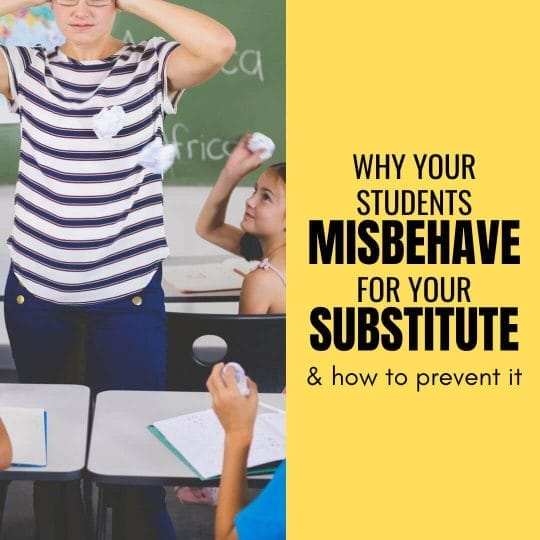
Students misbehave for subs. Almost every teacher knows this, and almost every teacher dreads coming back to a note about it.
Here’s what most teachers don’t know: a lot of substitute misbehavior is predictable — and preventable. It’s not just that students “act differently” with an unfamiliar adult. There are specific, fixable reasons behavior falls apart.

Why students misbehave with substitute teachers
The most common reasons, in order of how often they come up:
- The routine is disrupted. Students depend on predictable structure. When the normal routine changes, anxiety goes up and self-regulation goes down. Your sub plans should explicitly preserve your daily routine as much as possible.
- The activities don’t hold students’ attention. Long worksheets, passive review, and low-engagement tasks are a recipe for behavior problems. The best sub activities are engaging enough that students stay focused even without you there.
- The sub doesn’t have the behavior system information. If your sub doesn’t know how your classroom management works, they can’t use it. Include a clear explanation in your sub binder.
- Students want to test limits. Some students will push with any unfamiliar adult. The best countermeasure is preparation: letting your students know ahead of time (when you can) that you’ll be hearing how the day went, and that expectations are exactly the same.
- The sub doesn’t know which students need support. A student with an IEP behavior plan who’s managed well in your classroom can spiral quickly if the sub doesn’t know what to do. Name names. Be specific.
The fix for most of these isn’t complicated: better plans, better communication about your behavior system, and giving your sub the information they need to actually manage your classroom.
For the full breakdown of each reason and exactly how to prevent it: Why Students Misbehave for the Substitute (& What to Do About It) →
Part 4: Emergency Sub Plans
Emergency sub plans are plans you prepare in advance for the day you can’t prepare anything.
The scenario: it’s 5 AM, you’re sick, and you need to be done in 30 minutes. Emergency sub plans are already printed, already organized, and sitting in your sub binder or a labeled folder in your classroom. You call in, leave a note about where to find them, and go back to bed.
They’re not your best work. They don’t have to be. They just have to work.
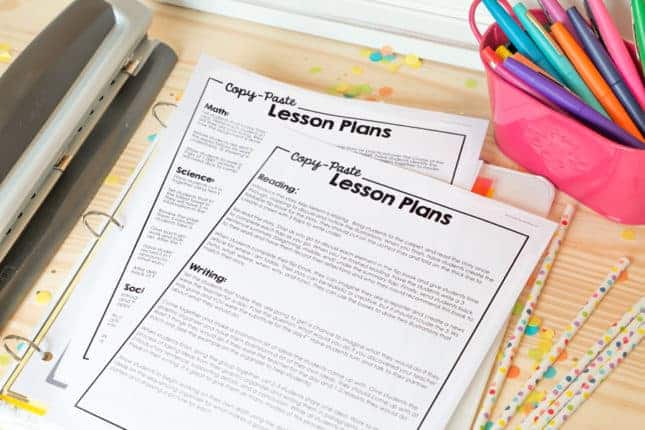
What makes a good emergency sub plan
Emergency sub plans should be:
- Self-contained: no teacher instructions needed beyond “open the folder and follow the plans”
- Grade-appropriate but not tied to your current unit: they need to work on any day, not just today
- Engaging enough to hold students’ attention without you or your sub having to work hard
- Easy to copy or print at short notice if you didn’t pre-print them
Common emergency sub plan formats that work well:
- A read-aloud with response prompts (the sub reads aloud, students respond in writing or discussion)
- An independent reading block with a structured response format
- A review activity for a skill students have already mastered
- A writing prompt with clear scaffolding
- A STEM challenge with minimal materials
Print-and-go vs. digital emergency plans
If you have the luxury of a day or two’s notice, digital plans via a shared folder or Google Classroom can work well. For true emergencies, print-and-go is more reliable… You don’t want your sub troubleshooting access to technology at 7:30 AM.

The best system: keep a physical emergency folder in your classroom at all times and update it at the start of each semester to keep the content current.
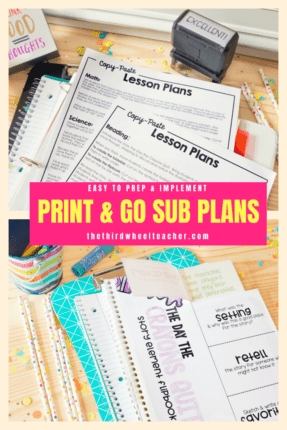
Ready-to-use emergency sub plans with reading, writing, math, science/social studies, and a STEM challenge — everything your sub needs for a full day, no prep required: Emergency Sub Plans: Print & Go →
Frequently Asked Questions
How far in advance should I write sub plans?
For a planned absence, ideally 3–5 days in advance — enough time to print materials and leave clear instructions without being so far ahead that the plans no longer match where you are in your curriculum. For unplanned absences, your emergency sub plans should always be ready to go so you’re never writing from scratch when you’re sick.
What should I NOT include in sub plans?
Anything that requires the sub to make judgment calls they’re not equipped to make: introducing new concepts for the first time, administering assessments they haven’t seen, or managing complex activities with lots of moving parts. Save those for when you’re there. Your sub day should feel like a slightly easier version of a normal day, not a different curriculum.
How long should sub plans be?
One to two pages is ideal. If your plans require more than that, they’re probably too detailed. A sub who’s reading a 6-page document while 25 kids watch them is already behind. Use bullet points, include exact times, and put the most important information first.
What’s the difference between a sub binder and a sub folder?
A sub binder is a permanent reference document that lives in your classroom year-round — class roster, schedule, behavior system, emergency info. A sub folder typically contains the day’s lesson plans. You need both: the folder for the daily plans, the binder for the context that makes those plans executable.
Can these resources work for homeschool families?
Absolutely. If you co-op, share teaching responsibilities with a partner, or plan for anyone else to lead a lesson with your child, having organized plans and a simple overview of your child’s routines and needs is just as valuable at home as it is in a classroom.
What’s the best way to find a reliable substitute?
Ask your colleagues which subs they request repeatedly and start there. Watch for subs you see on campus regularly… Consistency is a good sign. When you find someone who works well in your classroom, build a relationship: send a thank-you note, offer a small appreciation gesture, and let them know they’re welcome back. Good subs get booked fast.
You Deserve a Sick Day
Every teacher reaches the point where they’ve dragged themselves to school sick because the prep for staying home felt worse than showing up. That’s a sign that the system needs to change, not that you need to push through harder.
A good sub binder, a solid set of emergency plans, and a clear framework for writing day-of plans turn sub prep from a stressor into a routine. It takes one good afternoon of setup and a few updates every semester.
And then, the next time your kid wakes up sick at 2 AM, you go back to bed.
- Build your sub binder with the free template → Free Sub Binder Template
- What to include in your sub binder → Substitute Prep 101
- Write plans in 30 minutes → Last Minute Sub Plans
- Handle behavior with a sub → Why Students Misbehave for the Substitute
- Emergency sub plans, print-and-go → Emergency Sub Plans
🌟 Part of the Differentiated Teaching resource library. See our complete guide: Differentiated Teaching Strategies — covering reading, math, novel studies, sub plans, classroom management, and community.