
Differentiated teaching is the practice of adjusting what you teach, how you teach it, and how students show what they know — based on where each learner actually is, not where you wish they were. It is not a single strategy. It is a philosophy that shapes every decision you make in the classroom, from how you arrange the room to how you design an assessment.
This site exists to make differentiated teaching practical. Not overwhelming, not abstract — practical. The resources here are built around the idea that good differentiation does not require you to create 30 different lesson plans. It requires you to understand your learners well enough to make smart adjustments that move every student forward.
Whether you are new to differentiation or refining a practice you have built over years, this is your starting point.
What is differentiated teaching?
Differentiated instruction is a teaching approach that responds to the readiness, interests, and learning profiles of individual students. Rather than delivering the same content, at the same pace, in the same way to every student, differentiated teaching asks: what does this student need right now, and how do I design instruction that meets them there?
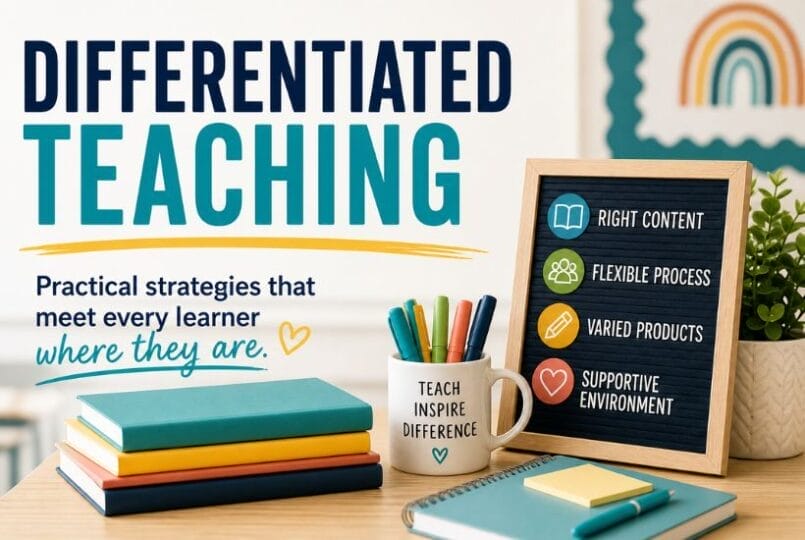
In practice, differentiation shows up in four main areas:
- Content — what students are learning, or the level of complexity at which they access it
- Process — how students make sense of the content (activities, grouping, pacing)
- Product — how students demonstrate understanding
- Environment — the physical and emotional conditions that support learning
The guides below are organized by the areas where differentiation has the biggest impact in elementary and middle school classrooms.
Reading and literacy differentiation
Reading is where differentiation matters most in elementary classrooms. When students cannot access grade-level text, every content area becomes harder. When students are significantly above grade level, they disengage. Meeting readers where they are — with the right tools, strategies, and support — is the foundation of differentiated teaching.
📚 Supporting Struggling Readers: Strategies, Tools & Support
Math differentiation
Math differentiation is about more than offering easier problems. It is about identifying where a student’s understanding breaks down — whether that is conceptual, procedural, or rooted in math anxiety — and designing instruction that rebuilds from there.
📚 Math Differentiation: Accommodations, Word Problems, Fluency, and Intervention
Novel studies and differentiated reading comprehension
Novel studies are one of the most powerful contexts for differentiation in upper elementary. A single text can be accessed at multiple levels of complexity, and discussion, response, and vocabulary work can all be scaffolded or extended without changing the book itself.
📚 Novel Studies: A Complete Guide to Planning and Differentiation
Substitute plans and differentiated prep
Sub plans are a differentiation challenge most teacher resources ignore. The activities you leave for a substitute need to be accessible to every student in your room, without requiring the sub to make instructional decisions they are not equipped to make.
📚 The Ultimate Guide to Sub Plans
Report card comments
Writing differentiated report card comments — ones that speak honestly to where each student is and what they need next — is one of the most time-consuming parts of teaching. The right language communicates clearly to families without causing harm or confusion about a student’s trajectory.
📚 Report Card Comments: A Complete Guide for Elementary Teachers
Classroom management and differentiated instruction
Differentiated instruction only works in a classroom where the environment supports it. That means students know the procedures, transitions run smoothly, and the space is set up to allow flexible grouping and different types of work to happen simultaneously. Strong classroom management is the container that differentiation lives inside.
📚 Classroom Management Strategies: A Complete Guide for Elementary Teachers
Classroom community and differentiated learning
Students learn differently in a classroom where they feel they belong. Community is not a soft add-on to academic instruction — it is a prerequisite for the kind of intellectual risk-taking that differentiation requires. Students who feel safe enough to attempt hard things and show you what they do not know are the students you can actually differentiate for.
📚 Building Classroom Community: Relationships, Routines, and a Sense of Belonging
Seasonal & Monthly Teaching Ideas
Differentiated teaching doesn’t stop at strategies — it also means having the right resources at the right time of year. The Teaching Calendar brings together month-by-month planning guides for every month of the school year, from August through summer, with seasonal activities, holiday resources, and ready-to-use materials that connect to real classroom skills.
📅 Elementary Teacher Planning Calendar: Monthly Teaching Ideas & Resources
Where to start with differentiated teaching
If you are new to this site, start wherever your biggest challenge is right now. Struggling readers — start with the reading hub. Widening math gaps — start with math differentiation. Classroom running you instead of the other way around — start with classroom management.
Differentiated teaching is not a destination. It is a direction. Every small adjustment you make toward meeting students where they are is differentiated teaching in practice.