How to Plan a Novel Study: A Complete Guide for Teachers and Homeschoolers
Getting students through a whole novel can feel like a lot at first. Add planning your first novel study to the mix, and it’s easy to see why even experienced teachers fall back on passages.
The good news: novel studies don’t have to be stressful. With a clear structure, they can become one of the most meaningful parts of your reading block — the kind of teaching that students actually remember.
In this guide, you’ll find everything you need to plan and run a novel study that works. Whether you’re a classroom teacher, a homeschooler, or somewhere in between, this guide will get you set up with confidence.
What is a novel study?
A novel study is a structured approach to reading a full-length book with students. Unlike a reading passage or a basal unit, a novel study follows one text over several weeks, building deep comprehension, vocabulary, and discussion skills along the way.
A well-designed novel study gives students:
- Daily reading with a clear comprehension focus (not just “read and answer 10 questions”)
- Intentional vocabulary instruction connected to the text
- Structured discussion — in partners, small groups, or as a class
- Multiple ways to respond, including written, oral, and creative options
- A shared reading experience that builds community in the classroom
Novel studies work especially well for upper elementary and middle school students who are ready to tackle longer texts but need a predictable structure to stay engaged.
What is the purpose of a novel study?
Novel studies do something that reading passages can’t: they let students live inside a story long enough to really think about it.
When students follow the same characters through challenges, choices, and consequences over weeks, their comprehension goes beyond recall. They start making inferences. Noticing themes. Connecting ideas across chapters. Asking “why” instead of just “what.”
That’s where real literacy growth lives.
For reluctant and struggling readers specifically, the right novel study structure can transform their relationship with reading. The key is reducing overwhelm: one comprehension focus per day, vocabulary that connects to the text, and discussion that lets them participate without having to write a paragraph first.
The difference isn’t the book. It’s the design.
For a deeper look at why novel studies work, see: Benefits of Novel Studies →
How to Choose the Right Novel
Choosing a novel isn’t just about reading level.
Yes, you want a text students can access. But for a novel study to work — especially with reluctant readers — engagement matters more than difficulty. A student who cares about the story will push through hard vocabulary. A student who is bored won’t make it through chapter three.
When evaluating a novel, look for:
- Character depth: Is there someone students will root for, argue about, or connect with?
- Discussion potential: Does the book raise questions without easy answers?
- Vocabulary richness: Are there meaningful words worth teaching in context?
- Student interest: Does it match what this particular group of kids cares about right now?
- Emotional engagement: Will students feel something? Humor, tension, hope, or surprise all count.
You’ll also want to think practically:
- Do you have enough copies (or access to a digital version)?
- Have you vetted the content for your grade level?
- Does the length and reading level fit your unit timeline?
Reading level is only one piece of the puzzle. The right novel is the one that works for your students this year.
For a deeper dive into picking the right book for your readers, see: How to Choose a Novel Study Book for Your Classroom.
Planning Your Novel Study: Step-by-Step
Planning feels overwhelming when you start with worksheets. It feels manageable when you start with purpose.
Here are the five steps I use every time.
Step 1: Set Your Purpose
Before you choose your book or plan a single lesson, ask: what do I want students to be able to do by the end of this unit?

Your purpose might be:
- Building reading stamina with a longer text
- Practicing a set of specific comprehension skills (inference, theme, character analysis)
- Creating a shared class experience around a powerful story
- Supporting a social-emotional learning focus
- Deepening academic vocabulary within a content area
Your purpose shapes every decision that follows — which book you choose, how long you spend, how you structure responses, and how you assess.
Step 2: Identify target standards.
Once you know your purpose, identify the 3–5 reading standards you’ll address throughout the unit. These don’t need to cover everything. They should be the skills you want students to practice repeatedly across multiple chapters.

Common standards for upper elementary novel studies include:
- Making inferences using text evidence
- Analyzing character development over time
- Identifying theme and how it develops
- Analyzing figurative or sensory language
- Comparing point of view or perspective
- Determining the meaning of vocabulary in context
Once you have your standards, you’ll know exactly what comprehension skills to teach — which makes Step 5 much easier.
Step 3: Select your framework & text(s).
How you run the novel study shapes everything from pacing to differentiation. There are four common formats:
Independent novel studies: Students choose their own books and work independently. Best for structured independent reading time. Works well in upper grades.
Whole-class novel study: The whole class reads the same book at the same pace. Works well for building shared discussion and community. Requires more differentiation built in.
Small-group / literature circles: Small groups read different books at different levels. Allows natural differentiation by reading level or interest. Requires more management.
Homeschool read-aloud: Parent or tutor reads aloud and guides discussion. Removes decoding demands entirely; great for struggling readers or early readers tackling complex texts.
Step 4: Create your timeline.
Once you know your format and your book, map out how many weeks you have. A typical novel study runs 3–6 weeks, depending on the length of the book and how much class time you have each day.
A common daily structure that works well:
- Read: 15–20 minutes of independent or read-aloud time
- Respond: One focused written response (not a worksheet — one deep question)
- Discuss: 5–10 minutes of partner, small group, or whole-class conversation
This three-part rhythm (Read → Respond → Discuss) keeps things predictable for students and manageable for you.
Build your timeline backward from your end date. If you have 4 weeks, that’s roughly 20 class days. How many chapters per day? What days will you skip for testing, assemblies, or holidays?
Step 5: Map Your Unit Plan for the Perfect Novel Study
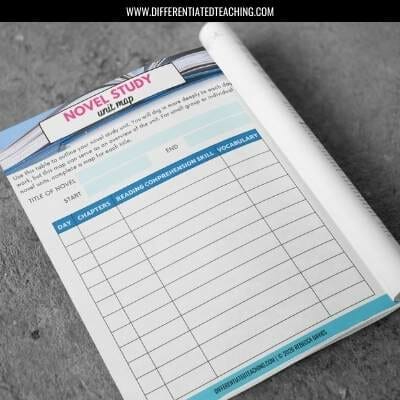
Now you’re ready to map skills to sections of the book. This is where everything comes together.
Divide your novel into sections (by chapter group or week). For each section, assign:
- A comprehension skill of the day (one per lesson, from your target standards list)
- A focused discussion question (one deep question is better than ten surface ones)
- Academic vocabulary (4–6 words from the text, taught in context)
Some sections will clearly align with specific skills. For example, a chapter where a character makes an important decision is a natural fit for “character motivation.” Plan those first. Leave the flexible spots for standards that need more repetition.
For comprehension questions, aim for depth over quantity. Instead of:
Identify the narrator and point of view.
Try:
How does the narrator’s perspective shape the reader’s understanding of the story?
Same standard. Much deeper thinking. That’s where real comprehension lives.
Plan Your Pre-Reading Hook and Post-Reading Activity
Strong novel studies don’t just live in the middle chapters.
Before students open the book, build background knowledge intentionally. If they aren’t familiar with the setting, time period, or major themes, they’ll spend the first few chapters catching up instead of comprehending.
A pre-reading hook might look like:
- A short nonfiction article connected to the book’s setting or theme
- A quick video clip that builds curiosity
- A discussion question with no right answer
- An image, artifact, or “what would you do?” scenario
The goal isn’t to frontload everything. It’s to spark interest and activate schema — so students arrive at chapter one already invested.
When the book ends, don’t default to a whole-book test. Instead, plan a culminating activity that lets students apply the thinking skills they practiced throughout the unit, not just recall plot details. This might be a Socratic discussion, a reflection essay, a creative project, or a skill-based written response.
Pre-reading builds curiosity. Post-reading builds synthesis. Both should feel purposeful — not like extra add-ons.
→ For specific pre-reading activity ideas: Pre-Reading Activities for your Novel Unit
For post-reading ideas beyond the traditional book report, see: Engaging Post-Novel Activities Students Actually Enjoy →
Preparing to Teach Your Novel Study Unit
You’ve done the planning. You know your purpose. You’ve mapped your skills. You’ve built your timeline.
Now it’s time to teach.
Before you start, think about assessment. How often will you review student responses? How will you give feedback without drowning in a stack of 25 journals every day?

Be realistic. Your unit should not depend on you grading everything nightly to function well.
Quick check-ins. Focused rubrics. Clear expectations. That’s what keeps things manageable.
You may also want to explicitly teach a response structure so students have a consistent framework for written answers. The RACE writing strategy works well here — when expectations are clear, student writing improves and grading becomes far less overwhelming.
And let me say this clearly: no whole-book tests.
If we are teaching kids — not books — then mastery should show up throughout the unit, not in a single high-stakes exam at the end. Skill-based checkpoints, discussion, and targeted responses will tell you far more about what students actually understand.
Plan smart. Assess strategically. Protect your energy.
Once those pieces are in place, you’re ready to begin.
How to Differentiate for Reluctant and Struggling Readers
Differentiation does not mean creating five separate units.
It means building one thoughtful structure that gives all students a way in.
A strong novel study naturally accommodates a range of learners when you:
- Keep response demands focused — one question, not ten
- Build vocabulary explicitly and repeatedly before students encounter it in context
- Offer flexible response formats (oral, written, visual, digital)
- Use structured discussion stems so struggling readers can participate in conversation
- Chunk the reading into predictable daily amounts so stamina builds gradually
- Provide graphic organizers for students who need support tracking characters and events
For students reading significantly below grade level, consider pairing the novel study with audio versions or read-aloud support. The comprehension work is the goal — decoding shouldn’t be the barrier.
For a deeper breakdown of how to differentiate without doubling your planning time, see: Differentiate Your Novel Unit
If your focus is specifically on supporting struggling readers in grades 3-8, see: How to Support Struggling Readers
Novel Studies by Grade Level
The right novel study looks different in 2nd grade than it does in 7th. Here’s a quick guide to what typically works at each level, along with recommended titles from this site.
| Grade | Recommended titles on this site | Planning notes |
| 2–3 | Charlotte’s Web, Boxcar Children, Stone Fox, Shiloh, Mr. Popper’s Penguins | Shorter chapters, more read-aloud support, simple daily response format. |
| 3–4 | Lemonade War, Bridge to Terabithia, Hatchet, Holes, Fried Worms, Maniac Magee | Students can handle more independent reading. Great for first novel studies. |
| 4–5 | Tuck Everlasting, Wishtree, Esperanza Rising, Wonder, Edward Tulane, Charlotte’s Web | Strong character and theme work. Mix of accessible and challenging vocabulary. |
| 5–6 | Among the Hidden, Harry Potter, Lightning Thief, Wrinkle in Time, Restart, Holes | More complex timelines and moral questions. Good for literature circles. |
| 6–8 | The Giver, Hunger Games, The Outsiders, A Long Walk to Water, Front Desk | Dystopian and social justice themes. Students can sustain longer independent reading. |
For curated reading lists beyond novel studies, see:
- Favorite 2nd Grade Chapter Books
- 3rd Grade Novels Kids Love
- 4th Grade Reading List for Teachers & Parents
- The Best Books for 5th Grade Novel Studies
- Great Reads for 6th Graders
- My Favorite Books for 7th Graders
Free Novel Study Planning Guide
Want the planning framework in your hands?
Grab the free Novel Study Planning Guide — a fillable template that walks through every step in this post. Perfect for planning from scratch or adapting a ready-made unit.
Browse All Novel Study Guides
Each guide below includes lesson plan ideas, comprehension activities, vocabulary support, and discussion questions. All are designed around the same skill-based framework described in this post.
Lower Elementary (Grades 2–3)
| Title | Grade band | Unit Length |
| Charlotte’s Web Novel Study | Gr 2–3 | 4 weeks |
| The Boxcar Children | Gr 2–3 | 2 weeks |
| Stone Fox Novel Study | Gr 2–3 | 2 weeks |
| Mr. Popper’s Penguins Novel Study | Gr 2–3 | 4 weeks |
Upper Elementary (Grades 3–5)
| Title | Grade band | Unit Length |
| Lemonade War Novel Study | Gr 3–4 | 3 weeks |
| Tales of a Fourth Grade Nothing | Gr 3-4 | 2 weeks |
| Charlie & the Chocolate Factory | Gr 3-5 | 3 weeks |
| Bridge to Terabithia Novel Study | Gr 3–4 | 3 weeks |
| Frindle Novel Study | Gr 3-5 | 3 weeks |
| Shiloh Novel Study | Gr 3–5 | 2 weeks |
| How to Eat Fried Worms Novel Study | Gr 3–4 | 3 weeks |
| Edward Tulane Novel Study | Gr 3–4 | 4 weeks |
Upper Elementary–Middle (Grades 4–6)
| Title | Grade band | Unit Length |
| Tuck Everlasting Novel Study | Gr 4–6 | 3 weeks |
| Hatchet Novel Study | Gr 4–5 | 4 weeks |
| Holes Novel Study | Gr 4–6 | 5 weeks |
| The Wild Robot | Gr 4–5 | 4 weeks |
| Wishtree Novel Study | Gr 3–5 | 4 weeks |
| Among the Hidden Novel Study | Gr 5–6 | 2 weeks |
| Esperanza Rising Novel Study | Gr 4–6 | 2 weeks |
| Wonder Novel Study | Gr 4–6 | 4 weeks |
| Harry Potter Novel Study | Gr 4–6 | 3 weeks |
| Restart Novel Study | Gr 4–6 | 3 weeks |
| Number the Stars | Gr 4–6 | 3 weeks |
Middle School (Grades 5–8)
| Title | Grade band | Unit Length |
| The Giver Novel Study | Gr 6–8 | 2 weeks |
| Hunger Games Novel Study | Gr 6–8 | 5 weeks |
| Wrinkle in Time Novel Study | Gr 5–7 | 4 weeks |
| Lightning Thief Novel Study | Gr 5–7 | 4 weeks |
| The Outsiders Novel Study | Gr 7–8 | 3 weeks |
| A Long Walk to Water Novel Study | Gr 6–8 | 4 weeks |
| Front Desk Novel Study | Gr 5–7 | 5 weeks |
Frequently Asked Questions
How long does a novel study take?
Most novel studies run 3–6 weeks, depending on the length of the book and how much time you have each day. A chapter book with 20–25 chapters typically takes 4 weeks to read if you read 1–2 chapters per day. Shorter books (like Charlotte’s Web or Lemonade War) can be done in 2–3 weeks.
How many chapters should students read per day?
One to two chapters per day is a comfortable pace for most upper elementary students. The goal is consistency, not speed. A predictable rhythm (read → respond → discuss) each day builds stamina without overwhelming students.
What’s the difference between a novel study and a book club?
A novel study is teacher-led, with structured components for comprehension, vocabulary, and discussion mapped to standards. A book club is more student-directed — students lead discussion and often choose their own reading schedule. Both can use similar materials, but the structure and level of teacher involvement differ. Many teachers blend the two, especially in small-group settings.
If you’re running book clubs specifically, this guide to upper elementary book clubs for January has practical setup ideas and discussion structures that work well for independent groups.
Do I need a ready-made resource, or can I plan it myself?
Both work. Planning from scratch gives you complete control and lets you tailor everything to your class. A ready-made novel study saves hours of prep and gives you a tested structure to follow. If you’re doing your first novel study, a ready-made unit can be a great way to see how the structure works before you customize.
How do I handle students who read at very different levels?
Build flexibility into your structure from the start: offer audio support for decoding challenges, use graphic organizers for students who need help tracking characters and events, and allow oral response as an alternative to written response. For significant level gaps, consider small-group novel studies where different groups read different books. See the differentiation section above for more.
Can novel studies work for homeschool families?
Absolutely — they’re often even more flexible at home. You can adjust pacing, read aloud together, and have natural conversations without the pressure of a classroom schedule. Many families use the same trifold or reader’s notebook format used in classrooms, adapting the response options to what works best for their learner.
What if students don’t finish the reading?
This is common. Build in buffer time at the end of each week, and consider starting class with 5–10 minutes of catch-up reading before the response activity. If students are consistently struggling to keep pace, the chapters-per-day count may be too high for your available time.
Ready to Plan Your Novel Study?
Novel studies are some of the most rewarding teaching you’ll do. When the structure is right, you’ll see students who normally avoid reading start asking when it’s time to read. You’ll have discussions that go longer than planned. You’ll finish a unit and have students asking what they’re reading next.
Start with the free planning guide, pick a book from the directory above, and use the step-by-step framework in this post. You don’t have to build it perfectly on the first try.
The best novel study is the one you actually teach.