
You did not become a teacher because you wanted to spend your days managing behavior. You became a teacher because you wanted to teach. But here is the reality most teacher prep programs skip: even the most beautifully planned lesson falls apart when your classroom systems are not working.
Classroom management is not about being strict. It is not about clip charts, marble jars, or elaborate reward economies. It is about designing an environment where learning can happen naturally, for every kid in the room, including the wiggly ones, the chatty ones, and the ones who would rather be anywhere else.
And when something in your system stops working, the most useful first step usually isn’t a new strategy. It’s a clear-eyed look at what’s actually happening: see When Classroom Management Feels Off: How to Reflect Before You React.
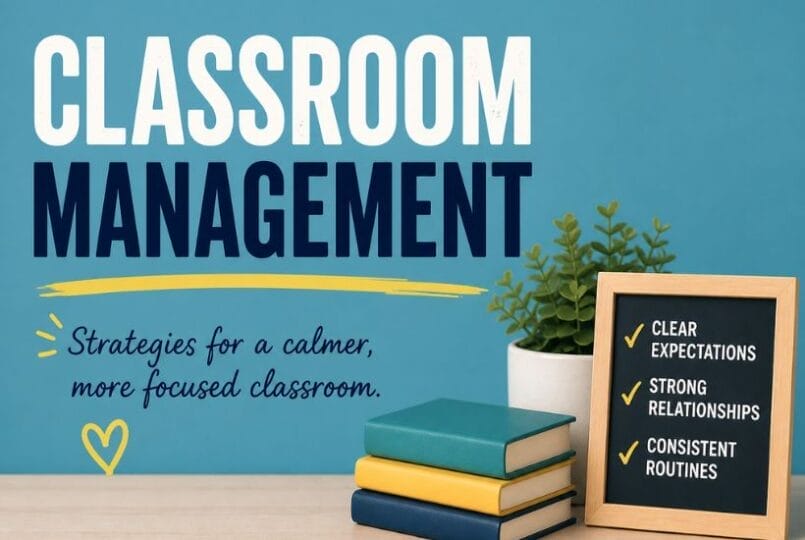
This guide pulls together everything on this site about building systems that work, so you can spend more of your energy on the part you actually love.
1. Classroom seating arrangements
Where students sit shapes everything else that happens in your room. The right arrangement reduces off-task talking, improves your ability to reach every learner, and signals to students how the day is going to feel.
Key questions to ask before rearranging:
- How much teacher movement do you need? (See: Teacher Movement in the Classroom)
- Does flexible seating make sense for your group, or would it add chaos?
- Are you seating for talking or against it? Chatty classes need specific configurations.
Related posts: The secret to classroom seating arrangements | Flexible Seating for Beginners | Flexible Seating Pros and Cons | Best Classroom Layout
2. Classroom transitions
Transitions are the most underestimated part of classroom management. Every minute lost between activities adds up. A class of 25 students losing four minutes per transition, across six transitions a day, is a full hour of instructional time gone every week.
- Give a 2-minute warning before any transition
- Teach the transition itself as a procedure, not just the activity
- Use a consistent signal so students know when you mean it
- Practice the first week until it is automatic
Related post: Why transitions are the key to an effective classroom
3. Managing blurting out and talking
Blurting out is one of the most common classroom management challenges, especially in upper elementary. Before you reach for a consequence, it helps to understand why kids blurt. Most of the time it is excitement, impulsivity, or a learned behavior that worked in previous environments.
- Brain dump notebooks so students can write the thought and let it go
- Hand signals that let kids signal they have something to say without disrupting
- Structured turn-and-talk so there is a legitimate outlet built into the lesson
Related post: 3 Super Easy Interventions for Blurting Out in Class
4. Stopping tattling
Tattling is exhausting. It also takes time you do not have. Teaching students the difference between tattling and reporting is one of the most effective one-time investments you can make in the first weeks of school.
Related post: How to stop tattling with one easy lesson
5. Anchor charts that actually teach
An anchor chart is not just a poster you put up and forget. The best anchor charts are co-created with students, referenced repeatedly, and designed to reduce the number of times a student has to raise their hand to ask a question you have already answered.
Related post: Anchor Charts 101: A Beginner’s Guide
6. Motivating students without burning out
Motivation problems are almost always one of two things: a skill gap dressed up as an attitude problem, or a relationship gap. Before you problem-solve the behavior, figure out which one you are dealing with.
Related posts: Motivation or Skill Deficit? How to Figure It Out | How choice transformed my classroom management
7. Spring fever and the hard stretches
February through April is when even well-managed classrooms start to crack. Energy is high, patience is low, and everyone is ready for summer. A few proactive resets go a long way.
Related posts: 5 Simple Tips to Cure Spring Fever | 3 Teacher Must Dos for the First Day after Spring Break
8. Homework systems that work
Homework management is a classroom management issue more than an academic one. What you do with late work, missing work, and homework passes shapes student behavior as much as any other system in your room.
Related posts: Differentiate to Simplify Homework | Why I stopped giving homework passes
9. When standard management is not enough: behavior intervention
Some students need more than a well-run classroom. When Tier 1 systems are working for 80% of your class but not for a handful of students, that is when behavior intervention tools come in. These resources bridge the gap between general classroom management and MTSS support.
Students who struggle with math anxiety or word problems often show behavior that looks like avoidance. See: Math Anxiety Support and Why Students Struggle with Math Word Problems for the connection between academic struggle and classroom behavior.
Related posts: How to Collect Behavior Data | How to Plan Successful Behavior Interventions | Function-based behavior intervention planning | The 4 things you must do BEFORE you refer a student | Cool Down Spots in the Classroom | Sensory Bottles to Reduce Meltdowns | Fidget tools to support classroom learning
Ready to build the community side?
The classrooms that run smoothly are not the ones with the strictest teachers. They are the ones where students feel clear on expectations, connected to the teacher, and like they can actually succeed in the work. Systems make that possible. Relationships make it last.
Head over to our complete guide on Building Classroom Community for the relationship side of the equation.
🌟 Part of the Differentiated Teaching resource library. See our complete guide: Differentiated Teaching Strategies — covering reading, math, novel studies, sub plans, classroom management, and community.