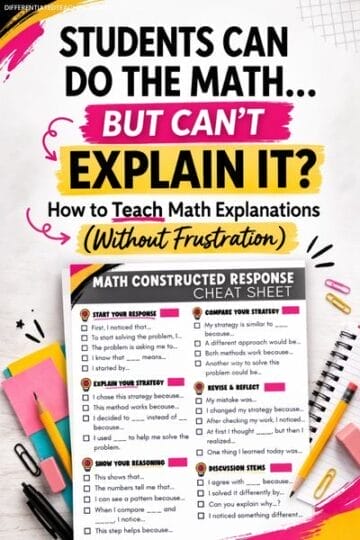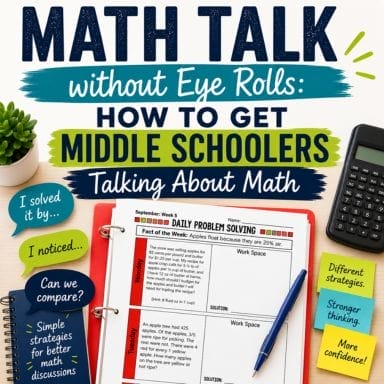
Why do students struggle with math word problems? (And What to Try)
Your students can compute. They know their multiplication facts. They can solve equations during guided practice. They understand the math skill itself, but still struggle to apply it during word problems.
But the moment a word problem appears… everything changes.
Students rush through reading. They grab random numbers. Some freeze completely before they even begin.
If this sounds familiar, you are not alone.
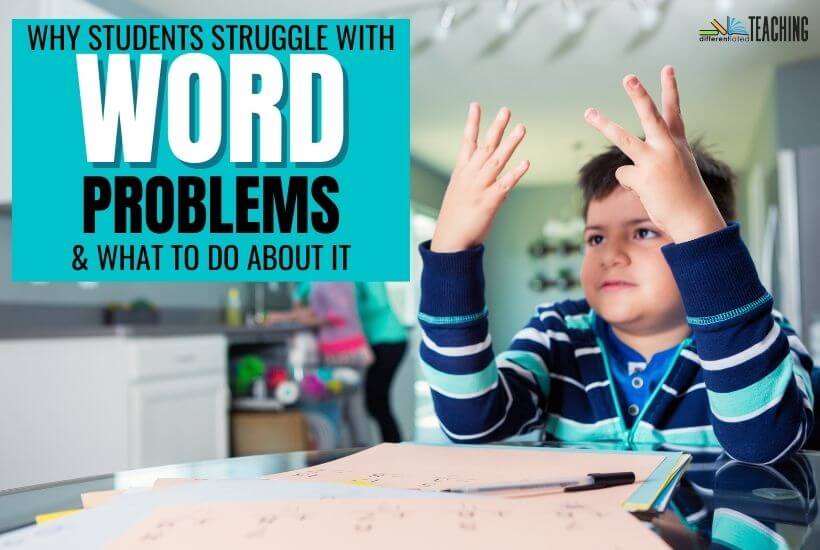
Word problems ask students to combine reading comprehension, vocabulary knowledge, executive functioning skills, and mathematical reasoning all at once. When even one of those skills breaks down, problem solving becomes frustrating instead of meaningful.
Even students who perform well during guided practice can struggle to apply skills independently. If you’re noticing students freeze, guess operations, or misinterpret problems despite strong computation skills, this article explores the classroom patterns teachers often see: My students can compute, but they’re failing word problems…now what?
Most word problem struggles follow predictable patterns. Once teachers understand what’s happening beneath the surface, it becomes much easier to help students build confidence and independence.
Let’s look at the most common barriers… and what actually helps.
Students Struggle to Read Math Word Problems
Word problems are as much a literacy task as they are a math task.
Students must decode text, interpret vocabulary, and determine what information matters… often within only a few sentences.
According to the National Assessment of Educational Progress, only about one-third of fourth graders demonstrate reading proficiency. That means many students enter math already struggling with comprehension.
Even strong math students struggle when they misunderstand what the question is asking.
Instructional Supports That Build Success
Reading problems aloud or providing audio access can support decoding challenges.
However, comprehension improves most when students regularly discuss problems together and analyze language intentionally.
Many teachers find success in slowing instruction through a daily discussion routine where one problem is explored deeply instead of rushing through many.
When comprehension breaks down, frustration often follows. Many reluctant learners begin avoiding word problems altogether… even when they understand the math concepts. If you’re seeing this in your classroom, these strategies for supporting students with math anxiety can help rebuild confidence alongside skills.

When students regularly discuss language and meaning, comprehension improves alongside math performance.
Vocabulary Gaps Prevent Understanding
Sometimes students can read every word correctly and still have no idea what the problem means.
Terms like difference, estimate, compare, or remaining carry specific academic meaning that students may not encounter outside school.
Without explicit instruction, students guess.
And guessing rarely leads to success.
Instructional Supports That Build Success
Explicit vocabulary instruction should be part of math routines… not something saved for reading class.
Visual supports, discussion, and repeated exposure help students connect language to reasoning.
Vocabulary challenges don’t only impact math. Academic language gaps often affect reading comprehension and test performance across subjects. Strengthening academic vocabulary routines can dramatically improve how students interpret complex directions and questions.
Keyword Strategies Often Create More Confusion
Many students are introduced to keywords early in elementary school.
Words like total or altogether become shortcuts for choosing operations.
Unfortunately, multi-step problems quickly expose the weakness of this approach.
Modern assessments intentionally include problems designed to challenge keyword thinking.
Students begin hunting for clues instead of thinking critically.
If you’ve noticed students relying on keywords and choosing the wrong operation, you’re not imagining it. Keyword strategies often create more confusion as problems become more complex. I share a deeper breakdown of why keyword strategies fail in math word problems here:
👉 Why Keyword Strategies Fail in Math Word Problems
Instructional Supports That Build Success
Students need a repeatable framework instead of shortcuts.
Giving students a consistent process helps them slow down and think intentionally. Strategies like CUBES help students slow down and analyze information before solving.
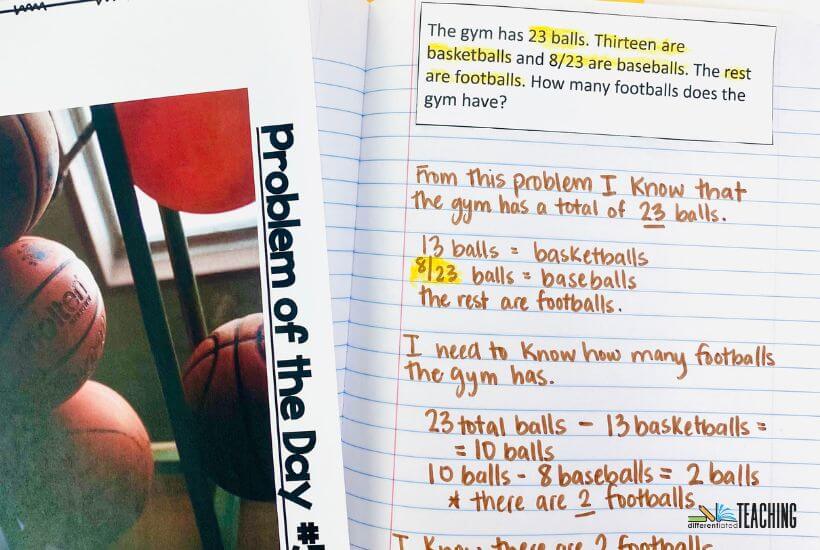
Rather than hunting for clues, students learn to interpret meaning. This shift builds independence and accuracy over time.
Many classrooms also benefit from predictable routines that allow students to practice problem-solving daily without overwhelming instruction time. This word problem routine has been especially helpful for building independence.

Executive Function and Math Anxiety: Why Some Students Shut Down
Some students appear unmotivated when faced with word problems, but overwhelm is often the real cause. Executive functioning demands can quickly exceed working memory capacity. Supporting reluctant learners requires intentional confidence-building strategies alongside academic support.
Students must hold multiple pieces of information in working memory while deciding which steps to take next. When cognitive load becomes too high, students rush, guess, or avoid the task entirely.
This is especially true for struggling learners, students receiving intervention support, or those who have gaps from missed instruction.
Instructional Supports That Build Success
Give students word problems AND active ways to process the story behind each problem.
Encourage them to:
- draw diagrams,
- label information,
- explain the scenario in their own words.
Numberless word problems can also help students slow down and analyze structure before numbers are introduced.
When students understand the situation first, confidence grows quickly.
Fact Fluency and Cognitive Load
Fact fluency plays a larger role in problem solving than many teachers realize. When students struggle with basic calculations, cognitive load increases dramatically. If you’re wondering how fact fluency connects to reasoning skills, this breakdown explains why it matters.
When students must spend significant mental energy calculating basic facts, fewer resources remain for reasoning and problem solving.
According to cognitive load theory, this overload makes multi-step thinking far more difficult.
Instructional Supports That Build Success
Build fact fluency into your routine in engaging ways.
Short daily practice combined with games or centers allows students to strengthen automaticity without burnout.
Looking for engaging practice ideas? These online math fact games are student favorites.
👉 30+ Awesome Online Games for Math Fact Practice.

Limited Practice Prevents Real Problem Solvers
Some curricula unintentionally create predictable word problem patterns.
Students begin recognizing formats instead of thinking critically. When problems suddenly require knowledge from multiple units or unfamiliar wording, students feel lost.
Students build confidence when they encounter a wide variety of problems across time instead of predictable formats. This becomes even more important in middle school, where problems often require combining multiple skills at once.
Instructional Supports That Build Success
Students need variety and productive struggle. Many teachers find that a short daily problem-solving routine gives students consistent exposure without taking over their math block.
Expose learners to:
- different formats,
- varied wording,
- cross-skill application.
Numberless problems, discussion routines, and gradual release supports help students build independence and resilience.
Confidence grows when students realize they can successfully approach unfamiliar problems.
FREE Problem Solver’s Guide for Students
Helping students work independently can be challenging… especially when you aren’t sitting beside them during every problem.
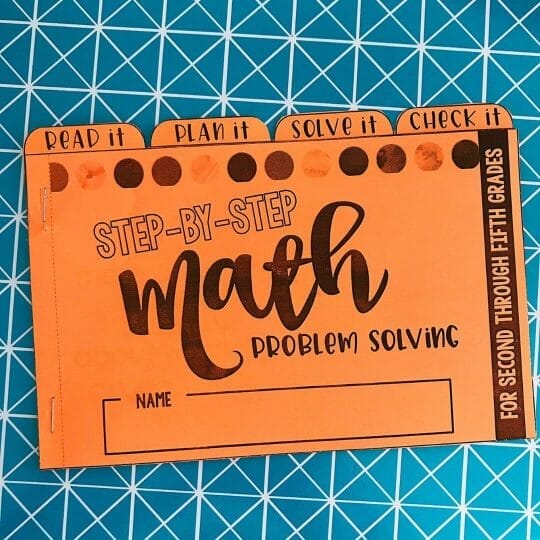
I created a free mini-book filled with guiding questions and step-by-step prompts that students can use to solve word problems on their own.
Want students to work through problems independently? This free Problem Solver’s Guide includes guiding questions and strategy prompts students can use anytime they feel stuck. Get the free Problem Solver’s Guide here.
Building Confident Math Problem Solvers
Word problems combine literacy, reasoning, vocabulary, and mathematical thinking.
When students struggle, it rarely means they can’t do the math.
More often, they need structured routines that give them time to think, discuss, and apply strategies consistently.
If you want a predictable routine that builds independence without taking over your math block, you can also explore my Daily Problem Solving resources designed to support meaningful word problem practice throughout the year.
Because when students understand how to think through problems… confidence follows.
Looking for more math differentiation support?
This post is part of the Math Differentiation resource collection — accommodations, word problem strategies, fluency support, and intervention tools all in one place:
→ Math Differentiation: Accommodations, Word Problems, Fluency, and Intervention