When Classroom Management Feels Off: How to Reflect Before You React
Every teacher has that one part of the day.
You know the one.
Maybe it’s right after lunch when everyone comes back louder, stickier, and somehow less able to follow directions. Maybe it’s the last 20 minutes before dismissal when backpacks become weapons of mass distraction. Maybe it’s math block, transitions, independent work, or anytime you say, “Go ahead and take out your writing notebook.”
Even in a well-managed classroom, there are moments that just don’t run as smoothly as the rest of the day.

When that happens, it’s easy to jump straight to the behavior.
“They’re off task.”
“They won’t stop talking.”
“They know better.”
And sometimes, yes, students need reteaching around expectations. But before you add another consequence, change your clip chart, or give the same reminder for the 47th time, it’s worth stepping back and asking a better question:
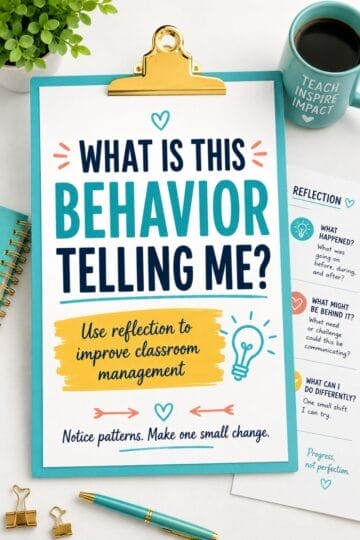
What is this behavior telling me?
Because behavior does not occur in a vacuum, it often relates to the time of day, the task, the level of support, the lesson structure, or the academic skills students are asked to use.
A quick classroom management reflection can help you stop guessing and start noticing patterns you can actually respond to.
Start by Identifying the Toughest Time of Day
You do not need to analyze your entire classroom management system at once. That gets overwhelming fast.
Instead, pick one part of the day that consistently feels harder than the rest.
It might be:
- Arrival
- Transitions
- Small group time
- Independent work
- Math block
- Writing time
- After lunch
- End of the day
- Clean up
- Lining up
For a few days, jot down what you notice.
Keep it simple. You’re not writing a formal behavior report. You’re looking for patterns.
You might track:
- What time of day it happened
- What students were being asked to do
- How long the task or transition lasted
- What behaviors showed up
- Which students seemed most affected
- What you had already taught or modeled
- What support was available
Sometimes the issue really is a routine that needs to be retaught. But other times, the problem is not the time of day. It’s what is happening during that time.
That distinction matters.

Look at What Students Were Being Asked to Do
Once you identify the rough spot, look closely at the task.
Ask yourself:
- Was the task too easy, too hard, or too open-ended?
- Did students know how to get started?
- Were the directions clear?
- Did the activity require a lot of reading, writing, stamina, or executive functioning?
- Was there too much wait time?
- Were students expected to work independently before they were ready?
- Did I model the process clearly enough?
This is where classroom management and instruction overlap.
Sometimes students are not avoiding the expectation. They are avoiding the work because the work feels confusing, frustrating, or impossible.
That doesn’t mean the behavior is okay. It means the solution may need to include academic support, not just another reminder about behavior.
For example, if students consistently struggle during independent writing, the answer might not be “they need to stop talking.”
The answer might be:
- They need a sentence starter.
- They need a model paragraph.
- They need a shorter first step.
- They need help generating ideas.
- They need a checklist.
- They need five minutes of guided practice before being released.
Behavior is often the first thing we notice, but it may not be the root problem.
Compare Behavior Patterns With Academic Data
This is one of the most overlooked classroom management moves.
If a student is frequently off task, disruptive, silly, avoidant, or shut down during a certain subject, pull out the academic data.
Look at:
- Recent exit tickets
- Spiral review results
- Writing samples
- Reading responses
- Informal observations
- Math work
- Quick checks
- Small group notes
- Unit assessments
More than once, I’ve sat down to think through a behavior concern and realized the same student was also struggling with the exact skill we were practicing.
The behavior was not random.
It was connected to the academic demand.
When students don’t understand the skill, they may avoid, distract, rush, copy, joke, argue, ask to go to the bathroom, sharpen a pencil for twelve years, or suddenly develop a deep interest in the ceiling tiles.
Again, that doesn’t mean you ignore the behavior. It means your response gets smarter.
You might need to:
- Reteach the skill
- Pre-teach vocabulary
- Pull a small group
- Reduce the number of problems
- Provide a worked example
- Offer a graphic organizer
- Pair students strategically
- Break the task into smaller chunks
- Check for understanding earlier
When you combine behavior observations with academic data, especially that you get consistently from a daily spiral review, you get a clearer picture of what students actually need.
If you don’t have a consistent daily data source yet, that’s often the missing piece. A short daily spiral review gives you a running picture of which skills students are actually retaining — and which ones keep slipping. When behavior problems cluster around a specific subject, that data tells you whether it’s a skill gap worth addressing before you do anything else about the behavior. My math warm-ups and ELA warm-ups are built exactly for this — five to ten minutes a day, consistent format, easy to track over time.
Review Your Lesson Format
Next, look back at your lesson plans from the past week.
Which lessons had the highest engagement?
Which ones required the most redirection?
This isn’t about blaming yourself. Some lessons are naturally harder to manage than others. Whole-group lessons, partner tasks, hands-on activities, independent work, technology, and transitions all require different levels of structure.
The goal is to notice what works well for your current group of students.
Ask yourself:
- When were students most engaged?
- What lesson formats seemed to go smoothly?
- Which activities had clear routines?
- Where did students need more modeling?
- Were materials ready and easy to access?
- Did students know what to do when they finished?
- Did I build in enough movement, talk, or response opportunities?
- Was the pacing too slow or too rushed?
If your students did well during guided practice but struggled during independent work, that tells you something.
If they were focused during task cards but chaotic during open-ended group work, that tells you something too.
You can use that information to plan more intentionally.
Maybe your class needs shorter independent work blocks. Maybe group work needs assigned roles. Maybe transitions need a visual timer. Maybe you need more structured partner talk before expecting students to collaborate independently.
The point is not to only teach in the format that feels easiest. The point is to add the supports students need for the formats that are harder.
Separate Skill Problems From Will Problems
This is a big one.
When behavior is frustrating, it can start to feel personal. It can feel like students won’t follow directions, won’t try, won’t listen, or won’t cooperate.
But many classroom management challenges are actually skill problems.
Students may not yet have the skills to:
- Start a task independently
- Work with a partner
- Stay organized
- Manage frustration
- Ask for help appropriately
- Transition quickly
- Sustain attention
- Revise their work
- Solve multi-step problems
- Participate in discussion
If the issue is a skill gap, then the solution is teaching, modeling, practice, and support.
That might sound obvious, but it’s easy to forget in the moment when you’re tired and someone is making sound effects with a glue stick.
Try asking:
Is this student refusing to do something they can do, or are they struggling with a skill they still need to learn?
That one question can shift your next step.
Not sure? A Can’t Do-Won’t Do Assessment can help.
Use a Quick Reflection Routine
You do not need a complicated form to reflect on classroom management. A sticky note or notebook page is enough.
Try this quick routine at the end of the day:
1. What part of the day felt hardest?
Name the specific time, routine, or lesson.
2. What was happening instructionally?
Write the task, subject, grouping, or transition.
3. What behaviors did I see?
Stick to observable behaviors.
4. What might students have needed?
Think about academic support, structure, modeling, movement, clarity, or regulation.
5. What will I adjust tomorrow?
Choose one small change.
That last part matters.
Reflection is only useful if it leads to a doable next step.
Not a full classroom overhaul. Not a brand-new management system. One small adjustment.
If your reflection keeps pointing back to a specific subject or task — students consistently off-task during math, writing, or independent reading — it’s worth looking at whether there’s an academic gap driving the behavior. How to plan instruction with classroom management in mind is a good next step once you’ve identified the pattern.
Try One Small Adjustment at a Time
Once you notice a pattern, choose one thing to change.
You might try:
- Reteaching the routine
- Posting the steps visually
- Shortening the task
- Adding a model
- Giving students a checklist
- Building in partner talk
- Pulling a small group first
- Moving a difficult task earlier in the day
- Adding a movement break before the lesson
- Giving a clear “when you’re finished” option
- Pre-teaching vocabulary
- Using a timer for transitions
Then watch what happens.
Did the behavior decrease?
Did students start faster?
Did you have to redirect less?
Did one group still need more support?
Classroom management improves through small adjustments repeated over time. You do not need to solve every problem by Friday.
You just need to get curious about what’s happening and respond with intention.
Final Thoughts
When classroom management feels off, it’s tempting to look for a quick fix.
And sometimes, a quick routine reset helps.
But if the same behavior keeps showing up at the same time of day, during the same type of lesson, or with the same students, it’s worth slowing down long enough to reflect.
Look at the time of day. Look at the task. Look at the academic data. Look at the lesson format.
The goal is not to blame yourself or your students. The goal is to understand what is happening well enough to make a better plan.
Because when you can see the pattern, you can choose a response that actually fits.
That is where classroom management starts to feel less reactive and more doable
Once reflection surfaces a clear pattern, the next question is what to do about it. If you’re seeing the same behavior from the same students across multiple parts of the day, it may be time to move beyond classroom-level adjustments. How to Plan Successful Behavior Interventions covers the step-by-step process for building a more targeted response — and The 4 Things You Must Do Before You Refer a Student for Behavior Intervention is worth reading first if a formal referral is starting to feel necessary.
📌 Looking for more classroom management strategies? Visit our complete guide: Classroom Management Strategies: A Complete Guide for Elementary Teachers.