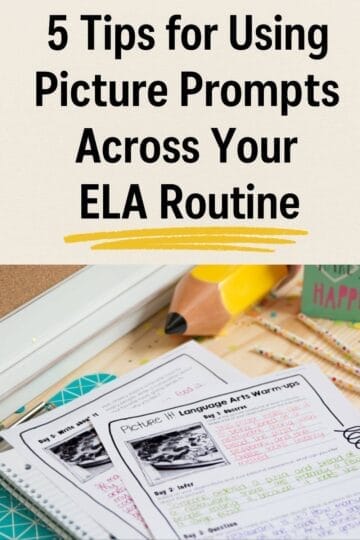
7 Ways to Get More from Your Picture-Based ELA Bell Ringers
If you’re already using picture-based bell ringers in your classroom, you’ve got a genuinely powerful routine in your hands. Taking decoding out of the equation so students can focus on pure comprehension – inferring, finding main idea, building vocabulary – is one of the most effective low-prep tools for reaching struggling and reluctant readers.
But most teachers use maybe 20% of what this kind of routine can actually do. The picture prompt you’re using for a five-minute warm-up on Monday can also become a small group reteach, a writing sample for your portfolio, a discussion launchpad, and a quiet way to track growth over time – all without creating a single new resource.
Here are 7 low-prep ways to squeeze more value out of the bell ringers you’re already running.
1. Turn Bell Ringers into Small Group Launchpads
Already using a picture prompt as a class warm-up? Pull that same skill into your small group instruction instead of starting from scratch.
If Monday’s prompt focused on main idea, grab a short passage at your group’s level and reinforce the same skill with a quick mini-lesson and guided practice. Use the original picture to spark the discussion again, then scaffold with sentence stems or a graphic organizer as students apply the skill to text.
Why this works: Students already have some familiarity with the skill from the whole-class warm-up, which lowers the cognitive load when you ask them to apply it somewhere new. You’re not introducing two new things at once – just transferring a skill they’ve already started practicing.
Bonus: This is also one of the easiest ways to document targeted practice for students receiving intervention or working toward an IEP goal, since you can show a clear line between the whole-class skill focus and the small group reteach.
2. Create a Writing Showcase Wall
Don’t let the writing your students produce during bell ringers disappear into a folder, never to be seen again. Pick one day a week – Friday works well – to display a few favorite responses.
This does double duty. It celebrates student voice and effort, which matters enormously for students who don’t often see their work held up as an example. And it gives you and your students a visible record of growth over the weeks, which is its own kind of motivation.
Tip: If your resource includes a revision or editing checklist, have students run their response through it before it goes on the wall. This adds a quick, authentic editing practice rep without creating extra work, and it means what goes up is genuinely their best effort, not just their first draft.
3. Use the Photos as Discussion Starters for Speaking & Listening Standards
If your class struggles with productive academic discussion – and many do – these images are an easy way to build that muscle in a low-stakes way.
Try:
- A simple pair-and-share routine before or after the written response
- A short Socratic circle using the picture prompt’s writing question as the opening prompt
- Sentence starters for academic talk (“I noticed… which makes me think…” or “I disagree because…”)
A simple prompt like “What do you think happened right before this picture was taken?” tends to generate real conversation – including from students who are far more hesitant to speak up about a text they’re not confident they understood correctly. Because the image is fully visible to everyone in the room, there’s no information gap creating anxiety about whether they “got it right.”
Result: More oral language practice, more comprehension reinforcement, and a built-in opportunity to hear student thinking out loud before or after they commit it to paper.n.
4. Build Mini-Lessons Around Skill Gaps
The comprehension skills in a well-built picture prompt routine spiral across the weeks, but real classrooms don’t move in a perfectly straight line. If you notice a cluster of students missing something – inference, point of view, supporting details – pause and build a quick mini-lesson using that week’s image.
The advantage here is real: students already know the image. They’ve been writing or talking about it for a few days, which means the visual itself is no longer new information competing for their attention. That lowers the barrier to the actual skill instruction, because you’re not asking them to process a brand-new image and a new skill at the same time.
For more support building out the specific skills that tend to need this kind of reteach, see:
5. Add Them to a Literacy Station Rotation
Once the week’s bell ringer is done, the picture and prompt don’t have to retire. Slide them into your literacy centers for spiral review. A few ways to repurpose them:
- Have students revisit the writing prompt and revise it with a partner, focused on adding more specific detail or stronger evidence
- Color-code the response for parts of speech, sentence structure, or text structure elements
- Trade papers with a peer and have them respond to or build on each other’s writing
This is a genuinely easy way to get a second instructional use out of material you’ve already prepped, without creating new center materials from scratch.
6. Use for Progress Monitoring & Documentation
Many interventionists and special education teachers love picture-based warm-ups for a specific reason: they’re a quick, low-stakes way to capture a snapshot of student thinking over time, without needing to administer a separate formal assessment.
A few responses copied into a student portfolio every few weeks can show:
- Growth in sentence construction and grammar
- Increasing sophistication in inference or main idea responses
- Vocabulary development over the course of a semester
This is one of the easiest ways to build a body of evidence for progress monitoring or IEP documentation, because the work is already happening as part of your normal routine – you’re just choosing to save and date a few samples along the way rather than letting them go home in a folder.ment.
7. Bridge the Gap Between Reading and Writing Instruction
Picture-based bell ringers aren’t just a warm-up – they’re a natural bridge between comprehension and writing instruction, and you can make that connection explicit for students.
Try this structure across a week:
- Use the reading/comprehension-focused prompts Monday through Thursday
- Let students apply that same comprehension skill in a writing task on Friday, using the same image
- Circle back and reflect as a class: How did understanding the main idea (or making a strong inference) help you write a better response?
That reflection step matters more than it might seem. Naming the connection between the comprehension skill and the writing outcome builds metacognition, which is exactly the kind of “thinking about your thinking” that struggling learners often need explicit support to develop. They don’t always make that connection on their own.

Ready to Try Something New This Week?
You already have the tool. Now you’ve got seven new ways to use it. The real strength of a picture-based bell ringer routine is its flexibility – whether you’ve got 10 minutes for a true warm-up or a full block to build out small group instruction, discussion, and writing around it, the same resource flexes to fit.
Haven’t started using picture-based bell ringers yet? Daily ELA Bell Ringers with Picture Prompts gives you a full year of ready-to-use prompts built specifically for struggling and reluctant readers.
More Support for Struggling Readers and Writers
Reading Comprehension Question Stems
Differentiation for Struggling Readers: Here’s What You Need to Know
5 Engaging Ways to Make Inferring Approachable to Struggling or Reluctant Readers
How to Build Writing Stamina with Struggling Writers
Want more skill-specific support? Check out the posts we linked above or explore our other comprehension tools designed for classrooms like yours, where readers come with all kinds of strengths and struggles.
Haven’t grabbed the full resource yet?
You can get it here: Daily ELA Bell Ringers with Picture Prompts on TPT