Discussion Questions to Build Classroom Community (50+ Ideas for Any Age)
Building real classroom community doesn’t require elaborate lessons or expensive curriculum. It requires consistent, low-pressure moments where students talk, listen, and find out they have more in common than they thought.
These discussion questions are designed for exactly that — a five-minute morning meeting opener, a quick do-now, or a turn-and-talk that doubles as a community builder. No prep. No materials. Just a question and a few minutes of real conversation.

Why Discussion Questions Work for Community Building
Research consistently shows that strong teacher-student and student-student relationships improve engagement, reduce behavior issues, and support academic outcomes — especially for struggling learners. The challenge isn’t knowing that relationships matter. It’s finding time to build them.
Discussion questions solve this by fitting into routines you already have:
- Morning meeting — use one question as your opening circle
- Do-now / bell ringer — quick write response before the lesson
- Turn-and-talk — pair students with someone they don’t usually talk to
- Exit ticket swap — students answer and share with a partner on the way out
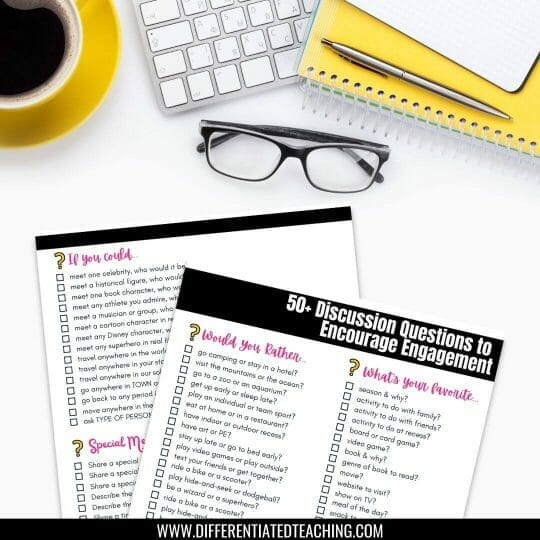
The questions below are organized by type and grade band so you can grab exactly what you need.
100+ Discussion Questions to Build Relationships with Students & Foster Classroom Community
Since you have enough to do, I’ve created a list of over questions you can use when you don’t have time to come up with your own. They were selected to be engaging, foster classroom community, and help you build positive relationships with your students.
I’ve broken the questions into categories to make them easier to find.
“Would you rather…” Ice Breaker Questions
Would You Rather questions are the easiest entry point — there’s no wrong answer, everyone has an opinion, and they naturally spark follow-up conversation.
Classroom & School Life
- Would you rather have indoor recess or outdoor recess?
- Would you rather have art class or PE?
- Would you rather have a longer lunch or a longer recess?
- Would you rather have a surprise day off or know about it a week ahead?
- Would you rather sit next to your best friend or your favorite teacher?
- Would you rather have no homework for a week or no tests for a month?
- Would you rather be the class president or the teacher for a day?
Food & Favorites
- Would you rather eat at home or at a restaurant?
- Would you rather have pizza every day or never eat pizza again?
- Would you rather only eat sweet foods or only eat salty foods?
- Would you rather have your favorite meal for breakfast or dinner?
- Would you rather give up candy or give up your favorite snack?
Activities & Adventures
- Would you rather go camping or stay in a hotel?
- Would you rather visit the mountains or the ocean?
- Would you rather go to the zoo or an aquarium?
- Would you rather ride a bike or a scooter?
- Would you rather play video games or play outside?
- Would you rather read a book or watch a movie?
- Would you rather play an individual sport or a team sport?
- Would you rather explore outer space or the deep ocean?
- Would you rather have the ability to fly or be invisible?
Favorites Questions
Favorites questions help students find common ground and give you insight into who your students are outside of school. Use these when you want low-stakes conversation that builds genuine connection.
Favorites questions help students find common ground and give you insight into who your students are outside of school. Use these when you want low-stakes conversation that builds genuine connection.
At School
- What is your favorite subject and why?
- What’s your favorite thing about our classroom?
- What’s your favorite thing to do at recess?
- What’s your favorite specials class?
- What’s the best thing that happened at school this week?
- What’s a book you’ve loved that you’d recommend to the class?
Outside School
- What’s your favorite activity to do with your family?
- What’s your favorite thing to do with your friends?
- What’s your favorite movie or show right now?
- What’s your favorite board game or card game?
- What’s your favorite hobby?
- What’s your favorite season and why?
- What’s your most prized possession?
- What’s your favorite meal?
- What’s your go-to snack?
- What’s your favorite genre of music?
- What’s a talent you have that most people don’t know about?
“If You Could…” Questions
These open-ended questions spark imagination and give quieter students a low-risk way to participate — there’s no factual answer to get wrong.
People & Connections
- If you could meet any celebrity, who would it be?
- If you could meet anyone from history, who would you choose?
- If you could meet a character from a book, who would you pick?
- If you could meet any athlete you admire, who would it be?
- If you could have lunch with any musician or band, who would you choose?
- If you could meet any superhero in real life, who would you pick?
Places & Travel
- If you could travel anywhere in the world, where would you go?
- If you could travel anywhere in our state for the day, where would you visit?
- If you could move anywhere in the world, where would you live?
- If you could travel back to any point in history, when would you go?
- If you could explore anywhere in our solar system, where would you go?
- If you could spend a day anywhere in our city or town, where would you go?
Changes & Choices
- If you could change one rule at school, what would it be?
- If you could add one thing to our classroom, what would it be?
- If you could teach the class for one day, what would you teach?
- If you could give everyone in the class one piece of advice, what would you say?
- If you could invent anything, what would you create?
- If you could have any superpower, what would you choose and why?
“One Questions” Conversation Starters
These are great for connecting classroom learning to the real world — and for middle school students especially, they spark genuine debate and deeper thinking.
- If you could ask the president one question, what would it be?
- If you could ask our principal one question, what would you ask?
- If you could ask a famous inventor one question, what would it be?
- If you could ask any historical figure one question, what would you ask?
- If you could ask a character from our current book one question, what would it be?
- If you could ask your family pet one question, what would it be?
- If you could ask your future self one question, what would you ask?
Future-Focused Questions
These questions help you understand your students’ goals and aspirations — and give you insight you can use to connect with them individually throughout the year.
- If you could be really great at one thing, what would you choose?
- What career are you most interested in right now?
- What do you think you’ll be doing in 20 years?
- Where do you want to live when you grow up?
- What are you most excited about as you get older?
- What is one goal you have for yourself this school year?
- What is one skill you want to learn or get better at this year?
- What are five things you want to do before you turn [age]?
- What’s something you want to be known for?
Memory & Story Questions
These questions take a little more time — plan for students to share across a few days rather than all at once. They’re especially powerful for building deeper connections because they ask students to be a little vulnerable.
Positive Memories
- Share a school memory that is really special to you.
- Describe a special experience you had with your family.
- Share a memory of a time someone was unexpectedly kind to you.
- What’s the most excited you’ve ever been about something coming up?
- What’s the most amazing thing you’ve ever seen in real life?
- What’s the most beautiful place you’ve ever visited?
- What’s a time you worked really hard for something and it paid off?
Challenges & Growth
- What’s something you used to think was really hard that you’re good at now?
- Share a time you helped someone else when they were struggling.
- What’s something you failed at that you’re glad you tried?
- Describe a time when you changed your mind about something important.
Community & Character Questions
These questions are especially useful at the start of the year, after a conflict, or when you want to reconnect after a break. They help students think about what kind of community they want to be part of.
Community & School
- Why do you think it’s important to have rules at school?
- What is one rule we have that you think is fair — and why?
- What does a really good classroom feel like to you?
- If you could change one thing about how our class works together, what would it be?
- What’s one way you could make someone in our class feel more welcome?
Kindness & Respect
- What does kindness look like in our classroom?
- How do you prefer others to show you kindness — notes, words, space, help?
- What’s a small thing someone can do that makes a big difference to you?
- How can you show respect to someone you don’t agree with?
- What’s the difference between being nice and being kind?
Identity & Belonging
- What’s something about you that most people in this class don’t know?
- What’s a tradition your family has that you love?
- What’s something you’re proud of that has nothing to do with school?
- What’s one thing you want your classmates to understand about you?
Grade-Level Tips
Elementary (Grades 2–5) Stick with Would You Rather, Favorites, and If You Could questions to start — they’re low-stakes and get even the quietest students talking. Morning meeting circle format works best: one question, everyone responds, no judgment.
Upper Elementary & Middle School (Grades 5–8) Add the Community & Character and Future-Focused questions — this age group responds well to being taken seriously. Pair students with someone they don’t know well for turn-and-talk, then invite sharing to the whole group.
All Grades Avoid questions that assume all students have two parents, pets, or travel experience. Questions framed as “if you could” are naturally more inclusive than questions that assume a specific life experience.
How to Use These in Your Morning Routine
You don’t need a formal morning meeting structure to make these work. Here’s the simplest possible approach:
- Post the question on the board or projector as students arrive
- Give students 2 minutes to think or quick-write their answer
- Pair share — 1 minute each direction
- Optional whole-group share — 2-3 students share out
Total time: under 7 minutes. Total prep: none.
Over time, these small moments build the kind of classroom culture where students feel seen, take more academic risks, and treat each other better — which makes everything else you do easier.
Looking for more classroom community resources? Visit our complete guide: Building Classroom Community — covering discussion questions, SEL read alouds, first week activities, and strategies for rebuilding community all year long.