The Wild Robot Novel Study: Activities, Comprehension Questions & Classroom Guide
Gearing up for a Wild Robot novel study? If you want something that goes beyond basic chapter questions and actually keeps your students thinking, you’re in the right place.
Because let’s be honest… novel studies can go one of two ways. Either students are engaged and making real connections, or you end up with a stack of completed worksheets and not much to show for it.
In this post, I’m sharing simple, classroom-tested ideas to help you start and wrap up your unit without it turning into busywork. You’ll also get a clear plan for structuring your lessons so students stay engaged and you’re not constantly reteaching.

The Wild Robot Summary
In Peter Brown’s The Wild Robot, we meet Roz… A robot who washes ashore on a wild island after a shipwreck. She has no memory, no instructions, and no idea what she’s supposed to do. What she does have is a drive to survive and a deep capacity to learn.
As Roz begins to observe and adapt to the world around her, she accidentally becomes the mother of a gosling named Brightbill. Raising a wild creature when you are not wild yourself turns out to be complicated. Roz must figure out how to feed him, protect him, and prepare him for a migration she cannot make with him — all while navigating a community of animals who don’t quite know what to make of her.
But as Brightbill grows and the seasons change, both he and Roz begin to ask bigger questions about belonging, identity, and what it means to be a family. And when the company that built Roz comes looking for her, the island community will have to decide whether this strange, gentle robot is one of their own.
The Wild Robot is a stunning story about survival, found family, and the unexpected places we find connection. It’s also the kind of book that stays with students long after they finish the last page.
Why The Wild Robot Works for 3rd–5th Grade Readers
There’s a reason The Wild Robot keeps showing up in classrooms — and it’s not just because of the movie. This is one of those rare books that works for a wide range of readers without you having to constantly adjust everything to make it fit.
Here’s why it works so well:
The themes are rich and age-appropriate.
Survival, belonging, identity, and found family are concepts students in grades 3–5 are already trying to make sense of in their own lives. This book gives them a way to explore those ideas without it feeling heavy or overwhelming… which leads to much better discussions.
The structure is manageable.
The short chapters make a big difference… especially for students who tend to lose track during longer texts. It’s much easier to keep your whole class moving together, and students who don’t usually finish chapter books often stick with this one.
Roz is a genuinely compelling protagonist.
She’s not human, but she’s incredibly relatable. She’s learning as she goes, trying to figure things out, and doesn’t always get it right the first time. Even students who don’t usually connect with characters tend to latch onto her pretty quickly.
The book naturally supports comprehension skill instruction.
Point of view, character development, cause and effect, inference… it’s all there. You don’t have to force it or over-explain it because the text gives you real opportunities to teach those skills in context.
It gives you built-in engagement opportunities.
If your students have seen the movie, the book-versus-film comparison is an easy win. If they haven’t, the story still pulls them in quickly, which makes everything else you’re doing with the novel feel easier to manage.
Pre-Reading Activities for The Wild Robot
Before you start reading, you want students to think about the big ideas in the book without overloading them with background information. You don’t need anything complicated here… just a few intentional entry points to get students thinking before the story does the work for them. Pre-reading activities are also your chance to hook students who might otherwise check out before you even get started.
Here are five pre-reading activities that work well:
Survival Scenarios
Present students with a scenario: you wake up in an unfamiliar place with no instructions, no tools, and no one to help you. What’s the first thing you do?
This works especially well for getting students past that initial “I don’t know” response and into actual problem-solving. It also sets them up to understand Roz’s situation in a much more concrete way.
“What Makes a Family?” Discussion
Give students a simple prompt: what makes a group of people (or animals, or even machines) a family?
Keep this low-pressure and open-ended. You’ll get a wide range of responses, and revisiting those ideas at the end of the book leads to much deeper thinking than if you introduce the concept later.
Nature Observation Journal
Take students outside or have them observe through a window. Ask them to record what they notice about the natural world.
Framing this as “thinking like Roz” helps students slow down and actually observe, which pays off later when you’re working on sensory language and inference.

Technology vs. Nature Quick-Write
Ask students whether technology and nature can coexist and have them explain their thinking.
This is a simple way to activate prior knowledge, and it gives you a quick read on how your students are thinking before you start digging into the text.
Book Trailer or First Chapter Preview
Show a trailer or read the opening pages aloud.
The beginning of The Wild Robot raises a lot of natural questions. Let students sit with that curiosity instead of explaining everything upfront… it makes them much more invested once you start reading.
Post-Reading Activities for The Wild Robot
After students finish the book, they need time to process what they’ve read and make sense of it. This is where you move beyond simple comprehension and into deeper thinking… without it turning into a pile of disconnected projects.
These book report alternatives give you meaningful ways to wrap up your novel study through discussion, writing, and creative work.
Book vs. Movie Comparison
This one practically runs itself if students have seen the film. Have students compare and contrast the book and movie versions of The Wild Robot — what was changed, what was left out, and which version tells the story more effectively.
This is one of those activities where even your quieter students usually have something to say… and it naturally leads to stronger written responses.
Want a ready-to-use version? Grab it here.
Found Family Reflection
Ask students to think about a time they felt like they belonged somewhere unexpected… or a time they felt like an outsider who was eventually welcomed in.
This works well as a writing piece or discussion, and it’s a great way to help students make personal connections without needing heavy scaffolding.
Character Instagram Profiles
Have students create an Instagram profile for a character like Roz, Brightbill, or Fink. What would they post? What captions would they write?
This is a great option if you have students who struggle with traditional written responses but still need to show strong character understanding.

Letter to Roz
Students write a letter to Roz at a specific point in the story. What would they want her to know?
This is a simple activity that builds empathy and perspective-taking… and it tends to pull more thoughtful responses than standard comprehension questions.
Island Community Mural
In small groups, students design a map or mural of the island community. They label key locations, characters, and important events.
This works especially well if your class needs a more hands-on or collaborative option at the end of a unit.
Survival Guide
Students create a survival guide for a robot starting over in the wild, based on what Roz learned.
This blends text evidence with creativity in a way that’s approachable… even for students who typically struggle to get started with writing.

Philosophical Discussion — “Do Robots Have Feelings?”
The Wild Robot naturally raises bigger questions about emotion, identity, and what it means to care for something.
Structured discussions or Socratic seminars around these ideas tend to bring out students who don’t usually participate… especially when there’s no single “right” answer.
Brightbill’s Migration Journal
Students write journal entries from Brightbill’s point of view during migration.
This is a strong way to reinforce point of view while still keeping the task manageable and engaging.
Sequel Preview
If you’re moving into The Wild Robot Escapes, have students predict what happens next and how Roz might have changed.
This is a simple transition activity that builds anticipation and keeps students invested in the story.
Book Club Discussion Cards
Have students create their own discussion questions that go beyond basic plot recall.
This is especially helpful for building student ownership and encouraging higher-level thinking without you having to carry the entire discussion.
What’s Included in the Wild Robot Novel Study Unit?
Now that you have a plan for before and after the book, you might be wondering what to do during your Wild Robot novel study. I’ve got you covered. In fact, this is the same structure I use to keep my own novel study instruction focused without overwhelming my students.
Each of my novel units comes with an instructional guide to help you plan your daily lessons with ease. You’ll also find PDF printables and digital resources to differentiate instruction and cover key comprehension skills and vocabulary in a student-friendly format, designed specifically for reluctant and struggling readers.

This Wild Robot novel study includes everything you need for a month-long literature unit. You’ll focus on a single comprehension skill and a text-based vocabulary word each day to maximize student learning without overwhelming your readers.
What’s Included in the Wild Robot Novel Study Unit?
Reading Comprehension Skills & Strategies
Instead of bouncing between five different skills at a surface level (which is where a lot of novel studies fall apart), each day focuses on one skill at a deeper level.
This helps students actually understand what they’re learning and apply it… instead of just completing an assignment and moving on.

Here are some of the comprehension skills covered:
- Generating a main idea and summarizing key events
- Analyzing characters and how they change over time
- Using sensory language to understand setting
- Identifying cause and effect relationships
- Analyzing point of view and how it shapes the story
- Using context clues to determine meaning
Text-Based Vocabulary
Each day includes a vocabulary word pulled directly from the text.
These aren’t random word lists. The words are either important to understanding the story or useful for building long-term vocabulary.
Students work with one word at a time using the vocabulary flip book format, which allows them to:
- Define the word using context clues
- Connect it to the text
- Use it in their own thinking and writing

This structure helps students actually learn the word… not just copy a definition and forget it the next day.
- emerge
- methodically
- demeanor
- meandering
- inoperative
- refurbish
Differentiated Formats
Everything is designed to give you flexibility without increasing your workload.
- Daily comprehension prompts in 2 formats for differentiation
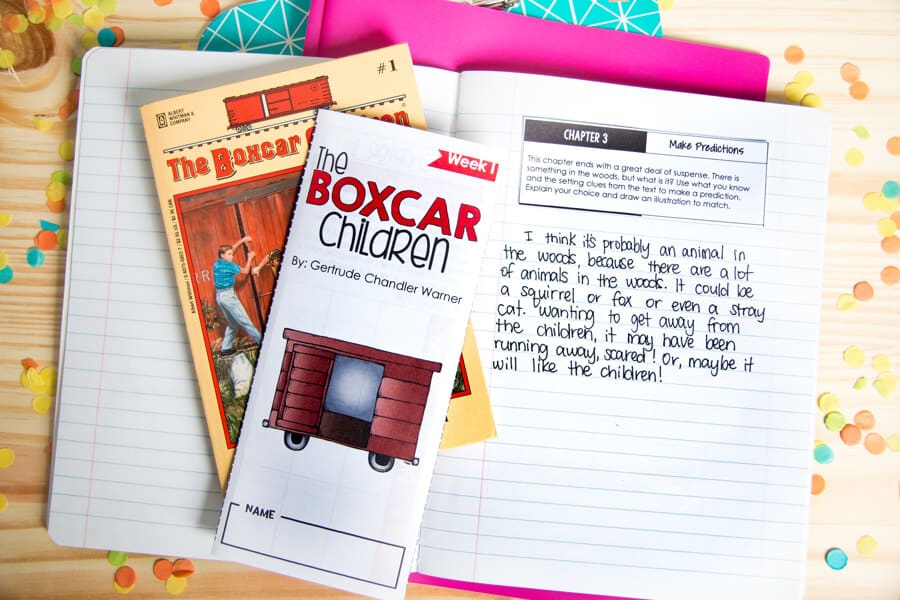
- Foldable trifold brochures
- Cut & paste journal prompts for interactive notebooks
- Digital Google Slides
- Weekly word of the day flip books for text-based vocabulary
- Easy-to-follow directions for printing & prep
- Instructional planning guide
- Answer keys

These options make it easier to support different learners while still keeping your instruction consistent.
Here’s What Teachers Are Saying:
“We used these for a whole-class novel study. Pre-printed brochures fully encompassed ELA skills for the novel. This is an extremely easy, but very rich set of activities for understanding and enriching students’ ELA skills.” — Allison M.
“This does a really good job of focusing on vocab and using context clues, practicing quoting from the text, and target skills. I really liked the way it focused on one skill for every two chapters, which made things really manageable for my students.” — Beth A.
“I LOVE the layout and how it guides my son and I through our reading time. I also love the vocab focus for each section and the skill listed so I can monitor his understanding.” — Antonia S. (homeschool parent)



Looking for more? Grab the Wild Robot Novel Study and its sequel in a bundle and save.
More About the Book
What is the reading level of The Wild Robot?
If you’re trying to decide whether this book is a good fit for your students, here’s a quick breakdown of the most commonly used leveling systems:
- Grades: 3–5
- Guided Reading Level: Q
- Lexile Level: 740L
- Accelerated Reader Level: 4.3
In most classrooms, this works well as a whole-class novel, small group text, or even a supported independent read depending on your students.
How many pages are in the book? How many chapters?
The Wild Robot is about 279 pages and broken into 45 short chapters.
Those shorter chapters make a big difference… especially if you’re working with students who tend to lose stamina during longer reads. It also makes it much easier to plan daily reading without falling behind.
What genre is the text? Any themes to be aware of?
This is a science fiction and adventure story with strong elements of nature writing.
The main themes include:
- Survival
- Belonging
- Identity
- Found family
There are a few moments of danger and loss throughout the story, but they’re handled in a way that typically leads to strong discussion rather than concern in a classroom setting.
Does the book have a sequel?
Yes. The Wild Robot Escapes continues Roz’s story after the first book.
If your students connect with the first book (and they usually do), it’s an easy next step… and a great way to keep that momentum going. There’s even a third book in the series called The Wild Robot Protects.