Spiral Review and Assessment Strategies: A Complete Guide for Elementary & Middle School Teachers
Spiral review is one of those ideas that almost every teacher agrees with in theory and struggles to implement well in practice. The concept is simple: students retain information better when they encounter it repeatedly over time rather than intensively once and then never again. The execution is harder… Because designing a genuinely useful review without becoming repetitive busywork takes more thought than most curriculum materials provide.

This guide brings together the best resources on this site for building review and assessment routines that actually work… Routines that surface gaps before they become crises, give you usable data without drowning you in paperwork, and help every student build the kind of long-term retention that shows up on tests and in their actual learning.
What is spiral review (and why most teachers do it wrong)
Spiral review means returning to previously taught content at spaced intervals — not reteaching it from scratch, but giving students low-stakes practice that keeps skills fresh and surfaces gaps before they calcify. Done well, it takes 10–15 minutes a day and replaces a significant amount of re-teaching time later in the year.
The most common mistake is confusing spiral review with test prep. Test prep is high-stakes, high-pressure practice on specific formats. Spiral review is a daily maintenance routine that builds confidence and retention over time. When teachers use spiral review as test prep — cramming all the standards into March and April — they get neither benefit.
The second most common mistake is making spiral review too long. A review routine that takes 25 minutes is not review — it’s a second lesson. Effective spiral review is brief, predictable, and consistent. Students should be able to do it almost automatically so the cognitive load stays on the content, not the format.
Related post: Why You’re Wasting Time on Spiral Review (And How to Fix It)
Daily language and ELA spiral review
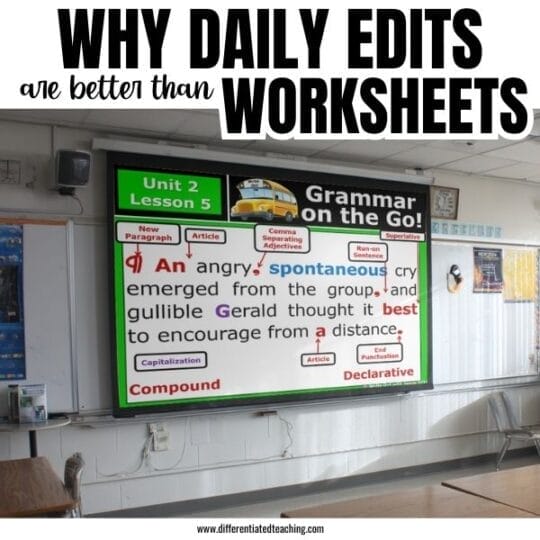
Language arts skills — grammar, mechanics, vocabulary, sentence structure — are the area where spiral review pays off most consistently. Students who encounter these skills in brief daily doses build automaticity that transfers to their writing in ways that grammar units rarely achieve.
An effective ELA spiral review routine hits four components: grammar and mechanics, vocabulary, reading comprehension skills, and writing conventions. Not all four every day — but rotating through them consistently across the week creates cumulative exposure that builds real mastery.
- Keep it to 10 minutes maximum — predictability matters more than depth here
- Use a consistent format so students don’t spend cognitive energy figuring out what to do
- Grade it quickly or not at all — this is practice data, not summative evidence
- Rotate standards intentionally rather than randomly — track what you’ve reviewed so nothing falls through
Related posts: 4 Key Components of an Effective ELA Spiral Review | Daily Language Spiral Review: The Secret to a Morning Routine That Works | Mastering 3rd Grade Language Standards in Just 10 Minutes a Day | How to Use Daily Spiral Review to Master 5th Grade Language Standards | 4th Grade Daily Language Review for Grammar, Vocabulary, and Spiral Practice
Math spiral review and daily math routines
Math is where spiral review has the strongest research base — and where the gap between knowing it works and doing it well is widest. The students who need math spiral review most are often the ones who struggle most with independent practice, which means your review format has to be accessible enough that it doesn’t create a daily frustration spiral before the real lesson even starts.
The most effective math spiral routines are short, mixed in difficulty, and tied directly to your current unit so students can see connections between what they already know and what they’re learning now. A 4th grade word problem routine that takes 15 minutes and hits two or three previously taught standards is more valuable than a 30-question review sheet that takes the whole class period.
Related posts: How to Use a Math Spiral Review to Increase Achievement | A 4th Grade Word Problem Routine That Works (and Only Takes 15 Minutes a Day) | A 15-Minute Routine to Build 1st Grade Math Skills | 5th Grade Math Spiral Review: A Bell Ringer Routine for the Hardest Year in Elementary Math
Formative assessment: the data that actually drives instruction
Formative assessment is the practice of gathering evidence of student learning during instruction — not at the end of a unit, but in the middle of it, while there is still time to adjust. The difference between a teacher who catches a misconception on day 3 and addresses it on day 4, versus a teacher who discovers it on the unit test, is formative assessment.
Graphic organizers are one of the most underrated formative assessment tools because they make thinking visible without requiring lengthy written responses. A well-designed organizer shows you exactly where a student’s understanding breaks down — whether it’s the vocabulary, the concept, the application, or the connection to prior knowledge.
Related post: 3 Graphic Organizers for Formative Assessment
Universal screening: knowing where every student is before you teach
Universal screening means assessing every student — not just the ones you’re already worried about — at the beginning of the year to establish a baseline. It is the first step in any tiered intervention model, and it is the step most teachers either skip, rush, or do without a clear plan for what to do with the results.
The point of universal screening is not to label students or generate paperwork. It is to give you a map of your classroom before you start teaching — so your Tier 1 instruction can actually serve the whole group, and so students who need more support can get it early rather than after six weeks of falling further behind.
Related post: A Teacher’s Guide to Universal Screening
Standardized test preparation that actually transfers
The most effective test preparation is not drill-and-kill practice on released test items. It is year-round instruction in the skills the test measures — reading comprehension, mathematical reasoning, written response — delivered in a way that builds genuine understanding rather than test-taking tricks.
That said, students do benefit from explicit instruction in test format and timing. Seeing the structure of a standardized test question, practicing how to eliminate wrong answers, and learning to budget time across sections are skills that transfer — as long as they are taught as thinking strategies, not just test strategies.
Related post: 5 Simple Ways to Freshen Up Your Test Prep
MTSS data and intervention documentation
Assessment data only matters if it leads to action. The gap between collecting data and actually using it to make intervention decisions is where most MTSS systems break down. Effective data meetings are short, focused, and tied to specific next steps — not two hours of reviewing numbers that don’t change anything.
Documentation matters, too… Not because paperwork is the goal, but because consistent records of what you tried, when, and with what results are the evidence base for every conversation you have about a struggling student, whether that’s with a parent, a specialist, or an IEP team.
Related posts: Take Control and Get More Done in Your Next MTSS Meeting | 4 Easy Tips for Documenting Tier 1 Interventions
Review, assessment, and differentiation work together
Spiral review and formative assessment are not just efficiency tools — they are differentiation tools. When you know where each student is on a skill before you teach the next one, you can make better decisions about grouping, pacing, and support. The data from a well-run morning review routine tells you which students are ready for extension and which ones need another pass at the concept before you move on.
📚 For more on using data to drive differentiated instruction: Supporting Struggling Readers | Math Differentiation | Writing Instruction Strategies
🌟 Part of the Differentiated Teaching resource library. See our complete guide: Differentiated Teaching Strategies — covering reading, math, novel studies, sub plans, classroom management, and community.