Frindle Novel Study: Activities, Lesson Plans & Resources
Ask your students what a pen is called. They’ll look at you like you’ve lost your mind. Then tell them: it’s only called a pen because enough people agreed it was. Someone made that up once, and it stuck. Watch their faces change.
That’s the premise of Frindle, and it is one of the most effective first-day hooks I’ve ever used with a class novel. In this post, I’ll walk you through pre-reading ideas, post-reading activities, and the complete novel study unit I use for grades 3–5. Whether you’re reading this as a whole class or a small group, I’ll share everything you need to make the most of it.

Frindle: Book Summary
Nick Allen is the kind of kid who has a gift for derailing lessons. When his fifth-grade teacher, Mrs. Granger, the most formidable language arts teacher in school history, challenges him to think about where words come from, Nick gets an idea. What if he just invented a new word? What if, starting now, a pen wasn’t called a pen at all… It was called a frindle?
What begins as a classroom prank quickly takes on a life of its own. Other students start using the word. Then the town. Then the country. And Mrs. Granger, who has built her career on the power of language, draws a hard line.
Frindle is a surprisingly layered book about the nature of language, authority, and what it actually takes to change the world. It’s also genuinely funny, which matters enormously when you’re trying to get reluctant readers invested in a class novel.
This book works well with grades 3–5. It’s short enough to read in two weeks but rich enough to build real comprehension skills, especially inference, character motivation, and theme.
Frindle Novel Study: Pre-Reading Activities
Finding great pre-reading activities is an important step in engaging learners with any book study. Here are a few favorites to get them engaged in Frindle.

Where Do Words Come From?: Before reading, ask students if they’ve ever wondered how a word got its meaning. Why is a dog called a “dog” and not something else?
This is the exact question Nick’s teacher poses…and it’s the one that sets the whole story in motion. A short class discussion gets students thinking like Nick before they’ve even met him & it is a great opportunity to make connections to morphology!

The Teacher You’ll Never Forget: Mrs. Granger is a teacher students remember for the rest of their lives…and Nick is about to find out why.
Ask students to think about a teacher or adult who had high expectations for them.
What did it feel like at the time?
What do they think now?
This sets up the Granger-Nick relationship in a way that makes the ending land harder.
Rules You’ve Wanted to Break: Nick is a rule-pusher, not a rule-breaker. There’s an important difference.
Before reading, ask students: Have you ever thought a rule was wrong or unfair? What did you do about it?
This connects to the theme of individual vs. institution that runs through the whole novel.
Invent a Word: Have students invent their own word for something that doesn’t have one yet… the feeling of waking up already tired, or the specific joy of the last day of school.
Share them and vote on favorites. This is the same impulse Nick has, and doing it themselves makes his motivation immediately understandable.
Frindle Post-Reading Activities
Post-reading activities that aren’t boring book reports are a must to wrap up a good novel unit. Here are a few ideas for Frindle that will actually get your learners excited:
Nick’s Letter: At the end of the novel, Mrs. Granger reveals that she knew what Nick was doing all along and was secretly on his side.
Students write the letter Nick might have written back to her after reading hers — capturing what he now understands about her that he didn’t at the time.
Then and Now: Nick changes significantly from the beginning to the end of the book. Students complete a before-and-after character analysis — who was Nick in chapter one, who is he by the end, and what caused that change?
This is a strong writing prompt for grades 4–5 because the change is nuanced, not just “he learned a lesson.”
Frindle vs. the Dictionary: The dictionary eventually accepts “frindle” as a real word. Students write a short argument either defending or opposing Mrs. Granger’s position — was she right to fight against the word, or was she wrong?
The beauty of this prompt is that there’s a genuine case to be made on both sides.
What Would You Invent?: Students identify something in their school, neighborhood, or daily life that needs a better word — and create a complete entry for their invented word: definition, etymology (made up), and usage example.
This is especially engaging as a final project because it applies the theme of the book directly.
The Frindle Literature Study Unit
My Frindle Novel Study is a complete print-and-digital unit with everything you need for two to three weeks of focused instruction. Like all my novel units, it’s built on the principle that one deep skill practiced well beats five skills practiced quickly.
What’s included in the Frindle Novel Study?
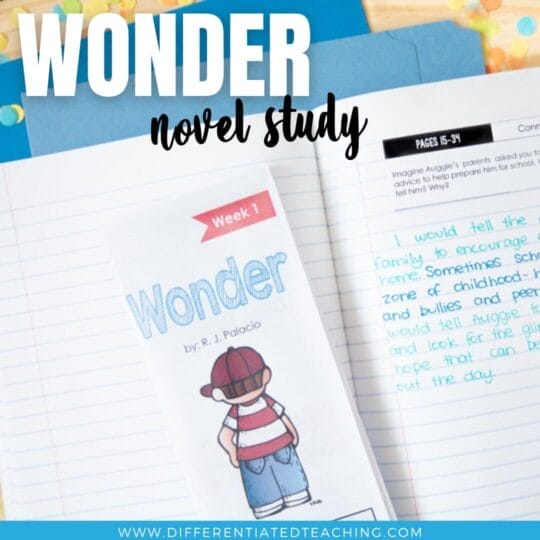
- Foldable trifold novel studies: weekly trifolds covering the full book, one skill per chapter per day. The trifold format is paper-efficient and structured in a way that doesn’t overwhelm reluctant writers — they see one task at a time, not a full worksheet.
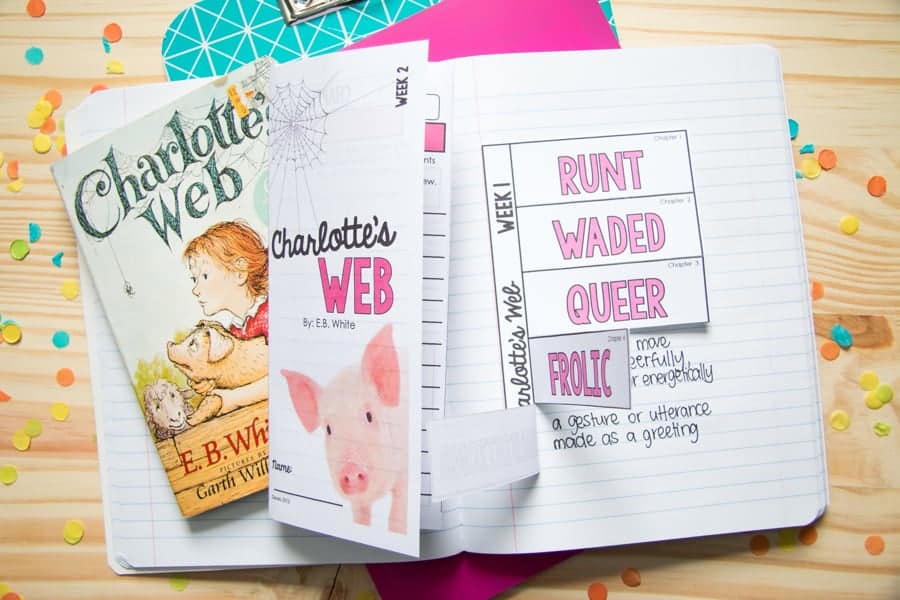
- Weekly vocabulary flip books: one text-based vocabulary word per chapter, chosen because it’s either central to the plot or a strong academic word. Students build understanding through multiple exposures: definition, context from the text, and personal connection.
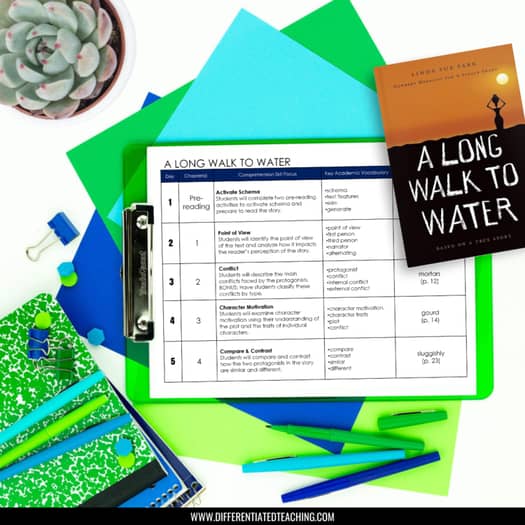
- Instructional pacing guide: daily objectives, reading assignments, Tier 2 academic vocabulary, and word of the day for every lesson. Planning a Frindle unit takes minutes, not hours.
- Reading journal cut-and-paste prompts: an alternative format for students who write more when they have room to spread out, or who benefit from having all their work in one place.
- Google Slides digital version: for classrooms using Chromebooks or Google Classroom. Students can type responses directly into the slides.

Comprehension skills covered
Frindle is a short book, but it supports deep skill work:
- Point of view and narrator analysis
- Defending inferences with text evidence
- Compare and contrast (Nick vs. Mrs. Granger; beginning vs. end)
- Problem and solution
- Main idea & Summarizing
- Genre identification with evidence
- Context clues
- Perspective taking — rewriting from an alternate point of view
- Character change and cause-and-effect analysis

About the book
Grades: 3–5
- Guided Reading Level: N–O
- Lexile Level: 830L
- Accelerated Reader Level: 5.4
Pages/Chapters: 105 pages, 15 chapters
Genre: Realistic fiction / contemporary fiction
Content notes: No significant content concerns. Frindle is a clean, widely used classroom novel. The only tension in the book involves a student pushing back against a teacher’s authority, which is the whole point, and it is handled with warmth and respect for both characters. This is one of the most universally accessible classroom novels for grades 3–5.
Get the Frindle Novel Study
If you’re looking to grab the no prep novel study to make things easy to implement. You can find it at the links below.


Looking for More Novel Studies?
If your students loved Frindle, they’re probably ready for more Andrew Clements; his other school-based novels, like No Talking and The Landry News, hit similar themes of students using their voices in unexpected ways.
Tales of a Fourth Grade Nothing by Judy Blume has a similar voice and age range. For readers ready for something with more emotional depth, The One and Only Ivan is a strong next read.
For a complete guide to structuring your novel units, see: How to Plan a Novel Study