25+ Community Building Activities for Back to School (That Actually Work)
The first week of school is not really about content. I know that might feel counterintuitive when you’re looking at your pacing guide and counting the days until state testing. But here’s what twenty-plus years of classroom experience and instructional coaching has taught me: the time you spend building classroom community in August and September pays back every single month after it.

Students who feel known and connected to their classroom community take more academic risks, handle conflict better, support each other through hard moments, and yes – they learn more. A classroom where kids feel safe to be wrong, to try again, and to ask for help is a classroom where real learning happens.
Why community building in the first week matters (especially for your struggling learners)
If you work with students who have had difficult school experiences – and most of us do – the first week is especially high stakes. For a student who has come to associate school with failure, humiliation, or disconnection, the tone you set in September can shift the entire trajectory of their year.
Predictable routines, low-stakes opportunities to be seen, and activities that surface genuine common ground rather than differences do something powerful for students on the margins: they signal that this classroom is going to be different. That message is worth every minute you invest.
See Differentiation for Struggling Readers and How to Build Relationships with Students from Day One for more on this foundation.
Getting-to-Know-You Activities
These activities help students find common ground with their new classmates, which is the fastest route to the sense of belonging that makes everything else easier.
1. Find Someone Who – Community Edition
You’ve probably done a “Find Someone Who” activity before. This version has one key twist: instead of looking for people who went on vacation or got a new pet this summer, students are finding people who share the same preferences, favorites, and quirks as they do.
Students walk around the room with a bingo-style grid and find classmates who share each attribute – same favorite season, same least-favorite food, same first-choice superpower. When they find a match, they record that person’s name in the box.
The shift from “what did you do” to “what do you like” is intentional. “What did you do this summer” can inadvertently spotlight students whose summers were hard – unstable housing, family stress, loss. “What do you prefer” puts everyone on genuinely equal footing and surfaces the surprising connections kids didn’t know existed.
Works for: Grades 2-8 | Time: 25-30 minutes | Materials: Printed grid (grab the free version below)

2. The Two Truths and a Fib
Students write three statements about themselves – two that are true and one that is a believable but false. Classmates try to identify the fib.
The genius of this activity is that kids instantly discover surprising things about their classmates – and that the kid who seems totally quiet is actually a competitive chess player or has been to fourteen states. Requires almost no prep and generates genuine conversation.
Works for: Grades 3-8 | Time: 20-30 minutes | Materials: Index cards or sticky notes
3. People Bingo
Create a bingo card where each square describes a person, not an activity (“has a middle name that starts with J,” “can say hello in another language,” “has moved to a new home in the last two years”). Students find classmates who match each square and collect signatures.
Great for classrooms with new students, high mobility populations, or classes where students come from different elementary schools and genuinely don’t know each other yet.
Works for: Grades 2-8 | Time: 20-30 minutes | Materials: Printed bingo cards
4. Would You Rather?
Call out a “Would You Rather” choice – cake or pie, extra recess or free reading time, live underwater or in space – and have students physically move to opposite sides of the room based on their answer. When they land, they find the nearest person and explain their choice in 30 seconds.
Simple, gets bodies moving, generates genuine laughter, and surfaces personality. Let students write their own questions on index cards after the first round – you’ll learn a lot from what they come up with.
Works for: Grades 1-8 | Time: 15-20 minutes | Materials: None required
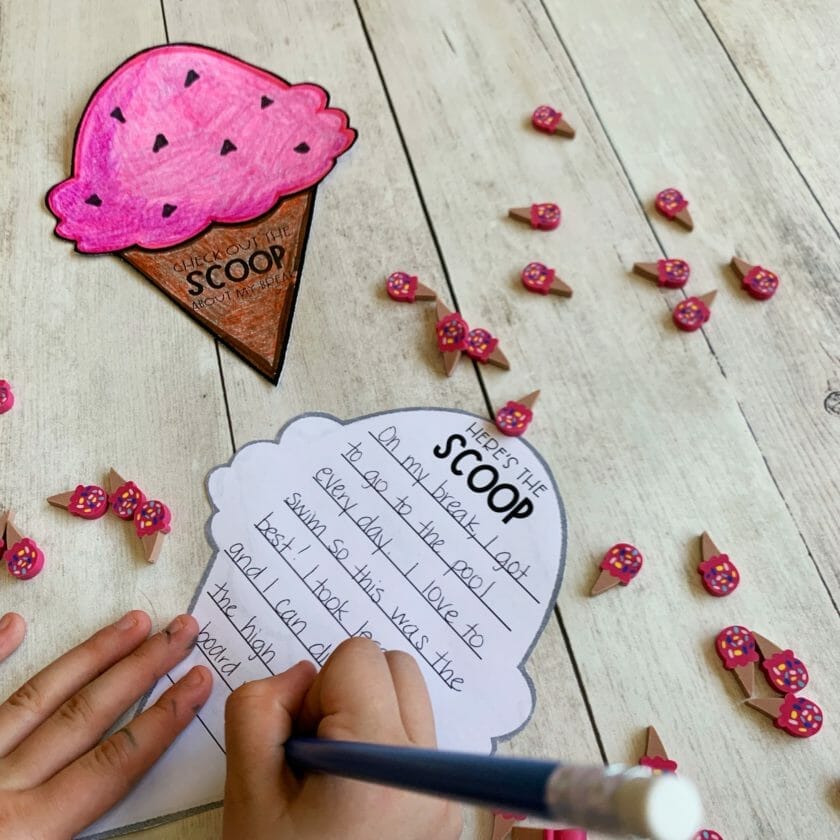
5. Scoop About My Summer (or My Break)
Instead of a standard “what I did this summer” writing prompt, have students create Scoop About My Summer project – real or imagined. Students who had a quiet or difficult summer get to invent scoops, which gives everyone equal footing and often produces the most creative and entertaining sharing.
Display these in the hallway during back-to-school nights so families can see them right away. It signals immediately that your classroom is a place where imagination is welcome.
Works for: Grades 1-6 | Time: 30-45 minutes + share time | Materials: Template or construction paper
6. Class Interest Survey
Before you dive into any community-building activities, spend five minutes having students complete a simple interest survey. What’s your favorite book? What’s something you’re really good at that not many people know? What’s something you’re hoping to learn this year? What’s something that’s hard for you?
You’ll use these answers all year – to pair students strategically, to find mentor texts that connect to student interests, to know who to call on when a topic relates to something they love. For students who struggle to connect, having a teacher who remembers and references what they shared is one of the most powerful relationship builders there is.
Works for: Grades 2-8 | Time: 10-15 minutes | Materials: Survey template
Activities That Establish Shared Values
These activities do the foundational work of helping students define what kind of classroom they want to be part of – which is more powerful than any list of rules you post on the wall.
7. Build Your Classroom Norms Together
Instead of presenting classroom rules as a fait accompli, facilitate a class discussion where students co-create the norms they want to live by. Ask three questions: What does our classroom need to feel safe? What does it need to feel fair? What does it need to feel fun?
Record answers, sort them into categories, and work together to craft 4-5 agreements that the whole class can commit to. Sign them. Post them. Refer back to them whenever the community needs a reset.
The research on this is clear: students who help create agreements are significantly more likely to follow them than students who are handed a list of rules. It’s also one of the most efficient ways to establish that this is a classroom where student voice matters.
8. Character Traits Anchor (Instead of Rules Posters)
Instead of starting with “do not” rules, start with positive character traits. What does it look like to be a responsible member of this community? What does respectful behavior actually look like in our class? What does it mean to be trustworthy?
For younger students, focus on three or four traits: safe, respectful, responsible, kind. For upper elementary and middle, you can expand: fairness, citizenship, perseverance, integrity.
Have students generate examples and non-examples for each trait, then anchor your classroom expectations to those traits all year. When a student struggles, you’re not saying “you broke rule #3” – you’re saying “let’s talk about what respectful looks like in this situation.”
See How to Teach Character Analysis + Free Character Traits List for resources that extend this into your reading instruction.
9. Classroom Compliments (Tootling)
This is the anti-tattling move every teacher needs in their toolkit. Tootling is the practice of reporting positive behaviors rather than negative ones.
Set up a “tootling station” – a box, a bulletin board, a shared doc – where students can anonymously write down something kind or helpful a classmate did. Read tootles aloud during morning meeting or end-of-day circle. Over time, students start actively looking for good things their classmates do because they want to be the one who reports it.
The shift this creates in classroom culture over several weeks is remarkable. Students who are typically invisible in the positive sense start getting noticed. Students who struggle with behavior hear genuinely positive things said about them.
Works for: Grades 1-8 | Ongoing all year
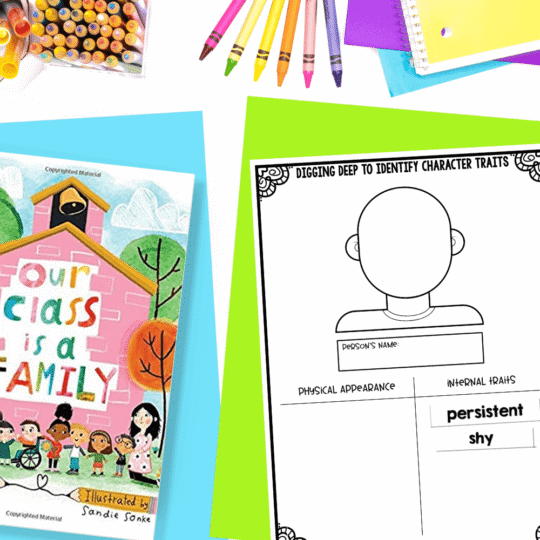
10. Our Class is a Family Read Aloud + Discussion
Read aloud a book that centers on belonging, teamwork, or community, then use it as a springboard for defining your classroom values together. The conversation that emerges is almost always richer than anything you’d generate from a discussion prompt alone.

See Start the Year Strong with Our Class is a Family for a ready-to-use lesson around this specific book, and Classroom Community Books: My 26 Favorites for a full back-to-school read aloud list.
11. Class Motto or Mission Statement
As a closing activity for your first week, have your class work together to write a one-sentence class motto or mission statement. What does your class stand for? What are you here to do together?
Post it prominently. Refer to it often, especially when the community needs a reset mid-year. Students who helped write it will remind each other of it.
Activities That Build Relationships Between Students
These activities go deeper than icebreakers – they create the kind of peer connections that make students feel like their classroom is a place where they belong.
12. Strength Inventory and Partner Share
Have students write down three things they’re genuinely good at – including non-academic strengths. Then pair students who don’t know each other well and give them three minutes each to share their strengths. Partners then introduce each other to the class.
This surfaces the hidden competencies that struggling students often have: the kid who can’t read on grade level but builds engines with his dad. The student who gets pulled for intervention but can cook a full meal. These introductions shift how classmates see each other in ways that last.
13. Venn Diagram Partners
Pair students who don’t know each other and give them a large Venn diagram template. Each side represents one partner; the middle represents things they have in common. Give them five minutes to discover as many overlaps as they can find.
Display the finished diagrams. Debrief: Was it harder or easier to find similarities than you expected? What surprised you?
Works for: Grades 2-8 | Time: 20 minutes
14. Story Spine Collaboration
In small groups, students create a collaborative story using the “Story Spine” structure: “Once upon a time… Every day… Until one day… Because of that… Because of that… Until finally… Ever since then…”
Each student contributes one line, building on what the previous student said. The resulting stories are hilarious, creative, and entirely collaborative – no one person can control where it goes. Great for building flexibility, listening, and the kind of trust that comes from taking creative risks together.
Works for: Grades 2-8 | Time: 20-25 minutes | Materials: Story spine template
15. Community Building Questions – Discussion Circles
Set up structured partner or small-group discussions using open-ended community building questions. Give students a card with 5-6 questions and let them choose which ones to discuss. Questions like:
- What’s something you’re looking forward to this year?
- What’s one thing most people don’t know about you?
- What’s something that was hard last year that you want to handle differently?
- Who is someone you admire and why?
- What’s something you wish teachers understood about being a student?
The last question always generates the most important answers. Listen carefully to those.
For 50+ ready-to-use questions, see Discussion Questions to Build Classroom Community.
16. Marshmallow Tower Challenge
Teams of 3-4 students get 20 pieces of spaghetti, one yard of tape, one yard of string, and one marshmallow. Goal: build the tallest freestanding structure that can support the marshmallow on top. 18 minutes, no prep beyond supplies.
This STEM challenge is a community builder because it forces students to negotiate, problem-solve together, and recover from failure as a team. The debrief is where the real community work happens: What went well? What would you do differently? When did your team struggle and how did you handle it?
Works for: Grades 2-8 | Time: 30-40 minutes with debrief
17. Book Character Connections
Have students choose a book character who reminds them of themselves (or who they wish they were more like) and share why. This works as a written artifact, a partner share, or a brief class presentation.
This is low-stakes because the conversation is technically about a character, not the student, which makes it more accessible for students who are reluctant to share about themselves directly. You’ll also get a snapshot of your readers’ identities and reading histories that’s genuinely useful.
Activities That Connect Your Class to a Bigger Purpose
These activities build community by directing student energy outward – toward the school, the neighborhood, or the world.
18. Find Your Classroom Cause
After you’ve had a few days to get to know your students, use a class meeting to identify a cause or charity your class wants to support this year. Give students time to research options that matter to them – local animal shelter, food bank, community garden, national literacy organization.
Once you’ve chosen together, integrate it throughout the year: letter-writing, fundraising, creating care packages, making videos. This is service learning in its most organic form, and the shared mission creates a “we’re in this together” feeling that strengthens community all year.

19. Class Newsletter Editors
Assign rotating groups of students to produce a short weekly class newsletter – what we learned, what was funny, what’s coming up, what someone did that deserves a shoutout. Share it with families.
Students who struggle academically often shine in this format because newsletters reward voice and personality, not just correctness. And family-facing work creates investment: students want to do good things because they know their classmates might put it in the newsletter.
20. Classroom Jobs With Real Responsibility
Move beyond simple classroom jobs (line leader, paper passer) to roles that have genuine responsibility and require students to rely on each other. Materials manager. Meeting facilitator. Tootling reporter. Community question curator. Conflict resolver.
Give students ownership of these roles and change them regularly so every student gets to lead. The message: this classroom runs because of everyone in it.
Read Aloud-Based Community Builders
A carefully chosen read aloud is one of the fastest community builders you have. When you read aloud together in the first week, you create a shared experience – a common reference point, a shared laugh, a shared emotional moment – that builds the “us” feeling of your classroom almost instantly.
21. The First-Week Read Aloud Ritual
Establish a daily read aloud as a non-negotiable during the first week. Keep it short if your schedule is tight – even 10-15 minutes counts. Choose a book that centers on belonging, courage, or friendship so the themes reinforce what you’re building.
For a full curated list, see Classroom Community Books: My 26 Favorites for Back to School and 25 SEL Read Alouds for Elementary Learners.
For the full case for making read aloud a daily practice all year, see Why You Should Read Aloud in the Classroom Every Single Day.
22. Character Connections Discussion After Read Aloud
After each first-week read aloud, ask one connecting question: “Which character do you feel most like right now? Why?” or “Has anything like this ever happened in a classroom you’ve been in before?”
These low-stakes discussions after a shared story are the safest place for students to share something real about themselves – because they’re technically talking about the book, not about themselves.
Ongoing Community Practices (Keep These Going All Year)
The real work of classroom community isn’t a first-week event. It’s a set of regular practices that keep the community healthy throughout the year.
23. Morning Meeting (or End-of-Day Circle)
A brief structured daily meeting – greeting, share, activity, message – gives students a daily touchpoint with each other and with you. It doesn’t need to be long: 15-20 minutes is plenty. The consistency is what matters.
For students who struggle socially, the predictable structure of morning meeting is enormously regulating. They know what’s coming. They know they’ll have a chance to be heard. That predictability is itself a community builder.
24. Weekly Community Questions
Each Monday, post a new community-building discussion question for students to respond to in writing or discussion. “What’s something you’re hoping to get better at this week?” “What’s a challenge you’re carrying right now that your classmates might not know about?” “What’s something someone in this class did this week that you noticed?”
These questions do double duty as writing warm-ups and community builders. Over time, students start to really know each other in ways that surface in how they treat each other day to day.
See the full bank at 50+ Discussion Questions to Build Classroom Community.
25. Student-of-the-Week or Star of the Class
A simple weekly spotlight where one student gets to share who they are – photos, favorites, a brief presentation, questions from classmates – gives every student their moment to be known. For students who are invisible or struggling, this moment can be genuinely transformative.
The key is making it personal and low-pressure. No performance required – just presence.
26. Rebuilding Community After Breaks
Community doesn’t maintain itself. After winter break, spring break, or any extended disruption, plan a one-to-two day community reset using a subset of these activities.
See Rebuilding Classroom Community After Winter Break for a specific plan.
Your First Week of School: A Sample Community-Building Schedule
Here’s how to sequence these activities across your first five days so you’re intentional rather than reactive:
Day 1 – Welcome and First Impressions
- Interest surveys (activity 6)
- Find Someone Who (activity 1)
- First-week read aloud (activity 21)
Day 2 – Getting Deeper
- Two Truths and a Fib (activity 2)
- Would You Rather? (activity 4)
- Character connections discussion after read aloud (activity 22)
Day 3 – Building Shared Values
- Build classroom norms together (activity 7)
- Character traits anchor activity (activity 8)
- Introduce tootling (activity 9)
Day 4 – Relationship Building
- Venn Diagram Partners (activity 13)
- Marshmallow Challenge (activity 16)
- Community questions discussion circle (activity 15)
Day 5 – Purpose and Looking Ahead
- Introduce classroom jobs (activity 20)
- Introduce classroom cause (activity 18)
- Class motto writing (activity 11)
- Read aloud + reflection on the week
What to do after the first week
Community building doesn’t end on Friday of week one. It’s an ongoing practice. Here are the most important next steps:
- Use your interest surveys to inform your classroom library additions – see How to Get Cheap Books to Build Your Classroom Library
- Start daily read alouds using community-focused books – see Classroom Community Books: My 26 Favorites
- Establish the 5 things you need to know about every student by the end of week two – see 5 Things You Must Know About Your Students After the First Week of School
- Keep discussion questions rotating weekly – see 50+ Discussion Questions to Build Classroom Community
- Connect community to your reading instruction using SEL mentor texts – see 25 SEL Read Alouds for Elementary Learners
For a complete look at building and sustaining classroom community all year, visit the Building Classroom Community hub.
And for your first week lesson planning beyond community, see 10 First Week of School Activities and Lesson Ideas and August Back-to-School Teaching Ideas: A Planning Guide.