First Week of School Activities: 20+ Ideas to Start the Year Strong
The first week of school is its own kind of planning puzzle. You need activities that help students get to know each other, give you information about your learners, feel purposeful rather than filler-y, and work with a schedule that’s usually chaotic at best.
That’s a lot to ask from five days.

I’ve been collecting and refining my first week activity toolkit for years, and this post is my full list – the ones I’d actually use, the ones that hold up with upper elementary students who’ve “already done this,” and the ones that do double duty by sneaking in some academic skills along the way. I’ve expanded it significantly from the original version of this post to give you more options across more categories.
One note before you dive in: this post focuses on what to do – the activity mechanics, the how-to, and the practical tips. If you’re also thinking about why community matters, how to build it all year, and ongoing practices beyond week one, that’s all in Community Building Activities for Back to School.
Why All About Me activities are worth your first week
All About Me activities can feel like filler when you’ve got a pacing guide staring you down. But they serve a real purpose, especially in those first five days.
First, they help students get to know one another in a low-stakes, structured way – which matters a lot for shy or introverted students who need a scaffold to enter conversation. Second, they give you critical information about your learners: their interests, their strengths, what they’re hoping for this year. That information shapes your small groups, your mentor text choices, your seating, and every individual conversation you’ll have for the next ten months.
Third, they give students practice with self-reflection and communication skills that show up throughout the year in writing, discussion, and collaborative work. And honestly? They help the first week feel welcoming instead of overwhelming.
See 5 Things You Must Know About Your Students After the First Week of School for what to prioritize as you gather this information.
Start with a Read Aloud
Before diving into any activity, I always recommend anchoring your first days with a great read aloud. Picture books are not just for primary grades – upper elementary students respond beautifully to a well-chosen picture book when the teacher reads it with genuine enthusiasm. The shared experience of a story is one of the fastest ways to create a sense of “us” in a new classroom.

Here are some of my favorites for the first days of school:
- Most Marshmallows by Rowboat Watkins
- The Day You Begin by Jacqueline Woodson
- Extra Yarn by Mac Barnett
- Mary Wears What She Wants by Keith Negley
- Remarkably You by Pat Zietlow Miller
- All the Ways to Be Smart by Davina Bell
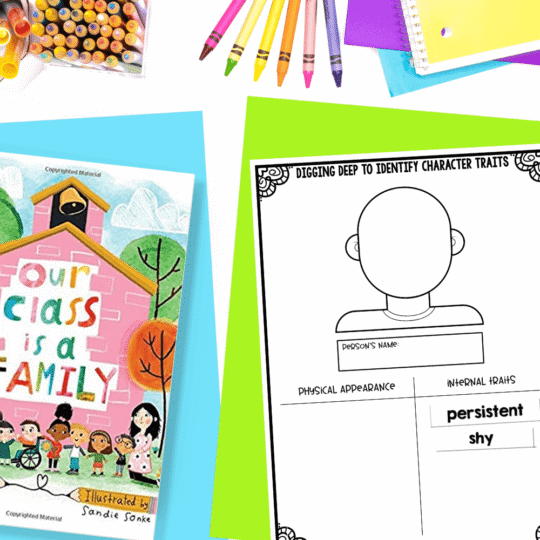
- Our Class Is a Family by Shannon Olsen
- Each Kindness by Jacqueline Woodson
- The Name Jar by Yangsook Choi

For a full curated list with grade-level recommendations, see Classroom Community Books: My 26 Favorites for Back to School and Why You Should Read Aloud in the Classroom Every Day.
First Week of School Activities: The Full List
1. Venn Diagram Partner Activity
It’s never too early to introduce your students to graphic organizers, and the Venn diagram is one you’ll use again and again all year long – so putting it to work in week one gives you a built-in anchor to refer back to later.
Pair students with a classmate they don’t know well and give them a large Venn diagram. Each side belongs to one partner; the middle captures what they share. The goal is to find as many similarities as possible in five to seven minutes.
These make a fantastic back-to-school bulletin board display, and because they introduce compare-and-contrast vocabulary in a genuinely personal context, students retain those terms better than if you’d introduced them cold in a reading lesson.

Tip: When you debrief as a class, ask: Was it harder or easier to find similarities than you expected? What surprised you? Students are almost always surprised by how much they have in common with someone they assumed was very different from them. That’s the whole point.
Works for: Grades 2-8 | Time: 20-25 minutes
2. Poetry: Acrostic Names and “I Am” Poems
Poetry is one of my favorite vehicles for first-week self-expression because it asks students to look inward and find something true and specific – and the format gives struggling writers just enough structure to get started without feeling exposed.
Acrostic Name Poems: Students write their name vertically and use each letter to begin a line that reveals something about themselves. If they’re stuck, prompt them: share something unique most people don’t know, name a favorite thing to do, finish the sentence “I wish I could…”
These are accessible across a wide range of writing levels because the length is naturally limited and the structure is clear. A student who shuts down at “write a paragraph about yourself” can usually complete an acrostic.
“I Am” Poems: Two formats work well depending on your grade level:
- Option 1 – Formulaic (grades 2-4): Each line follows a sentence starter pattern: “I am… I wonder… I hear… I see… I want… I pretend… I feel… I worry… I cry… I understand… I say… I dream… I try… I hope… I am…” Students fill in the blanks with their own words. The predictable structure removes the blank-page anxiety that shuts down reluctant writers.
- Option 2 – Free verse (grades 4-8): Each line begins with “I [verb]…” but the student controls the direction entirely. More room for voice, stronger results with students who are already confident writers.

Both make incredible open house displays. Parents stop at these every single time.
Works for: Grades 1-8 | Time: 30-45 minutes
3. Math About Me
Add a little arithmetic to your All About Me activities and get double duty out of your first week. Math About Me asks students to describe themselves using numbers – and then write equations that equal each number.
How many people are in my family? How many letters are in my full name? How many years have I been at this school? What’s my favorite number, and why?

This goes beyond the basics of listing favorite movies or book characters. Students get hands-on with math to describe themselves, which makes it memorable in a way that a standard review worksheet is not. Combine all the pages into a class book and put it in your classroom library – it will get read and reread all year.
Tip: Differentiate by adjusting the operations you require. Younger or below-level students write simple addition sentences. Above-level students write multi-step equations or include multiplication and division.
Works for: Grades 2-6 | Time: 30-40 minutes
4. Student Commercial
If you’ve got a tech-savvy group – or if you’re teaching in a hybrid or virtual setting – having students write and film a 30-second commercial about themselves is one of the most engaging first-week activities I’ve found for upper elementary.
The goal: make a short video telling their classmates what makes them a great friend to have. Why should someone want to sit next to them? What do they bring to a group? What makes them uniquely them?
This introduces media literacy and the art of persuasion in a low-stakes personal context. It’s also an excellent opportunity for students who are reluctant writers but who come alive in front of a camera – and those students exist in every classroom. A “showing” of all the commercials at the end of the week is a genuinely fun event.
Works for: Grades 3-8 | Time: Two to three class periods with filming and viewing
5. Find a Friend (Community Version)
We’ve all done a “Find Someone Who” activity – and for good reason. It gets students up and moving, talking to people they don’t know yet, and discovering connections they didn’t expect.
This version has one intentional twist: instead of looking for people who went on vacation or did something specific over summer, the prompts focus entirely on shared preferences, personality traits, and interests. Find someone who prefers mountains to the beach. Find someone who would rather read than watch TV. Find someone who thinks mornings are better than nights.
The reason for the shift matters: “what did you do this summer” can inadvertently highlight differences in privilege or put students who had a difficult summer in an uncomfortable spot. “What do you prefer” puts everyone on genuinely equal footing, regardless of what their summer looked like.

Students walk around with a bingo-style grid and collect names as they find matches. Get the free version by entering your info:
Works for: Grades 1-8 | Time: 20-30 minutes
6. Four Corners
Four Corners is a “Simon Says”-style movement game where students move to different parts of the room based on their answers – and it’s one of the easiest ways to get everyone moving on those early days when kids are still a little stiff and nervous.
Label your corners with colors or letters ahead of time. Put the answer choices on the projector. Call out a question and have students move to the corner that best represents their answer. Favorite subject. Number of siblings. Preferred season. Morning person or night owl.

Beyond the fun factor, Four Corners is genuinely useful for you as a teacher. Watching where students cluster helps you quickly identify shared interests and potential groupings. The student who always ends up alone in a corner is information you need. The unexpected pairing of two students with the same favorite subject might be exactly the small group connection you didn’t know to make.
Tip: Pre-label corners before class. It makes transitions faster and the game runs much more smoothly.
Works for: Grades 1-8 | Time: 15-20 minutes | No materials beyond projector
7. All About Me Book
A multi-page All About Me booklet gives students a structured way to document who they are – favorites, family, goals, strengths, things they’re proud of, things they’re working on.
You can go two directions with this:
- Open format: Use blank booklets (the Target Dollar Spot 8×8 booklets work great) and let students write and illustrate freely. Great for creative students and classrooms with strong independent writers.
- Structured template: Use a pre-made template with guided pages. Stronger for students who need scaffolding, and it ensures you get consistent information across the class.

Either way, these work beautifully as morning work spread across the first few days, as an open house display, and as a reference you return to throughout the year when you want to remind yourself what a particular student cares about.
Read more: All About Me Books: A Back-to-School Activity
Works for: Grades K-6 | Time: 30-45 minutes spread across 2-3 days
8. Letter to Future Self
This is one of the most meaningful first-week activities I’ve used, and it consistently produces better writing than almost anything else I assign in September – because the audience is real and personal.
Students write a letter to themselves that you’ll seal and save, then return at the end of the year or mail to them the following fall. Prompts to include: What are you nervous about this year? What are you hoping to get better at? What do you want your future self to remember about right now? What do you think will be hard? What do you think will be great?
This works especially well at transition years – end of elementary, beginning of middle school – where students are carrying a lot of anticipation and anxiety. The writing they produce is often surprisingly honest. And the ritual of sealing and saving it creates a sense of significance that students feel.
Works for: Grades 3-8 | Time: 30-40 minutes | Store sealed letters somewhere safe all year
9. Getting to Know You Fortune Tellers
At some point, most students have made a paper fortune teller, so lean into the novelty and make it a getting-to-know-you activity instead of just a craft.
Have students create their own fortune teller using a template. Pre-write some community-building questions on the template before copying, or let students add their own – just remind them to keep questions school-appropriate and preview them if needed. Good prompts: What’s your hidden talent? What would your superpower be? What’s something you’re proud of? What’s a goal you have for this year?

When students use the fortune teller with a partner, the partner must answer the question under the flap they selected. Add music to make it feel like a game – whoever they’re standing near when the music stops is their partner for that round.
For question ideas, see Discussion Questions to Build Classroom Community.
Works for: Grades 2-6 | Time: 30-40 minutes including creation and partner time
10. All About My-Selfies
This one is a favorite with upper elementary and middle school students, especially any class that has even a passing interest in social media. It taps into a format they already understand and turns it into something genuinely personal.

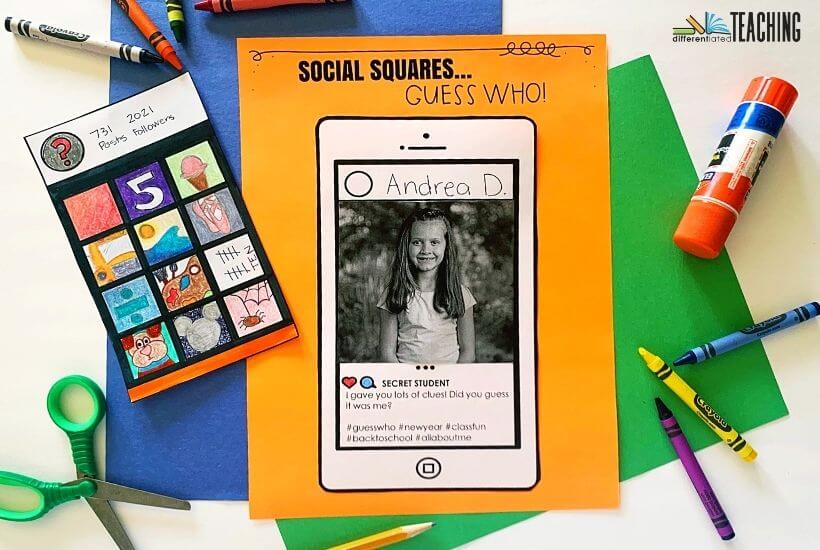
Option 1 – What makes you unique: Students draw a selfie showing something about them that makes them unique, then write a caption and hashtags to match. Do these on phone templates and display them – they spark conversations between students that continue all week. Also a great open house display (parents love them).
Option 2 – Secret Selfie guessing game: This version works best if students have been together for a year or two and think they already know each other. Students fill a grid of squares with images representing their likes and dislikes – “draw something that represents your favorite color,” “draw what you do after school,” “draw your dream vacation.” Then display them numbered without names and let the class guess who made each one. It’s genuinely entertaining, and watching parents try to guess their own child’s during open house is a delight.
Works for: Grades 3-8 | Time: 40-50 minutes
New Additions: More First Week Activities to Try
11. Interest and Strengths Survey
Before you launch into any activity, spend ten minutes having students complete a brief written survey – not the standard “favorite color, favorite food” version, but one that actually tells you something useful:
- What’s something you’re really good at that most people don’t know about?
- What kind of work feels hardest for you?
- What’s something you’re hoping will be different about school this year?
- What’s the best way to help you when you’re stuck or frustrated?
- What do you want your teacher to know about you?
The answers to these questions shape everything that comes after: how you seat students, who you pair together, which texts you choose, how you respond the first time someone shuts down. Keep these and refer back to them. Students notice when a teacher remembers what they shared.
Works for: Grades 2-8 | Time: 10-15 minutes
12. Two Truths and a Fib
Students write three statements about themselves – two true, one believable but false. Share in small groups or whole class; classmates vote on which is the fib.
The magic here is what it reveals. This activity consistently surfaces surprising facts – the quiet kid who has lived in four countries, the class clown who plays competitive chess – and those revelations shift how students see each other. Once you know something unexpected about a classmate, you see them differently. That’s exactly what you want in week one.
Works for: Grades 3-8 | Time: 20-30 minutes | Materials: Index cards or sticky notes
13. Scoop About My Summer (or Break)
Students create an ice cream scoop for each highlight of their break – real or imagined. The imagined option is not a throwaway: it’s an intentional equity move that gives students who had a difficult, quiet, or unstable summer a face-saving way to participate on equal footing. And the made-up stories are often just as entertaining as the real ones.
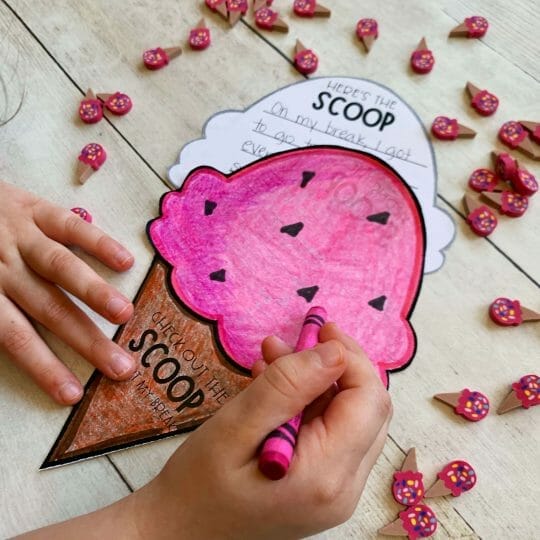
Display these and use them as conversation starters throughout the week. Strong open house display too.
Works for: Grades 1-6 | Time: 30-40 minutes
Resource: All About Me Back-to-School Activity and All About Me Pennant Banner Bulletin Board Craft
14. People Bingo
A bingo card where each square describes a person rather than a thing: “has a middle name with more than five letters,” “can say hello in more than one language,” “has moved to a new home in the last two years,” “has a pet that isn’t a dog or cat.” Students find classmates who match and collect signatures.
Works especially well in classrooms where students are coming from multiple feeder schools and genuinely don’t know each other – it gives them a structured, low-pressure reason to approach someone new.
Works for: Grades 2-8 | Time: 20-30 minutes | Materials: Printed bingo cards
15. Classroom Library Browse
Give students unstructured time to browse the classroom library with no expectation other than “find something that interests you.” Not independent reading time – exploring time. Students pick things up, read back covers, flip through pages, ask each other questions.
You’ll learn an enormous amount about your readers just by watching who goes where. And a student who finds a book they’re genuinely excited about in week one is a more motivated reader in week twelve.
Works for: Grades 1-8 | Time: 20-30 minutes
For resources on stocking a library worth browsing, see How to Get Cheap Books to Build Your Classroom Library.
16. Classroom Procedures Scavenger Hunt
Instead of walking students through procedures while they zone out, let them discover the systems. Create a scavenger hunt: find where supplies are kept, read the sign on the reading corner, locate the bathroom pass, figure out where finished work goes.
Students discover the routines rather than being lectured on them – and discovery sticks better than explanation. Pair students intentionally: a student who seems confident with one who seems anxious.
Works for: Grades 1-6 | Time: 20-30 minutes
17. Letter to the Teacher
A simpler version of the future-self letter for younger grades or as a complement to it: students write a letter directly to you. What should I know about you? What do you want school to be like this year? What are you nervous about? What are you good at that I might not see right away?
These give you candid information you wouldn’t get any other way, and responding to each one – even briefly – sends a powerful message that you actually read what they wrote.
Works for: Grades 2-8 | Time: 20-30 minutes

A Sample First Week Schedule
Here’s one way to sequence these across five days. Adjust based on your grade level and school’s specific first-week structure.
| Morning Focus | Midday Activity | Afternoon | |
|---|---|---|---|
| Monday | Interest survey + room tour | Read aloud + discussion | Find a Friend or Four Corners |
| Tuesday | Venn Diagram partners | All About Me Book (begin) | Two Truths and a Fib |
| Wednesday | Poetry (acrostic or I Am) | Math About Me | Fortune Tellers |
| Thursday | All About My-Selfies | Letter to Future Self | Classroom library browse |
| Friday | All About Me Book sharing | Student commercials viewing | Letter to the Teacher + week reflection |
What to do after the first week
The first week builds the foundation. Here’s what keeps it going:
- Use your interest surveys actively all year – see 5 Things You Must Know About Your Students After the First Week of School
- Keep community-building intentional throughout the year – see Community Building Activities for Back to School
- Establish a daily read aloud ritual – see Classroom Community Books: My 26 Favorites
- Use discussion questions to keep students connected to each other – see 50+ Discussion Questions to Build Classroom Community
- Plan your August intentionally – see August Back-to-School Teaching Ideas: A Planning Guide
- Build strong home connections early – see 9 Ways to Build Strong Home-School Relationships
For the full picture on building classroom community all year, visit the Building Classroom Community hub.