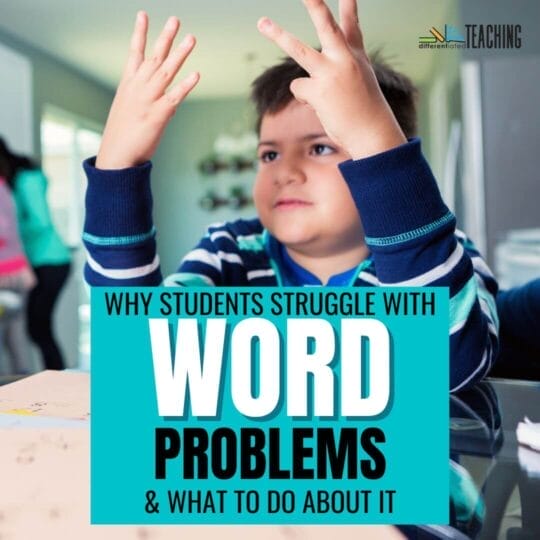
Why Middle Schoolers Struggle With Word Problems (And What Helps)
Daily word problem practice can make a huge difference for middle schoolers, especially when it comes to confidence and stamina. But if you’ve ever watched your students freeze the moment they see a word problem, you know practice alone isn’t always enough.
Ever given your students a word problem…only to watch them stare blankly at the page like it’s written in code?
You’re not alone.

Something happens in middle school. Word problems suddenly shift from simple arithmetic stories to multi-step monsters packed with unfamiliar vocabulary, layered reasoning, and real-world twists. And for a lot of students, that jump is overwhelming.
So why is solving word problems so hard for middle schoolers?
Let’s dig into the core challenges…and, more importantly, what you can do to help.
1. Abstract Thinking Shows Up Before Some Students Are Ready
In elementary grades, many word problems rely on concrete reasoning: You have 5 apples, you give away 2, how many are left?
By middle school, those problems start looking more like:
Jamie is 3 years older than twice the age of his cousin. In 5 years, the sum of their ages will be 41. How old are they now?
These problems aren’t just “harder.” They require abstract thinking, flexible reasoning, and comfort working with unknowns—all skills that are still developing for many tweens and early teens.

The Fix: Start with models and visuals before you jump to equations.
Use bar models, diagrams, manipulatives, or even numberless versions of the same problem so students can focus on the story and relationships first, then translate that thinking into algebra.
2. Executive Functioning Gaps Derail Problem-Solving
Even students who “get the math” sometimes can’t get through the problem.
That’s because word problems are also a test of executive functioning. They quietly ask students to:
- Organize the information
- Decide what matters and what doesn’t
- Plan and follow a sequence of steps
- Stay focused through multiple parts

Students who struggle with attention, working memory, or sequencing (including many kids with ADHD and other learning differences) often shut down before they ever reach the computation.
What helps:
Teach word problem routines explicitly instead of assuming students “pick them up.”
Strategies like CUBES, UPSC, or your own class framework give students a starting point and a repeatable path.
If you’re already using CUBES in your classroom, model it over and over on real problems…not just on a poster. Think aloud as you circle, underline, and box, so students see what that actually looks like with messy, multi-step tasks.
3. Math Anxiety Is Real…And Word Problems Are Prime Triggers
By the time students reach middle school, many have built up some serious math baggage.
If they’ve struggled in the past or decided they’re “just not a math person,” word problems can feel like proof. They look long, feel confusing, and don’t offer an obvious way in. That’s a perfect storm for avoidance and shutdown.
What helps:
Normalize struggle and lower the stakes. A short, daily Word Problem of the Day routine can help reframe problem-solving as a skill to practice…not a test of whether you’re smart.
Celebrate how students approach the problem, not just whether they land on the right answer.
Model your own thinking out loud, including when you misread or have to start over. If you need ideas for supporting anxious mathematicians, you can find more here: Supporting students with math anxiety

4. Weak fact fluency eats up their brainpower.
We talk a lot about math fact fluency in the younger grades, but its impact shows up in a major way in middle school word problems.
If a student has to work hard just to compute 7×8, they’re using precious mental energy on the arithmetic, leaving less available for planning, monitoring, and checking their work. Cognitive load theory tells us that when basic processes aren’t automatic, higher-level thinking takes a hit.
What helps:
Build fact and computation practice into your routine in short, engaging ways instead of relying on long, stressful drills.
Online games, partner activities, or quick warm-ups can all reinforce fluency without tanking motivation. The goal isn’t speed for its own sake—it’s freeing up brain space so students can focus on the actual problem-solving.
5. Students Can’t Visualize the Story Behind the Numbers
Another big hurdle: many students can’t “see” what’s happening in the problem.
If they can’t map out the situation, it’s almost impossible to decide which operations make sense. They end up grabbing numbers and doing something… anything… just to get an answer.

What helps:
Give students active ways to build a mental movie of the problem:
- Have them sketch a quick diagram with labels.
- Ask them to restate the story in their own words.
- Use numberless word problems where they analyze the situation first, then add numbers later.
Numberless problems, in particular, force students to slow down and notice relationships instead of racing to compute. Over time, this builds the habit of understanding first, solving second.
6. Their Experience With Word Problems Is Too Narrow
In some curricula, word problems only show up at the end of the lesson and follow the exact pattern students just practiced.
That predictability can feel comforting at first, but it also trains students to rely on guess-the-procedure instead of real comprehension. They stop reading carefully and start hunting for numbers and keywords.
Plus, real-world word problems often pull in skills from multiple units – fractions and ratios, or percentages and equations. If students have gaps from earlier instruction, these multi-skill problems can feel impossible.
What helps:
Mix in a variety of problem types across time and allow for productive struggle:
- Rotate problem formats and structures.
- Use problems that require different combinations of skills.
- Give students chances to wrestle with a problem before stepping in.
You can support this with gradual release: model a few, try some together, and then give students a simple checklist or mini guide to use when they work independently. That support helps them remember the critical steps without taking away all the thinking.

Building Your Middle Schoolers’ Problem-Solving Toolbox
Word problems can be tough for learners, but they don’t have to stay intimidating forever. With the right routines, scaffolds, and variety, students can learn to approach them with more confidence and a clear plan.
That’s exactly why I created my Middle School Math Word Problem of the Day series: to give you a ready-made way to offer daily, meaningful practice without writing new problems every night.

Each problem is themed with a fun fact to hook your students’ interest, and the built-in scaffolding makes it easier for learners to show their thinking, build confidence, and develop real-world problem-solving skills.
Want a sneak peek?
Grab a free week of problems here:
👉 Free 6th Grade Multistep Problem of the Day
👉 Free 7th Grade Multistep Problem of the Day
👉 Free 8th Grade Multistep Problem of the Day
From here, you might also explore how a short, consistent Problem of the Day routine can fit into your middle school math block…even if your time is limited.
It’s one of the easiest ways to give students daily, supported practice with exactly this kind of thinking.
Looking for more ways to support learners from upper elementary through middle school? Check out the math hub for teaching strategies, lesson ideas, and activities.
📐 Looking for more math differentiation support? Visit our complete guide: Math Differentiation: Accommodations, Word Problems, Fluency, and Intervention.