7th Grade Math Bell Ringers: How Daily Spiral Review Closes the Gap Before 8th Grade
Seventh grade math is a pivotal year, and not in a comfortable way. Students who arrive without solid number sense, fraction fluency, or proportional reasoning are already behind before the first unit test. And the gap between where they are and where they need to be by the end of 8th grade doesn’t close on its own.
That’s the pressure 7th grade math teachers work under every day. You’re not just teaching this year’s standards. You’re building the foundation students need to access algebra, geometry, and beyond.
Why 7th Grade Is the Year Spiral Review Matters Most
Most math teachers know that 7th grade is where students either consolidate their middle school math foundation or fall further behind. The jump from 6th to 7th grade math is significant: students go from working with basic ratios and one-step equations to navigating proportional relationships, rational number operations, and multi-step algebraic reasoning — often all in the same week.
The problem is that teachers don’t have time to reteach the entire 6th grade curriculum before moving forward. And students don’t retain skills they’ve only practiced once during a single unit.
Spiral review solves both problems at once. When students encounter the same types of problems — in short, low-stakes doses — week after week, skills that would otherwise fade actually stick. By the time state assessment season arrives, students aren’t panicking because they’ve been practicing all year.
What 7th Grade Math Spiral Review Should Cover
A strong 7th grade spiral review touches every major standard, not just the ones from the current unit. Here’s the full scope of what students need consistent practice with across the year:
- Ratios, rates, and proportional reasoning — unit rates, equivalent ratios, proportional relationships
- Percentages — percent of a number, percent increase and decrease, discounts, tips, tax
- Integers and rational numbers — operations with positive and negative numbers, absolute value
- Fractions and decimals — all four operations, including dividing fractions and mixed numbers
- Algebraic expressions and equations — writing, evaluating, and solving one- and two-step equations
- Inequalities — writing and graphing solutions on a number line
- Geometry — area, surface area, volume, and circumference
- Financial literacy — calculating tips, discounts, simple interest, and real-world money problems
- Probability and statistics — theoretical and experimental probability, data analysis
- Word problems and real-world applications — the skill that ties everything else together
The key is that none of these appear once and disappear. A well-designed spiral review returns to each skill multiple times throughout the year so that students genuinely internalize it — not just recognize it on a familiar worksheet.s and strategies needed to master grade-level content.
How to Structure a 7th Grade Bell Ringer Routine
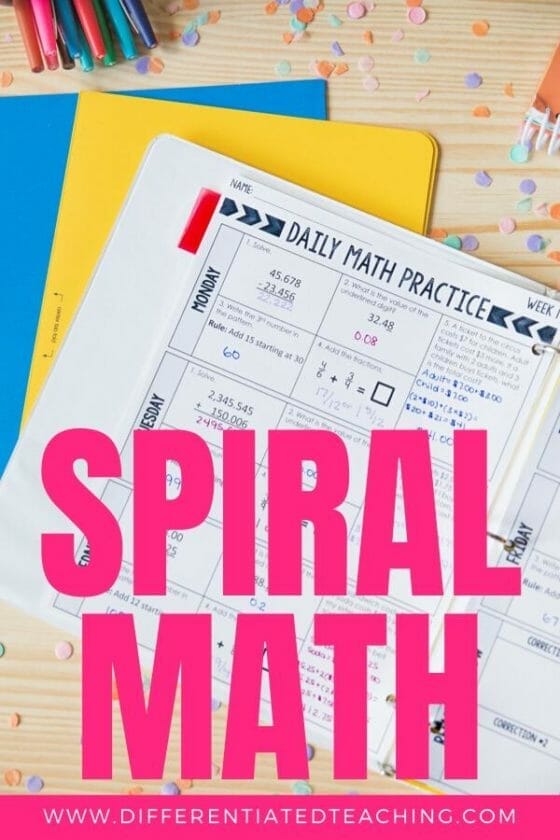
The mechanics of a successful spiral review routine are simple. The consistency is what makes it work.
Before students sit down: the warm-up is already visible — on the board, on their desks, or pulled up on Google Slides. No instructions needed. Students know the routine.
First 5–7 minutes: independent silent work. You’re taking attendance, handling logistics, scanning the room. Students are working.
Next 3–5 minutes: whole-class debrief. You don’t need to go through every problem. Ask which one was hardest. Address one misconception. Move on.
Total time: under 15 minutes. If it’s taking longer, the warm-up is too long.
The predictability of this routine matters for 7th graders especially. Students who feel anxious about math often regulate better when they know exactly what to expect at the start of class. The routine removes the cognitive load of “what are we doing today” and lets them get straight to work.
What to Look for in a 7th Grade Spiral Review Resource
The resource itself matters as much as the routine. Here’s what separates a useful spiral review from a forgettable packet:
True spiraling. Skills should return throughout the year, not disappear after their unit ends. If your resource covers integers in September and never brings them back, it’s not spiral review — it’s a review worksheet with a nicer name.
Five problems per day. Not ten. Not fifteen. Five well-chosen problems that students can complete in 5–7 minutes. More than that and you’re eating into instruction time.
Full-year scope. Thirty-six weeks of material means you never have to hunt for something on Monday morning. The whole year is planned.

Both print and digital options. Some years you’re projecting slides. Some years you’re printing packets. A resource that works both ways means you’re not locked into one format.
Actual teacher support. Answer keys, vocabulary lists, and pre-written student objectives mean setup is minimal. You shouldn’t have to build infrastructure around your bell ringer.

The 7th Grade Spiral Review I Use
After years of patching together my own bell ringers — and spending more Sunday nights on it than I care to admit — I use 7th Grade Math Spiral Review in my classroom.
Here’s what makes it work:
36 weeks, 180 instructional days. The entire school year is covered. Every major 7th grade math standard appears, revisited across the year so students encounter key skills multiple times.
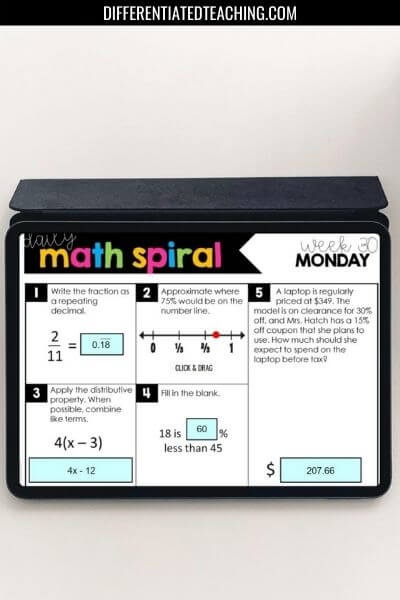
Five problems per day across the full range of 7th grade standards. Students practice ratios and proportions, integer operations, algebraic equations, geometry, financial literacy, probability, and statistics — not in isolated units, but interwoven throughout the year the way actual mathematical thinking works.
Weekly reflection built in. Every Friday, students identify which problems were hardest and reflect on why. It’s a small addition with real payoff: students start thinking about their own learning, which directly supports growth over time.
Available as both daily Google Slides and print-and-go pages. I’ve used both depending on the year. The Google Slides version is ideal for projecting one day at a time. The print version is a single clean page per week — genuinely low paper waste.
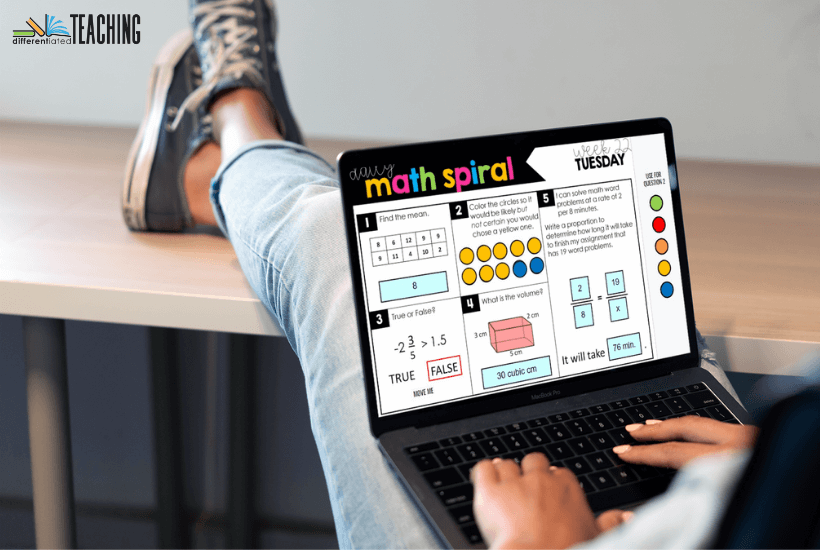
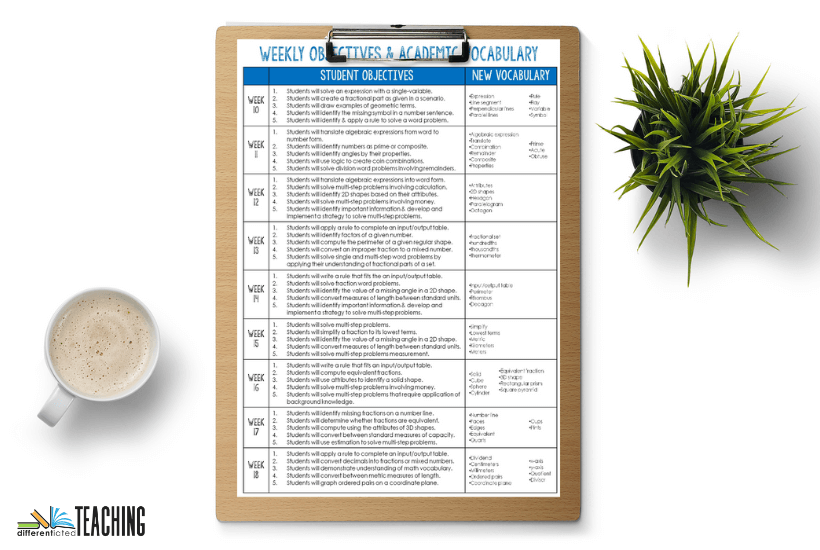
Includes scope and sequence, vocabulary, objectives, and answer keys. The planning infrastructure is already done. You know what’s coming each week, what vocabulary students need, and what the learning target is — without digging through standards documents yourself.oblems on Monday, he should be more independent on the skills by Friday.
The Skills Students Practice (Across the Year)
In the early weeks, students revisit and build number sense: decimal and fraction computation, prime and composite numbers, number patterns, and basic ratio work. As the year progresses, the resource moves through:

- Proportional reasoning and percent applications — discounts, tips, tax, percent change
- Integer operations and absolute value — a persistent challenge for 7th graders
- Writing and solving one- and two-step equations and inequalities
- Geometry — area, surface area, circumference, and volume
- Financial literacy — calculating simple interest, budgeting scenarios, real-world money problems
- Probability and statistics — theoretical probability, data analysis, interpreting results
By spring, students are regularly practicing the full breadth of 7th grade math. Not because you’ve gone back to reteach everything, but because the spiral has been doing the work all year.
What Happens by the End of the Year
Teachers who use this resource consistently across the year see the same pattern: students who struggled with number sense in September are more confident by January, not because they had a breakthrough moment, but because they’ve been practicing the same types of problems in low-stakes contexts week after week.
The other thing that shifts is test prep. When students have been revisiting every major standard since August, the weeks before state assessments aren’t a scramble to reteach forgotten material. They’re a review of things students already know — which is a completely different experience for both teacher and student.

The Most Important Thing: Start on Day One and Don’t Stop
The routine only works if it’s consistent. Teachers who skip it when time gets tight, swap it out when a unit feels urgent, or let it drift by November don’t see the same results as teachers who hold it every single day.
Five minutes a day across 180 school days is 15 hours of math practice — just from your bell ringer. That time either compounds into real skill retention or it doesn’t, depending entirely on whether you protect the routine.
Start on the first day of school. Hold it through the last. The skills that feel shaky in September will be reliable by May — and your students will walk into 8th grade math ready for what’s waiting for them.
Looking for spiral review resources for other grade levels? I have versions for 3rd Grade, 4th Grade, 5th Grade, 6th Grade, and 8th Grade as well.
If your students are heading into 8th grade, here’s what a week of 8th grade math spiral review actually looks like — same daily routine, built for the concepts they’ll be working through next.