Report Card Comments for Reading and ELA
Reading and ELA comments are tricky because the skill set is so broad. Decoding, fluency, comprehension, vocabulary, writing mechanics, composition — a student can be strong in some areas and significantly behind in others, and a vague comment like “reading is an area of growth” doesn’t tell families anything useful.

The comments below are organized by the specific skill so you can pick the ones that actually match what you’re seeing. Each section includes both strength and growth comments so you can build the positive-honest-actionable structure that makes report card feedback useful.
For comments focused specifically on students working significantly below grade level, the struggling students guide has 200+ ready-to-use comments organized by academic area, behavior, and work habits. For the full comment-writing framework, visit the complete report card comments guide.
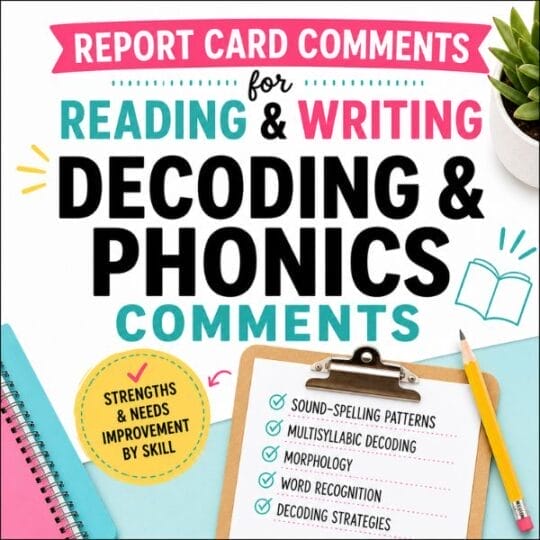
Decoding and phonics comments
Decoding comments are among the most important to get right because families sometimes don’t understand that a decoding gap is a skills issue, not a maturity issue or a lack of effort. Be clear about what the gap means and what evidence-based support looks like.
Strengths
- _____ accurately decodes unfamiliar words by applying known sound-spelling patterns, rather than guessing. This is a strong foundation for continued reading growth.
- _____ is beginning to read many words automatically (without needing to sound them out), which allows them to focus more on understanding what they read.
- _____ uses knowledge of prefixes, suffixes, and base words to help read and understand longer words. This is an important step in becoming a more advanced reader.
- _____ demonstrates strong word recognition skills, quickly and accurately reading grade-level words with little effort.
- _____ breaks apart longer words into meaningful parts (such as root words and endings), which supports both decoding and comprehension.
- _____ uses knowledge of word parts (prefixes, suffixes, and roots) to determine the meaning of unfamiliar words.
- _____ recognizes common prefixes and suffixes and uses them to support both reading and comprehension.
- _____ is able to break apart multisyllabic words and use word structure to support accurate reading.
- _____ reads most grade-level words automatically, without needing to stop and sound them out.
- _____ accurately decodes unfamiliar words using known sound-spelling patterns, even when the words are longer or more complex.
- _____ smoothly reads multisyllabic words by breaking them into manageable parts.
- _____ uses knowledge of prefixes, suffixes, and base words to read and understand longer academic vocabulary.
- _____ recognizes common spelling patterns (such as vowel teams and syllable types) and applies them consistently while reading.
- _____ reads with strong accuracy, making very few errors even in unfamiliar texts.
- _____ self-corrects when a word doesn’t look or sound right, showing strong awareness of how words work.
- _____ transfers decoding skills effectively from isolated practice into connected reading.
- _____ recognizes irregular high-frequency words automatically, which supports overall reading fluency.
- _____ demonstrates flexibility when reading, adjusting strategies when a word doesn’t make sense.
- _____ uses word structure to support both pronunciation and meaning when encountering unfamiliar vocabulary.
Needs improvement
- _____ is still developing automatic word recognition, which means a lot of their energy goes into figuring out words rather than understanding the text. Building this automaticity will be an important focus.
- _____ relies on guessing based on the first letter or picture cues rather than fully decoding the word. We are working on strategies to support accurate word reading.
- _____ has gaps in their understanding of common spelling patterns, which makes reading unfamiliar words more difficult. Targeted practice with these patterns will support growth.
- _____ has difficulty breaking longer words into smaller, meaningful parts (such as prefixes, suffixes, and root words). Developing this skill will help with both reading and vocabulary.
- _____ is still working to connect sounds to letters efficiently, which can slow down reading and impact overall comprehension.
- _____ may read words correctly in isolation but has difficulty recognizing them automatically in connected text. Repeated exposure and practice will help build fluency and ease.
- _____ has difficulty recognizing and using common prefixes and suffixes to support reading unfamiliar words.
- _____ needs support breaking down longer, multisyllabic words into manageable parts.
- _____ is still developing an understanding of how word parts (such as prefixes and suffixes) affect meaning.
- _____ is continuing to work toward reading words more efficiently so that comprehension becomes easier and more natural.
- ____ is still developing automatic word recognition and often needs to stop and sound out words that should be familiar.
- _____ reads accurately in isolation but struggles to apply those same skills consistently in connected text.
- _____ has difficulty decoding multisyllabic words and may skip, guess, or misread parts of longer words.
- _____ relies on partial information (such as the first letter) rather than fully processing the entire word.
- _____ has gaps in recognizing common spelling patterns, which affects their ability to read unfamiliar words.
- _____ reads some words accurately but not automatically, which slows down overall reading and impacts comprehension.
- _____ has difficulty blending sounds smoothly, which can make reading feel slow and effortful.
- _____ does not consistently notice when a word does not look right or sound right in context.
- _____ has difficulty transferring phonics skills into independent reading tasks.
- _____ may avoid attempting unfamiliar words and instead skip or substitute them.
- _____ is still developing consistency in applying decoding strategies independently.
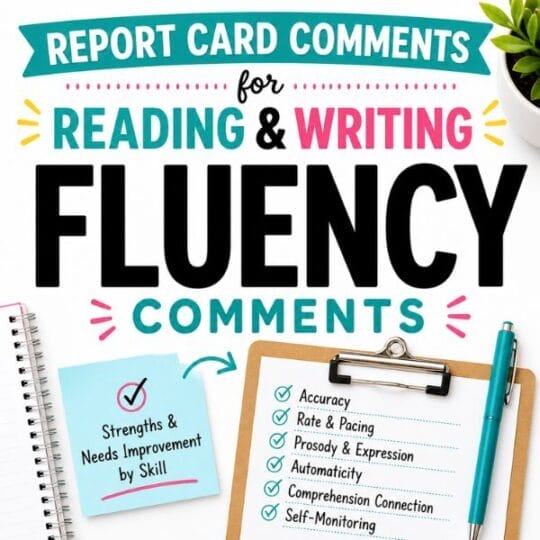
Reading fluency comments
Fluency is often the visible symptom of a deeper decoding gap — and it has a direct impact on comprehension because students who are working hard to decode words have less mental energy left for understanding what they read. Name this connection clearly when it’s relevant.
Strengths
- _____ reads smoothly and accurately, with very few errors, which supports strong overall comprehension.
- _____ reads with appropriate pacing, adjusting speed based on the difficulty of the text.
- _____ uses expression and phrasing effectively, which shows strong understanding of the text.
- _____ reads in natural phrases rather than word-by-word, which supports meaning-making.
- _____ demonstrates strong accuracy even when reading unfamiliar or more complex texts.
- _____ reads grade-level text with ease, allowing them to focus on deeper comprehension.
- _____ uses punctuation cues (pauses, stopping, intonation) effectively when reading aloud.
- _____ maintains fluency across longer passages, showing strong reading stamina.
- _____ rereads and self-corrects when something doesn’t sound right, which supports both fluency and comprehension.
- _____ has developed automatic word recognition, which allows reading to sound natural and effortless.
- _____ reads with a high level of accuracy, making very few decoding errors.
- _____ reads with expression that reflects understanding of the text.
- _____ uses phrasing and intonation effectively to support meaning.
- _____’s fluency allows them to focus on understanding the text rather than figuring out individual words.
- _____ reads with enough ease that they can think about deeper meaning while reading.
- _____ applies fluent reading skills consistently across different types of texts.
- _____ demonstrates independence when reading, maintaining fluency without support.
- _____ notices when something doesn’t sound right and self-corrects independently.
- _____ monitors for meaning while reading and adjusts as needed.
Needs improvement
- _____ reads slowly and with effort, which makes it difficult to focus on understanding the text.
- _____ reads in a word-by-word manner rather than in phrases, which impacts overall comprehension.
- _____ has difficulty maintaining accuracy while reading, which interrupts fluency and meaning.
- _____ reads at an inconsistent pace, sometimes rushing and other times slowing significantly when encountering unfamiliar words.
- _____ focuses heavily on decoding, which limits their ability to read smoothly and understand the text.
- _____ has difficulty reading with appropriate expression, which can indicate challenges with comprehension.
- _____ does not consistently pause at punctuation, which affects both fluency and meaning.
- _____ may skip or substitute words, which impacts both accuracy and overall understanding.
- _____ benefits from repeated reading to build both accuracy and automaticity.
- _____ is still developing reading stamina and may struggle to maintain fluency across longer texts.
- _____ makes frequent reading errors, which interrupt fluency and make comprehension more difficult.
- _____ reads at a slow pace, which makes it harder to retain meaning across sentences and paragraphs.
- _____ reads too quickly at times, which leads to errors and reduced comprehension.
- _____ reads in a flat or monotone voice, which may indicate limited understanding of the text.
- _____ has difficulty grouping words into meaningful phrases while reading.
- Because _____ is still working to read words accurately and efficiently, much of their effort goes into decoding, which makes comprehension more challenging.
- Improving _____’s reading fluency will directly support stronger comprehension over time.
- _____ reads more fluently with support but has difficulty maintaining that same fluency independently.
- _____ benefits from guided reading support to maintain pacing and accuracy.
- _____ continues reading even when errors affect meaning, indicating a need to build self-monitoring skills.
- _____ does not consistently recognize when reading breaks down.
For strategies and free tools to support fluency at home, the repeated reading guide walks through exactly how this works.
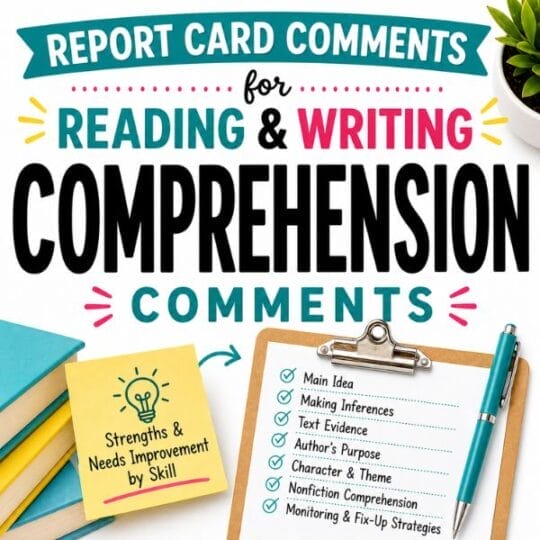
Reading comprehension comments
Comprehension gaps often look different from decoding gaps — students can read the words accurately but struggle to explain what they’ve read, make inferences, or identify main ideas. Be specific about which comprehension skills you’re seeing difficulty with.
Strengths
- _____ demonstrates strong overall comprehension of grade-level texts and can explain their thinking clearly.
- _____ understands what they read and is able to discuss key ideas with accuracy and detail.
- _____ engages thoughtfully with text, asking questions and making meaningful observations.
- _____ reads with understanding and is able to explain both what happened and why it matters.
- _____ uses evidence from the text to support their thinking when responding to reading.
- _____ monitors their understanding while reading and seeks clarification when needed.
Needs improvement
- ______ is able to read the words accurately but has difficulty explaining what they have read.
- _____ struggles to maintain understanding, especially when reading longer or more complex texts.
- _____ has difficulty explaining their thinking about a text, even when they understand parts of it.
- _____ benefits from stopping periodically while reading to check for understanding.
- _____ may focus on individual details but has difficulty understanding the text as a whole.
- _____ is still developing the ability to think deeply about what they read.
Reading Comprehension – Specific Skill Gaps
Sometimes students will have specific areas of strength or gaps that you’d like to point out in report card comments. Below I’ve shared a few common areas this occurs.
Main Idea/Summary
Identifying the main idea and summarizing are foundational comprehension skills that show whether a student understands what matters most in a text. Many students can recall details but struggle to determine which ideas are essential. These comments focus on how well students can prioritize information and explain it in their own words.
Strengths
- _____ accurately identifies the main idea of a text and supports it with key details.
- _____ summarizes texts clearly, focusing on the most important information.
- _____ is able to distinguish between essential information and less important details.
- _____ can explain a text in their own words while maintaining the overall meaning.
Needs Improvement
- _____ has difficulty identifying the main idea and often focuses on minor or interesting details instead.
- _____ summaries may include too many details or miss the most important points.
- _____ needs support determining what information is most important when reading.
- _____ has difficulty putting ideas into their own words when summarizing.
Making Inferences
Inferencing is where reading moves from surface-level understanding to deeper thinking. Students must combine text clues with what they already know to figure out what the author is implying. These comments highlight how well students can read between the lines and support their thinking with evidence.
Strengths
- _____ makes thoughtful inferences based on evidence from the text.
- _____ uses clues from the text along with background knowledge to deepen understanding.
- _____ is able to explain not just what is happening, but why it is happening.
- _____ draws logical conclusions and supports them with evidence.
Needs Improvement
- _____ tends to rely only on what is directly stated and has difficulty reading between the lines.
- _____ has difficulty using text clues to make logical inferences.
- _____ may make guesses that are not supported by the text.
- _____ needs support explaining their thinking when making inferences.
Text Evidence
Using text evidence is a key shift in upper elementary and beyond…students are expected to support their thinking, not just share opinions. This requires both understanding the text and being able to locate and explain relevant details. These comments reflect how well students back up their ideas with what they’ve read.
Strengths
- _____ consistently uses specific evidence from the text to support responses.
- _____ is able to locate relevant information in the text to justify their thinking.
- _____ supports answers with clear and appropriate examples from the text.
Needs Improvement
- _____ has difficulty finding evidence in the text to support answers.
- _____ responses are often based on opinion rather than text-based evidence.
- _____ needs support connecting ideas back to the text.
- _____ may choose evidence that does not clearly support their thinking.
Point of View/Perspective
Understanding point of view helps students recognize that the narrator, characters, or author shape texts. This skill becomes more important as texts grow more complex and perspectives become less obvious. These comments focus on how well students can identify and explain different viewpoints.
Strengths
- _____ understands how point of view affects a story or text.
- _____ is able to identify and explain different perspectives within a text.
- _____ recognizes how a narrator’s point of view influences how events are described.
Needs Improvement
- _____ has difficulty identifying the narrator’s point of view.
- _____ may confuse their own perspective with that of the characters or author.
- _____ needs support understanding how point of view shapes a text.
- _____ has difficulty recognizing differences between perspectives.
Character & Theme
In fiction, strong comprehension goes beyond retelling events…students need to understand characters, their motivations, and the deeper message of the story. This requires connecting actions, changes, and outcomes across the text. These comments reflect how well students think about characters and theme.
Strengths
- _____ understands character motivations and can explain why characters act the way they do.
- _____ identifies themes and messages within stories and supports thinking with evidence.
- _____ tracks character development and explains how characters change over time.
Needs Improvement
- _____ has difficulty explaining why characters make certain choices.
- _____ may retell events without explaining deeper meaning or themes.
- _____ needs support identifying the message or lesson of a story.
- _____ has difficulty tracking how characters change throughout a text.
Informational Text
Reading informational text requires a different set of skills than reading stories. Students must identify key ideas, use text features, and connect information across sections. These comments focus on how well students understand and navigate nonfiction texts.
Strengths
- _____ understands key ideas in informational texts and can explain them clearly.
- _____ uses text features (headings, captions, diagrams) to support understanding.
- _____ is able to connect ideas across sections of informational texts.
Needs Improvement
- _____ has difficulty identifying the main idea in informational texts.
- _____ may focus on interesting facts rather than understanding the overall topic.
- _____ needs support using text features to support comprehension.
- _____ has difficulty connecting ideas across a text.
Monitoring & Fix-up Strategies
Strong readers notice when something doesn’t make sense and take steps to fix it. This kind of self-monitoring is critical for independent reading and deeper comprehension. These comments reflect how aware students are of their own understanding and what they do when meaning breaks down.
Strengths
- _____ notices when something doesn’t make sense and takes steps to fix it.
- _____ rereads or slows down when meaning breaks down.
- _____ uses strategies independently to maintain understanding.
Needs Improvement
- _____ continues reading even when meaning breaks down.
- _____ does not consistently recognize when they are confused.
- _____ needs support using strategies such as rereading or summarizing to improve understanding.
Vocabulary comments
Vocabulary plays a major role in both reading comprehension and writing quality. Students with strong vocabulary skills are better able to understand complex texts and express their thinking clearly. These comments reflect how well students understand, use, and continue to build word knowledge.

Strengths
- _____ has a strong vocabulary and uses precise, varied language in both speaking and writing.
- _____ understands and uses grade-level academic vocabulary accurately.
- _____ demonstrates a deep understanding of word meanings, including how words are used in different contexts.
- _____ uses newly learned vocabulary naturally in conversation and writing.
- _____ shows curiosity about new words and seeks to understand their meanings.
- _____ makes connections between new vocabulary and prior knowledge.
- _____ understands subtle differences between similar words.
- _____ uses context clues effectively to determine the meaning of unfamiliar words.
- _____ rereads and uses surrounding information to clarify word meaning.
- _____ demonstrates flexibility when encountering new vocabulary.
- _____ understands and uses academic vocabulary across subject areas. _____ accurately applies vocabulary from classroom instruction in both discussion and writing.
- _____ demonstrates strong understanding of content-specific language.
- _____ uses academic vocabulary to explain thinking clearly.
- _____ uses knowledge of prefixes, suffixes, and root words to determine meaning.
- _____ recognizes common word parts and applies them when reading unfamiliar words.
- _____ uses word structure to support both decoding and comprehension.
- _____ uses new vocabulary confidently in both speaking and writing.
- _____ incorporates precise and descriptive language to strengthen communication.
- _____ applies learned vocabulary across subjects and contexts.
Needs Improvement
- _____ has a limited vocabulary, which can impact both comprehension and written expression.
- _____ often relies on basic or repetitive word choices.
- _____ needs support understanding and using grade-level academic vocabulary.
- _____ has difficulty applying new vocabulary independently.
- _____ benefits from repeated exposure to new words in different contexts.
- _____ may understand words when heard but has difficulty using them independently.
- _____ has difficulty using context to determine the meaning of unfamiliar words.
- _____ may skip over unfamiliar words rather than attempting to figure them out.
- _____ needs support using surrounding text to clarify meaning.
- _____ benefits from modeling and practice with context clue strategies.
- _____ has difficulty understanding academic vocabulary used in instructions and texts.
- _____ needs support applying academic vocabulary in speaking and writing.
- _____ may avoid using more precise language when explaining ideas.
- _____ benefits from explicit instruction and repeated use of academic vocabulary.
- _____ may recognize words but does not yet have a deep understanding of their meaning.
- _____ has difficulty understanding how word meanings change in different contexts.
- _____ needs support developing a deeper understanding of vocabulary.
- _____ may use words incorrectly due to partial understanding.
- _____ has difficulty using prefixes, suffixes, and root words to determine meaning.
- _____ does not consistently use word parts to support understanding of new vocabulary.
- ____ needs support breaking down unfamiliar words into meaningful parts.
- _____ is still developing an understanding of how word parts affect meaning.
- _____ has difficulty incorporating new vocabulary into speaking and writing.
- _____ tends to rely on familiar, simple language rather than expanding word choice.
- _____ needs encouragement to use newly learned vocabulary independently.
- _____ benefits from opportunities to practice using new words in context.
Writing report card comments
Writing requires students to generate ideas, organize them clearly, and communicate effectively using language conventions. Strong writers develop over time with consistent practice, feedback, and opportunities to revise. These comments reflect overall writing ability, including both ideas and execution.

Strengths
- _____ communicates ideas clearly in writing and shows strong overall development.
- _____ produces thoughtful writing that is organized and easy to follow.
- _____ demonstrates strong writing skills across a variety of tasks and genres.
- _____ writes with a clear voice and engages the reader.
- _____ shows growth in writing and continues to build confidence.
Needs Improvement
- _____ has difficulty organizing ideas clearly in writing.
- _____ writing may be brief or underdeveloped.
- _____ needs support expressing ideas in a clear and structured way.
- _____ benefits from additional support during the writing process.
- _____ is still developing confidence and independence in writing.
Report Card Comments for Ideas & Content – Writing Development
Strong writing starts with clear, well-developed ideas. Students need to move beyond basic responses and fully explain their thinking with relevant details. These comments focus on how well students develop and communicate their ideas.
Strengths
- _____ generates strong ideas and develops them with relevant details.
- _____ includes specific examples that support their writing.
- _____ stays focused on the topic and fully addresses the task.
- _____ demonstrates creativity and originality in writing.
Needs Improvement
- _____ generates interesting ideas and has a natural storytelling voice. The next step is developing those ideas more fully — adding details, elaboration, and a clear structure.
- _____ writing lacks sufficient detail to fully develop ideas.
- _____’s writing is often a list of events rather than a developed piece with a clear focus. Talking through ideas before writing — and asking “so what?” about each detail — helps develop this skill.
- _____ may list events or ideas without expanding on them.
- Encouraging _____ to say more — “tell me more about that part” — during informal conversation helps develop elaboration in writing.
- _____ needs support explaining thinking more clearly.
- _____ has difficulty staying focused on the main topic.
Report Card Comments for Organization & Structure
Organization helps readers follow a writer’s thinking from beginning to end. Students need to structure their writing with a clear introduction, supporting details, and a conclusion. These comments reflect how well students organize their ideas.
Strengths
- _____ organizes writing with a clear beginning, middle, and end.
- _____ uses paragraphs effectively to separate ideas.
- _____ presents ideas in a logical and easy-to-follow order.
- _____ uses transitions to connect ideas smoothly.
Needs Improvement
- _____ has difficulty organizing ideas into a clear structure.
- _____ writing may feel disjointed or out of order.
- _____ needs support using paragraphs to separate ideas.
- _____ has difficulty connecting ideas clearly.
Elaboration & Detail Comments
Elaboration is what turns basic writing into meaningful communication. Students need to explain, describe, and expand on their ideas so the reader fully understands their thinking. These comments focus on how well students add detail and depth.
Strengths
- _____ adds meaningful details that strengthen writing.
- _____ explains ideas clearly with supporting examples.
- _____ uses descriptive language to enhance writing.
- _____ expands on ideas in a way that supports understanding.
Needs Improvement
- _____ writing is often too brief and needs more detail.
- _____ needs support expanding ideas beyond basic statements.
- _____ may repeat ideas rather than adding new information.
- _____ benefits from prompting to “tell more” or explain thinking.
Sentence Structure
Strong writing includes clear, complete sentences and a variety of sentence types. As students progress, they move from simple sentences to more complex structures that improve clarity and flow. These comments reflect how well students construct sentences.
Strengths
- _____ writes clear, complete sentences.
- _____ uses a variety of sentence structures to improve writing.
- _____ combines ideas effectively into more complex sentences.
- _____ demonstrates strong control of sentence construction.
Needs Improvement
- _____ writes incomplete sentences or sentence fragments.
- _____ relies heavily on simple sentences.
- _____ has difficulty combining ideas into more complex sentences.
- _____ needs support writing clear and complete sentences.
Grammar, Spelling & Conventions
Conventions include grammar, spelling, capitalization, and punctuation. While these skills develop over time, they play an important role in making writing clear and readable. These comments reflect how consistently students apply writing conventions.
Strengths
- _____ consistently applies grade-level grammar and punctuation rules.
- _____ demonstrates strong spelling skills in writing.
- _____ edits writing to improve accuracy and clarity.
- _____ shows attention to detail when applying conventions.
Needs Improvement
- _____ is working on applying grammar and punctuation conventions consistently in their writing. These are skills that develop with practice and targeted feedback over time.
- _____ needs support with consistent use of capitalization and punctuation.
- Spelling is a growth area for _____. A short daily word study routine — even just 5 minutes — would support the pattern recognition that underlies both spelling and reading.
- _____ makes errors in grammar that affect clarity.
- _____ spelling is a growth area and affects readability.
- _____ has strong ideas in writing but needs continued support with sentence structure and capitalization/punctuation. We are working on editing strategies in class that _____ can also apply at home.
- _____ would benefit from reviewing and editing work more carefully.
The Writing Process
Strong writers use a process that includes planning, drafting, revising, and editing. Many students need support slowing down and improving their work rather than completing it quickly. These comments reflect how students approach the writing process.
Strengths
- _____ understands and uses the writing process effectively, including planning and revising.
- _____ revises writing to improve clarity and detail.
- _____ takes feedback and applies it to improve writing.
- _____ demonstrates independence throughout the writing process.
Needs Improvement
- _____ tends to rush through writing without revising.
- _____ needs support planning before writing.
- _____ has difficulty improving writing after the first draft.
- _____ benefits from guidance during revising and editing.
Supporting struggling readers: additional resources
If a student’s reading challenges are significant, report card comments are just one piece of the picture. The guides below cover differentiation, accommodations, and early intervention strategies that work alongside what you’re communicating to families.
- Differentiation for struggling readers: what you need to know
- Simple accommodations for struggling readers in content areas
- How to use reading screeners to guide next steps
- The 5 key components of effective reading instruction
← Back to the complete report card comments guide