
Middle School Grammar Bell Ringers: Why Routine Beats a Worksheet Every Time
Let me paint you a picture.
It’s 8:07 AM. You’ve got 28 sixth graders trickling in, one of them is already arguing about whether his hoodie counts as a jacket, three people forgot their Chromebooks, and you’re supposed to somehow transition into a productive grammar lesson before the bell finishes echoing.
Sound familiar?
Here’s what I’ve found works better than any grammar worksheet, any warm-up packet, or any “open to page 47” routine I’ve ever tried:
A consistent daily grammar bell ringer.
Not because it’s magic. Because it’s a system. And middle schoolers (even the ones who act like they couldn’t care less) actually thrive inside of systems.
Let me tell you what I mean.

What Are Daily Grammar Edit Bell Ringers (And Why Do They Work)?
A bell ringer is exactly what it sounds like: a short, focused activity students start the moment they walk in the door, before you’ve even called the class to order.
For grammar edits specifically, we’re talking about 5–8 minutes, one prompt or short passage, and a targeted skill focus.
The research behind daily, low-stakes practice is pretty solid. Studies on distributed practice, sometimes called the spacing effect, consistently show that short, repeated exposure builds retention far better than one long unit taught all at once.
When grammar happens once a week for 50 minutes, students cram it, sort of get it, and forget it by Thursday.
When you give it 7 minutes every single day, it becomes part of how they think about writing.
That’s the goal, right?
Not grammar as a subject.
Grammar as a writing habit.
What Should a Middle School Grammar Bell Ringer Include?
Not all bell ringers are created equal. The ones that actually move the needle tend to hit a few key areas in rotation:
Usage — Subject-verb agreement, pronoun-antecedent agreement, commonly confused words (there/their/they’re, affect/effect, who/whom). These are the errors that show up over and over in student writing because students have heard “rules” but don’t really apply them under pressure.
Mechanics — Punctuation, capitalization, apostrophe use. Again: not just identifying rules, but recognizing errors in context.
Sentence Structure — Fragments, run-ons, parallel structure, varying sentence beginnings. This is where grammar connects most directly to their actual writing quality.
Vocabulary — Tier 2 academic vocabulary woven in means students are building language skills at the same time. Win-win.
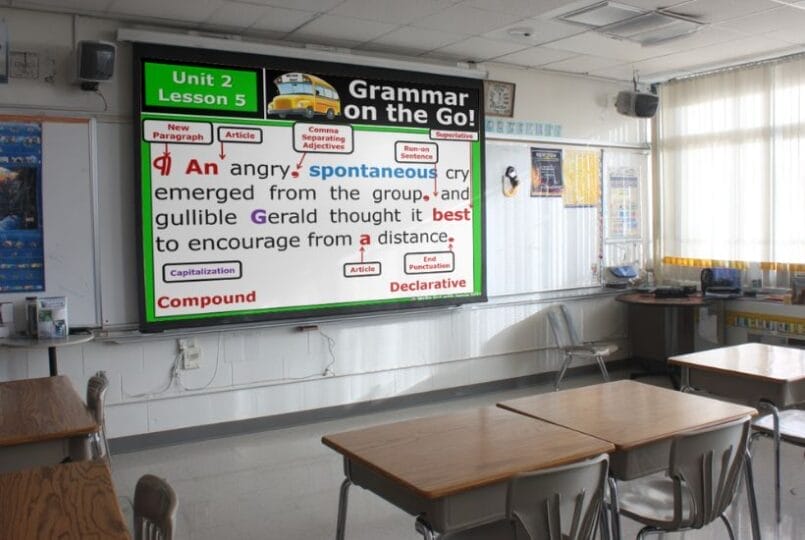
When you rotate through these areas consistently, students get exposure to the full range of skills they’ll be tested on — and that they need as writers — without any single day feeling like a deep dive they have to prepare for mentally.
The Routine That Actually Works
Here’s the structure I’d recommend:
- Bell rings → students open their bell ringer (paper or digital) immediately. No instructions needed. The routine does the work for you.
- 5–7 minutes of independent work. You take attendance, handle the hoodie debate, and do what you need to do.
- 2–3 minutes of whole-class review. Call on students, discuss the why, not just the right answer. “What made that a run-on?” is more powerful than “The answer is B.”
- Move on. That’s it. 10 minutes, done.
The key word there is consistent.
The bell ringer only becomes a management tool when it happens the same way every day.
The first two weeks are the investment. After that, the routine runs itself.
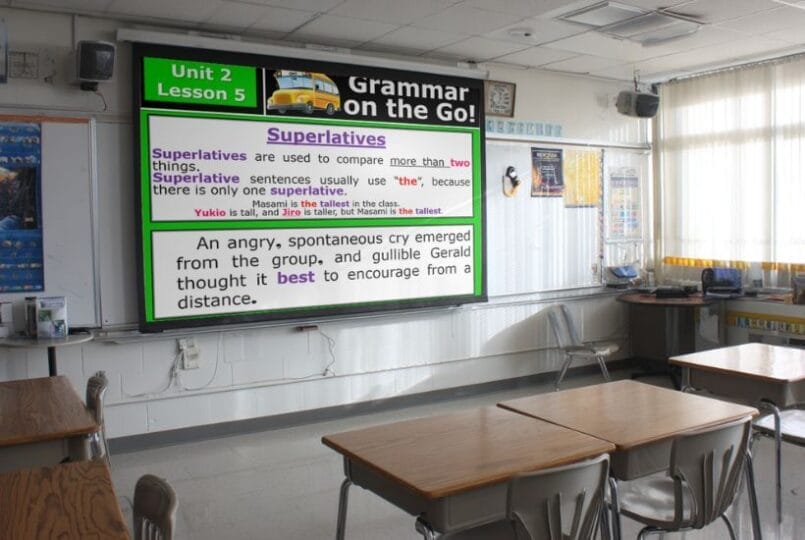
If you’re using a daily grammar edit routine, having the prompts already prepared makes the system much easier to maintain. Many teachers use a set of ready-to-go Daily Grammar Edits so students can open to the next page each morning and start immediately without waiting for instructions.
But What About Grading All of That?
Oh, I see you. The thought of grading a bell ringer every day sounds like a nightmare, and I get it.
Here’s the secret: you don’t have to grade every single one.
Most teachers I know use one of these approaches:
- Weekly collection — Students keep their bell ringers in a designated spot in their notebook or folder, and you spot-check or collect on Fridays only.
- Completion credit — You circulate during review and give a quick stamp or check for students who attempted the work. Full credit for trying, not for being right.
- Self-grading — During the review phase, students correct their own work in a different color. This is arguably the most effective approach because immediate feedback is more powerful than feedback that arrives two days later.
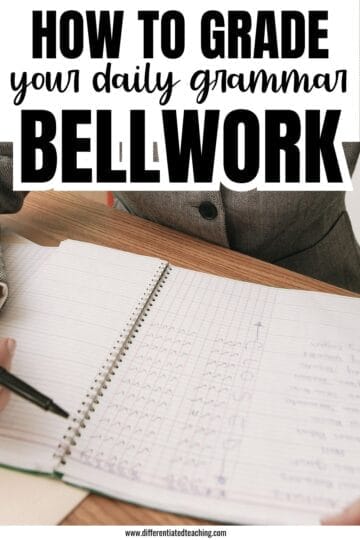
Pick the system that fits your management style and your grade policy. The point isn’t the grade; it’s the daily practice.
What This Looks Like Across Grade Levels
The structure is the same, but the skill expectations should scale.
6th Grade is where many students are bridging from upper elementary. They’re solidifying foundational mechanics (commas in a series, basic sentence structure, possessives) while starting to work with more complex usage.
Your bell ringers should meet them there with real sentences, real editing, but accessible enough to build confidence.
7th Grade students are ready for more complexity: semicolons, appositives, more nuanced pronoun work, and sentence variety that goes beyond just “don’t write run-ons.”
This is also a good grade level to start weaving in more vocabulary work, since academic language demands increase significantly.
8th Grade is where you’re preparing writers for high school expectations. Parallel structure, varied syntax, proper use of dashes and colons, and precision in word choice all become fair game.
Bell ringers at this level can start to feel more like editing real writing instead of identifying isolated errors.

How This Connects to Your Writing Instruction
Here’s what I love most about a strong bell-ringer routine: it creates a shared language.
When you’ve been doing grammar bell ringers every day, and a student turns in a draft with comma splices, you can just write “comma splice — check your bell ringer from Tuesday.” They know what that means. You don’t have to reteach from scratch.
The bell ringer becomes a reference point. A common vocabulary. A shortcut to the feedback that actually sticks.
And when students start self-editing their writing using the same skills they practice every morning? That’s when you know the routine is doing what you wanted it to do.
Two Types of Grammar Bell Ringers Teachers Use
Not all bell ringers work the same way. Most middle school teachers end up using one of two formats depending on their goal for the day.
Daily Grammar Edits
These focus on sentence editing. Students revise a sentence or short passage to correct grammar, mechanics, and usage errors. This format helps students practice spotting mistakes and understanding how sentences should actually be written.
Daily editing routines work best when your goal is targeted grammar practice.
ELA Spiral Review Bell Ringers
Spiral review bell ringers go a step further. Instead of focusing only on editing, they rotate through grammar, vocabulary, sentence structure, and language skills across the week.
This type of routine builds overall language fluency, not just error correction.
Both approaches work well. Many teachers use editing practice on some days and spiral review on others to keep grammar instruction consistent without feeling repetitive.
Middle School Grammar Bell Ringers, By Grade
If you’d rather not build a year’s worth of bell ringers from scratch, here are ready-to-use sets organized by grade level.
Daily Grammar Edits (Sentence Editing Practice)
These bell ringers focus on editing and revising sentences so students practice spotting grammar and mechanics errors.


ELA Spiral Review Bell Ringers (Full Language Warm-Ups)
These bell ringers rotate grammar, vocabulary, and sentence structure so students get consistent review across multiple language skills.


The Bottom Line
Grammar doesn’t have to be a whole production. It doesn’t need a unit launch, a spiral notebook, or a large block of time carved out of your already-packed schedule.
It needs 7 minutes. Every day. The same way every time.
That’s the routine that actually changes how students write.
Give it two weeks. You might be surprised how quickly the routine starts working.
Looking for more ways to build daily ELA routines that actually stick? Check out The 10-Minute Academic Vocabulary Routine That Actually Builds Mastery and How to Introduce the Writing Process in Middle School Without Losing Their Attention for more ideas you can use tomorrow.
✍️ Looking for more writing instruction strategies? Visit our complete guide: Writing Instruction Strategies — covering grammar, narrative writing, reluctant writers, and middle school writing support.


