How to Teach Students to Explain Their Math Thinking…even on Tests
You’ve probably seen it happen. A student solves the problem correctly. The math is right. But when you ask them to explain their math thinking?
Blank paper. Shrugged shoulders.
Or a single sentence that says: “I just knew.”
Explaining math thinking is one of the hardest skills students are asked to master… especially on standardized tests and constructed response questions.
And honestly, it’s frustrating for teachers too.
Because students often understand more than they can communicate.
The good news?
This isn’t a motivation problem.
It’s a language and structure problem. And once you see it that way, the fix becomes much clearer.
Let’s talk about why students struggle to explain their thinking… and what actually helps.
Why Students Struggle With Written Math Explanations
Most students learn math as procedures.
Solve.
Compute.
Move on.
But explanation questions ask them to do something completely different.

They must:
- organize reasoning,
- choose mathematical vocabulary,
- connect steps logically,
- and communicate clearly in writing.
That’s a heavy lift.
Especially for:
- struggling readers,
- multilingual learners,
- or students who lack confidence.
Many students freeze because they don’t know where to start.
Not because they don’t understand the math.
You’ve probably noticed students who can talk through their reasoning out loud but suddenly struggle once writing is involved.
That gap between thinking and communicating is where most breakdowns happen.
Why Tests Are Especially Challenging
Today’s assessments don’t just ask students to compute.
They ask students to justify. Explain. Compare strategies. Analyze mistakes.
Students may suddenly need to explain why 3/4 is greater than 2/3 or defend their approach to a multi-step word problem.
Without daily exposure to explanation tasks, these questions feel overwhelming. Students aren’t used to writing in math class, so when it suddenly counts, it feels high-stakes.
This is especially true when students already struggle conceptually.
(If you’re seeing this during fraction units, you may also notice many of the same challenges discussed in this guide on fraction misconceptions.)
Sentence Stems That Actually Help Students Get Started
One of the simplest ways to support students is giving them language structures.
Sentence stems reduce cognitive load.
Instead of figuring out how to start writing, students can focus on explaining their reasoning.

Examples that work well:
- First, I noticed…
- I chose this strategy because…
- This shows that…
- Another way to solve this problem could be…
- I know my answer is correct because…
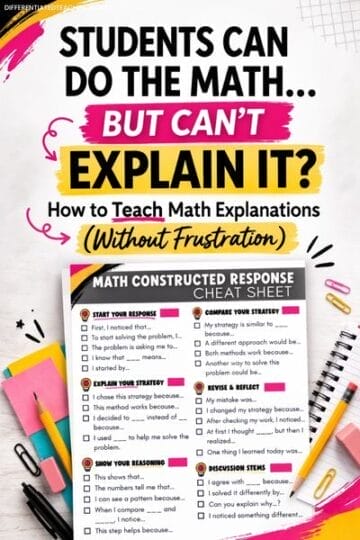
If you’d like a ready-to-print version of these stems organized by purpose, I created a simple one-page Math Thinking Sentence Stems cheat sheet you can use for constructed response questions, daily problem solving, or math discussions.
You can grab the free printable below and start using it tomorrow.
Over time, students internalize academic language and begin explaining independently.
Sentence stems aren’t training wheels.
They’re scaffolds.
Build Explanation Skills in 10 Minutes a Day
The biggest mistake schools make?
Saving explanation questions for test prep season.
Students build confidence faster when explanation becomes part of daily math routines.
Short, consistent practice works better than long assignments once a month.
Try this:
- Present one problem.
- Model thinking aloud.
- Ask students to write just 2–3 sentences explaining reasoning.

That’s it.
Eight to ten minutes is often enough.
Many teachers find daily problem-solving routines especially helpful because students repeatedly practice reasoning without overwhelm.
If you want a done-for-you version of this routine, my Daily Problem Solving bundles are built around short, structured explanation practice that fits into 10 minutes a day.

What Strong Math Explanations Actually Look Like
Students don’t need long essays.
They need clarity.
Strong explanations usually include:
- the strategy used,
- key math vocabulary,
- and evidence supporting the answer.
Model examples frequently. For example: “I multiplied first because the problem describes equal groups, which tells me to use multiplication.”
Show weak answers and improve them together.
Students learn faster when they see the difference.
If you already use spiral review or warm-up routines, explanation questions fit naturally into those structures.
If you’re looking to start spiral review in your classroom, you can find ready-to-use options for grades 1-8 here: Daily Spiral Review

Supporting Struggling Learners Without Adding More Worksheets
When students struggle to explain math thinking, adding more worksheets rarely solves the problem.
Many learners need:
- vocabulary support,
- chunked tasks,
- and opportunities to talk before writing.
Small accommodations can dramatically improve confidence and participation.
Structured supports help students organize ideas without lowering expectations. And the best part? This doesn’t require an extra unit or a brand-new curriculum.
Final Thoughts
Students don’t struggle to explain math thinking because they’re lazy.
They struggle because explanation combines reasoning, language, and confidence all at once.
When explanation becomes part of daily routines instead of test prep panic, students begin to see math differently.
They stop guessing.
They start thinking.
And honestly… that’s when math gets a lot more fun to teach.
Need more support for teaching math this year? Find more math strategies here.