Why Fractions Are So Hard for Students (And What Actually Helps)
Fractions are often the moment when perfectly capable math students suddenly lose confidence. You’ve probably watched students who felt confident in math suddenly start guessing during fraction lessons. After working with struggling learners for years, I’ve learned that fraction mistakes usually aren’t about effort… they’re about understanding.
You know the moment.
They understood multiplication. They could explain place value. Math finally felt steady.
Then fractions show up.

Suddenly students are convinced that 1/8 must be bigger than 1/6 because eight is bigger than six… and you’re standing there wondering how everything unraveled so quickly.
If fractions feel harder to teach than almost any other math unit, you’re not imagining it.
But why are fractions hard for students? They don’t just introduce new skills. They ask students to completely rethink how numbers work.
And unless we slow down and build that understanding intentionally, students often end up memorizing steps they don’t actually understand.
Let’s talk about why fractions feel so challenging for students… and what actually helps them finally make sense of it.
Why Fractions Feel So Different for Students
For years, students learn one very consistent rule about numbers:
Bigger numbers mean bigger amounts.
Fractions quietly break that rule.
Suddenly:
- 1/8 is smaller than 1/6.
- 3/4 can be larger than 2/3.
- 2/4 equals 1/2 even though the numbers look different.
Students try to apply whole-number thinking to fractions because that’s what has worked for them up to this point.

That’s why you’ll see mistakes like:
- adding straight across (2/3 + 1/4 becomes 3/7)
- assuming larger denominators mean larger fractions
- struggling to recognize equivalent fractions.
This isn’t carelessness.
It’s a genuine conceptual shift.
Students have to stop thinking about two separate numbers and start seeing a fraction as one value.
That takes time and repeated exposure.
We Often Move to Procedures Too Quickly
Another reason fractions fall apart?
We move to procedures before understanding is fully there.
I’ve done it. Most of us have.
Time gets tight. Standards keep moving. Students seem ready enough.
So we teach:
Find a common denominator.
Multiply across.
Invert and multiply.
Students can follow the steps… until the problem changes slightly.
Then everything unravels.
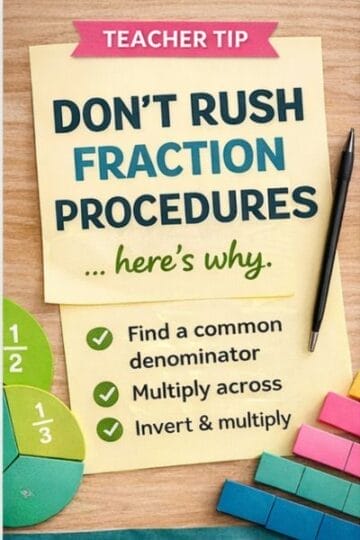
Because the rules never actually meant anything to them.
This lines up with what the National Council of Teachers of Mathematics emphasizes…conceptual understanding before procedural fluency, especially when students are learning fraction relationships and equivalence.
Before students add fractions with unlike denominators, they need strong understanding of equivalence. They need to see why denominators must represent equal-sized parts.
Spending time comparing fractions and building equivalency early makes later fraction operations dramatically easier.
Why Fraction Word Problems Feel Even Harder
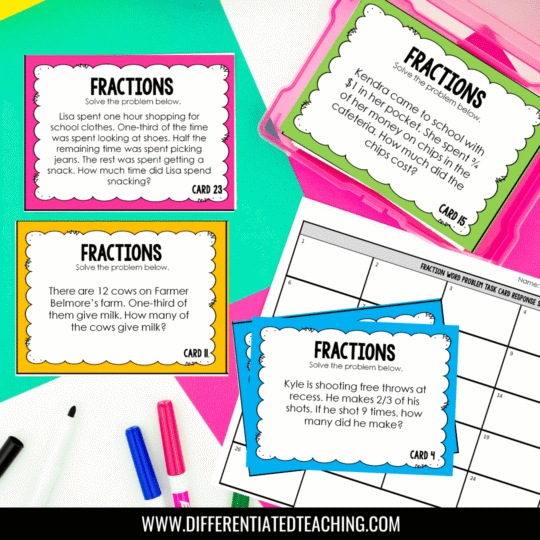
Many students can complete fraction computations on a worksheet but completely freeze when fractions appear inside a story problem.
That’s because word problems require students to do several things at once:
- understand what the fraction represents,
- decide which operation makes sense,
- and connect math to a real situation.

If fraction practice only happens through isolated skills, students never build that transfer.
Regular exposure to fraction word problems helps students see fractions as quantities instead of abstract numbers on a page.
Over time, they begin to recognize patterns instead of guessing.
If students regularly struggle to decide what operation to use, these strategies for teaching math problem solving can help.
The Most Common Fraction Mistakes Students Make (And What They’re Really Telling Us)
If you’ve taught fractions for more than a year, you’ve probably noticed the same mistakes showing up again and again.
Students aren’t being careless. Most fraction errors actually tell us exactly what they misunderstand.
Here are some of the patterns I see most often.
Thinking Bigger Denominators Mean Bigger Fractions
Students assume 1/10 must be larger than 1/4 because ten is bigger than four.
This tells us they’re still applying whole-number thinking.
Frequent comparison practice helps students see that the denominator describes how many pieces something is divided into, not how large it becomes.

Adding Straight Across
You’ve probably seen it:
2/3 + 1/4 = 3/7.
Students memorize procedures without understanding equivalence.
Before adding fractions successfully, students need repeated opportunities to build equivalent fractions and see why denominators must match.

Freezing During Word Problems
Some students can compute fractions accurately… until the math shows up inside a story.
Now they must decide what the fraction represents before choosing an operation.
Regular exposure to fraction word problems helps students connect skills to meaning instead of guessing.
Struggling With Multi-Step Fraction Problems
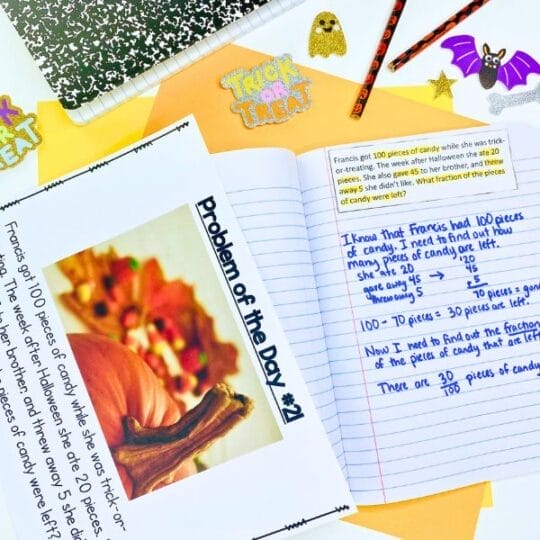
Multiplying fractions by whole numbers or solving two-step problems often reveals whether students truly understand fractions as quantities.
Practice that combines reasoning with computation helps students build confidence faster than isolated drills.
What Actually Helps Students Understand Fractions
If fractions feel shaky in your classroom, here are the strategies that consistently make the biggest difference.

1. Use Visual Models Again and Again
Research summarized through the What Works Clearinghouse highlights the importance of visual models and repeated reasoning opportunities. Area models, fraction bars, and number lines give students something concrete to reason about.
Even older students benefit from seeing fractions visually.
2. Build Equivalence Before Operations
Students should be comfortable generating equivalent fractions before adding or subtracting.
When equivalence makes sense, common denominators stop feeling like random steps.
3. Compare Fractions Frequently…and Start with Manipulatives.
Short comparison activities strengthen number sense and prevent many common misconceptions.
Students start noticing relationships instead of memorizing shortcuts.
4. Keep Practice Short but Consistent
Long fraction units followed by months without review rarely stick.
Five or ten minutes of regular fraction reasoning throughout the year builds far more confidence. Many teachers find spiral review routines especially helpful for keeping fraction skills fresh.
5. Include Word Problems Early
The application portion shouldn’t come at the very end of the unit.
Students build understanding faster when they regularly explain their thinking.
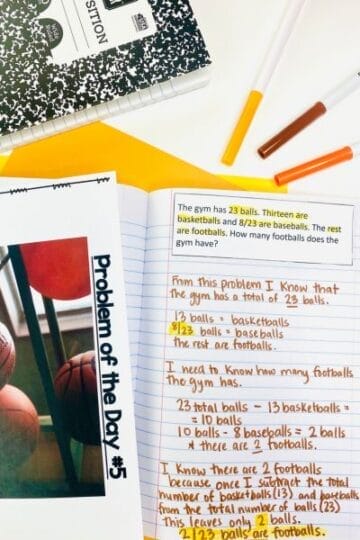
For students who need additional support, small adjustments and accommodations can dramatically change outcomes.
A Simple Fraction Routine That Builds Confidence
One of the easiest ways to support struggling learners is keeping fractions part of a predictable routine instead of treating them as a one-and-done unit.
A quick daily routine might include:
- one comparison problem,
- one equivalence task,
- and one short word problem.
That kind of steady exposure helps students see fractions as part of everyday math instead of a temporary hurdle.
It also gives you quick insight into misconceptions before they turn into bigger problems.
If you already use daily math routines or problem-solving warm ups, fractions fit naturally into that structure.
Final Thoughts
Fractions are hard for students because they challenge everything students believe about numbers.

But when we slow down, focus on understanding before procedures, and revisit fractions consistently, students start to notice patterns instead of contradictions.
And once fractions finally click, so many other parts of upper elementary math become easier.
If you’re building stronger math routines across your classroom, you can explore more teaching math strategies here: Math Hub