When Students Understand Math… But Still Get Word Problems Wrong
Teachers tell me this all the time:
“My students can do the math during practice. They understand the skill. But the moment a word problem appears… everything falls apart.”
Students stare at the page.
Some immediately start adding every number they see. Others hunt for a keyword and hope it tells them what to do. And some simply shut down before they even begin.
The confusing part is that many of these students actually do understand the math.
Word problems don’t just measure computation skills. They ask students to:
- manage language,
- working memory,
- organization,
- and decision-making
all at the same time. When even one of those pieces breaks down, students who seemed successful yesterday suddenly look completely lost today.
Over the years, both in the classroom and at homeschooling, I’ve noticed the same patterns again and again. Students who struggle with word problems aren’t usually lacking intelligence or effort. More often, they are overwhelmed by everything happening around the math.
Understanding why this happens is the first step toward helping students become confident problem solvers instead of frustrated guessers.
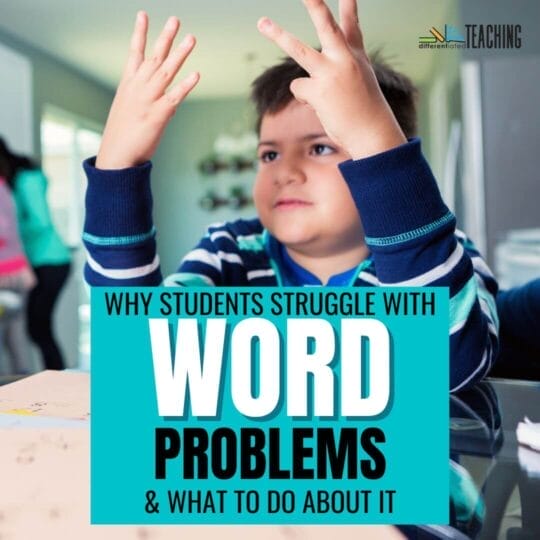
If you’re looking for a deeper breakdown of the most common reasons students struggle with word problems, you may also find this guide helpful.
👉Why Students Struggle With Word Problems
Why Word Problems Feel Harder Than Regular Math
Before looking at specific patterns students show, it helps to understand why word problems feel so different from regular math practice.
Computation problems ask students to apply a skill they already know.
Word problems ask them to read, interpret language, organize information, and make decisions before solving even begins.
Students must track vocabulary, hold multiple details in working memory, and determine what the question is asking while managing numbers at the same time.
For many learners, the challenge isn’t the math itself.
It’s everything happening around it.
When Students Freeze Before They Even Begin
One of the most common reactions teachers notice during word problems isn’t a wrong answer.
It’s no answer at all.
Students stare at the paper.
They reread the problem several times. They fidget. Sometimes they look around the room hoping someone else will start first. From the outside, it can look like avoidance or lack of effort.
In reality, many students are experiencing cognitive overload.
Unlike a straightforward computation problem, word problems require students to juggle multiple tasks at once. They must read and understand the situation, identify what information matters, decide what the question is asking, and plan how to solve it. All of that happens before a single number is written down.
For students with working memory challenges or executive functioning difficulties, that mental load can feel overwhelming.
When students don’t know where to begin, many of them simply don’t.
Others jump straight into solving without understanding the situation because doing something feels safer than sitting with uncertainty.
That’s why the first step in supporting struggling problem solvers isn’t always teaching a new strategy. Often, it’s helping students slow down long enough to understand what the problem is actually asking before they start solving.
When Students Guess the Operation Instead of Understanding the Problem
After the freeze response, the next pattern teachers often notice looks very different… but it comes from the same place.
Students immediately begin calculating.
They add every number they see.
Or they multiply.
Or they subtract because the last few problems used subtraction.
From the outside, it can look like careless mistakes. In reality, many students are trying to solve uncertainty as quickly as possible.
When students don’t fully understand a problem, choosing an operation becomes a guessing game. They learn that math usually means “do something with the numbers,” so they default to whatever strategy feels safest or most familiar.
I often see students who successfully completed the exact skill during guided practice suddenly combine unrelated numbers in a word problem simply because they recognized them.
They aren’t misunderstanding the math.
They are skipping the thinking that comes before the math.
Word problems ask students to interpret a situation first and calculate second. Without that pause to understand the scenario, computation becomes disconnected from meaning.
This is why slowing students down can feel uncomfortable at first. Many struggling learners want to start solving immediately because action feels productive.
Helping students stop long enough to ask, What is this problem actually asking me to find? is often the turning point between guessing and true problem solving.
Why Keyword Strategies Often Fail Students
For years, many classrooms relied on keyword strategies to help students identify operations in word problems.
Circle the word total and add.
Find difference and subtract.
Look for each and multiply.
While these strategies can feel helpful at first, they often create new problems for struggling learners.
Students begin searching for a single word instead of understanding the situation.
I frequently see students latch onto the first familiar term they recognize, even when it doesn’t apply. A word like more might appear in the story, and students immediately assume addition… even if the question is asking them to compare quantities or determine how many are left.
The result is students who appear confident but consistently arrive at incorrect answers.
The math vocabulary is right there on the page, yet it doesn’t support them because they never built flexibility with language.
In fact, one of the biggest surprises for teachers is how often students struggle simply because problems are worded differently. When students only hear math explained one way, unfamiliar phrasing can make a familiar skill suddenly feel impossible.
Students need exposure to a wide range of mathematical language.
Words like combined, altogether, and in total may describe the same action. Helping students hear and use that vocabulary in multiple contexts builds understanding that transfers beyond a single worksheet or lesson.
When students move from hunting for clues to truly understanding the situation, word problems begin to make sense again.
When Executive Function Gets in the Way of Good Math Thinking
Some of the most frustrating word problem mistakes don’t come from misunderstanding the math at all.
They come from everything happening around the math.
Teachers may notice students:
- solving only half of a multi-step word problem,
- forgetting to label answers,
- misaligning numbers during computation,
- or trying to hold everything mentally.
At first glance, these mistakes can look careless.
In reality, many students are trying to manage too many mental tasks at once.
Word problems require students to read, plan, calculate, and monitor their thinking at the same time. They must remember what the question asked while deciding what to do first and keeping track of numbers along the way.
When that mental load becomes too heavy, something has to give.
Students may stop early because they forget there was a second step.
They may arrive at the correct number but forget what it represents.
Others try to hold everything in their heads instead of writing their thinking down.
I often see students rely on mental math because writing feels slower or harder. Ironically, that choice makes problem solving even more overwhelming.
I’ve seen this firsthand at home as well. For years, my daughter experienced significant fine motor challenges that made writing difficult and frustrating. Because showing her work was so hard, she learned to do as much thinking as possible mentally.
Even after years of occupational therapy helped remove that barrier, the habit remained.
She was so used to relying on working memory that she continued trying to carry every step in her head long after she no longer needed to.
Now we keep an oversized whiteboard nearby as a reminder that writing isn’t just about showing work for a teacher.
It’s a tool for freeing mental space.
When students put their thinking somewhere visible, they no longer have to juggle every detail at once. Many of these challenges can also be supported through thoughtful math accommodations that reduce cognitive overload and help students organize their thinking more effectively.
Sometimes the struggle isn’t about learning new math skills. It’s about helping students unlearn survival strategies they developed when something else made problem solving harder.
When Students Know the Words… But Don’t Understand the Language
Another surprise for many teachers is how often word problem errors stem from vocabulary rather than computation.
The math didn’t change.
The language did.
The terminology students need is often sitting right there in the problem, yet unfamiliar phrasing can make a familiar skill suddenly feel impossible.
In many classrooms, teachers naturally explain concepts using consistent phrasing. That repetition helps students feel secure during instruction, but it can unintentionally limit flexibility when wording changes.
A student may understand how to find a total when a teacher asks, “How many altogether?”
Change that wording to “What is the combined amount?” or “How many in all?” and suddenly the same student feels unsure where to begin.
Students need exposure to a wide range of mathematical language so they can recognize ideas across different contexts. Building academic vocabulary intentionally across subjects can make a significant difference in how students approach complex math tasks.
Words like combined, altogether, in total, or the sum may describe the same action. Hearing and using those variations helps students connect familiar skills to unfamiliar problems.
This is especially important for struggling learners who rely heavily on predictable patterns. When language varies, they may assume the task itself is new even when they already know how to solve it.
Expanding vocabulary isn’t about making math harder.
It’s about giving students more ways to recognize what they already understand.
When Students Can’t See the Story Inside the Math
One of the biggest differences between students who guess and students who problem solve well has very little to do with computation.
Strong problem solvers can picture what is happening.
Struggling learners often cannot.
When students read a word problem, they are asked to imagine a situation they may never have experienced. If they cannot visualize the scenario, the numbers quickly lose meaning.
A student might read about sharing supplies between classrooms or comparing distances traveled and never truly picture what is happening. Without that mental image, deciding what to do next becomes incredibly difficult.
This is why slowing down to visualize the situation can be more powerful than immediately searching for numbers or operations.
Sometimes we pause and simply “stop and jot” a quick picture.
Not a perfect drawing. Just enough to imagine what is happening.
Who is involved? What is changing? What is being compared?
Other times, connecting the problem to a real experience makes all the difference.
If a problem involves dividing snacks among friends, students might relate it to sharing treats at a birthday party. A comparison problem might connect to sports scores or collecting items they care about.
Once students can see the situation, the math becomes purposeful instead of confusing.
Visualization shifts the focus from “What numbers do I use?” to “What is happening here?”
And that change alone often helps students recognize what the problem is asking before they ever begin solving.
When Helpful Strategies Become New Obstacles
Many teachers introduce highlighting, underlining, or annotation strategies to help students slow down during word problems.
These tools can be incredibly helpful when used intentionally.
But sometimes students become so focused on completing the strategy that they lose access to the problem itself.
I’ve seen students carefully highlight every number, circle vocabulary words, underline sentences, and mark arrows across the page… only to realize they can no longer reread the problem clearly.
The strategy becomes the task instead of supporting understanding.
For struggling learners, especially those managing attention or executive functioning challenges, too many required steps can create additional cognitive load.
Instead of helping students focus, excessive marking can interrupt comprehension.
Students may also assume that once the highlighting is finished, the thinking is finished.
Annotation works best when it serves a clear purpose.
Rather than marking everything, students benefit from returning to one simple question:
- What information actually helps me understand what the problem is asking?
- Sometimes that means circling only the question.
- Sometimes it means rereading without a pencil at all.
Helping students use strategies flexibly reminds them that the goal isn’t perfect annotation.
The goal is understanding.
The Power of Asking “Why” Before Solving
One of the biggest shifts I see in students who begin to succeed with word problems doesn’t start with a new strategy or worksheet.
It starts with a conversation.
When students struggle, it’s tempting to immediately reteach the skill or show another example. But often the most helpful thing we can do is pause and ask a simple question:
What are you going to do first?
And more importantly…Why?
Students who can explain their plan before solving almost always perform better than those who jump straight into computation.
That explanation doesn’t need to sound academic or polished.
Sometimes a student simply says, “I think I need to compare these because it’s asking which one has more.”
Other times they point to a sentence in the problem and explain what helped them decide.
Those moments reveal far more than written work alone.
When students talk through their thinking, gaps become visible.
A student who chooses subtraction because they saw the word more immediately shows where confusion began. Another student might realize halfway through explaining that they misunderstood the question entirely.
The goal isn’t to catch mistakes. It’s to understand thinking.
In many ways, this process mirrors what strong readers do when they cite text evidence. Students learn to justify decisions using information from the problem itself rather than relying on guessing or habit.
Interestingly, I don’t rely heavily on cognitive terminology when working with students. A short verbal explanation often tells me everything I need to know.
It shows whether a student understands the situation, recognizes what is being asked, and has a clear starting point.
And once students begin asking themselves why before solving, problem solving starts to feel less like guessing and more like planning.
What Actually Helps Students Become Confident Problem Solvers
When students struggle with word problems, the solution usually isn’t more worksheets.
It’s more clarity.
Over time, I’ve noticed that progress tends to happen when we focus less on speed and more on structure.
Students improve when classrooms emphasize:
- consistent exposure to varied problem types so students learn to think instead of rely on patterns,
- predictable daily routines that reduce anxiety around problem solving,
- opportunities to visualize situations before calculating,
- writing thinking externally instead of holding every step in working memory,
- and conversations that allow students to explain their reasoning out loud.

Daily opportunities to read, plan, and solve help students feel prepared rather than surprised when word problems appear.
Writing thinking down — even in small ways — reduces cognitive load. A quick model, number sentence, or short explanation allows students to focus on reasoning instead of remembering every detail.
And perhaps most importantly, students need space to explain their thinking.
When they can say:
“This is asking me to compare.”
“I’m finding the total first because…”
They begin to internalize planning before solving.
Exposure, structure, visualization, and conversation create something far more powerful than memorized keywords.
These daily word problem practice opportunities build confidence.
When the Shift Finally Happens
One of the most encouraging moments as a teacher or parent happens quietly.
A student picks up a word problem and pauses.
Not because they are stuck.
Because they are thinking.
Instead of circling numbers immediately or hunting for a keyword, they reread the question. They ask themselves what they’re being asked to find. They begin forming a plan before writing a single number.
That pause tells you everything has changed.
Students who once rushed into computation begin recognizing the goal first. They explain their reasoning more clearly. They notice when an answer doesn’t make sense. They correct themselves.
The math itself hasn’t become easier.
Their thinking has become stronger.
When students learn to recognize what a problem is asking before they start solving, they move from reacting to numbers to reasoning through situations.
And that is when word problems stop feeling like traps and start feeling like challenges they know how to approach.
Frequently Asked Questions About Math Word Problems
Why do students understand math but struggle with word problems?
Word problems require language processing, working memory, and planning skills in addition to computation. Many students struggle with these combined demands even when they know the math.
Should students rely on keyword strategies?
Keyword strategies can help initially but often lead students to guess operations instead of understanding the situation.
How do executive functioning challenges affect math problem solving?
Students may forget steps, lose track of information, or struggle to organize their thinking during multi-step problems.