3 Middle School Math Word Problem Strategies That Stop Guessing
Many teachers are searching for middle school math word problem strategies that actually help students stop guessing and start solving. If you’ve taught math for any time at all, I can guarantee you’ve had the experience of looking at a student’s work and thinking,
“How on earth did they get that?”
Middle school math word problems are tough. Not just for students… but for the teachers trying to teach them.
You can write the most engaging problem about a pizza party or a haunted house and still end up with answers that make absolutely no sense.
Here’s the thing: it’s not always a reading issue.
Most of the time, it’s a strategy gap.
Many middle schoolers haven’t been taught how to approach complex problems in a structured way…or they’ve been taught ways that no longer apply in middle school, like looking for keywords. So when they see a paragraph full of numbers, they panic a little.
They grab random numbers.
They try the first operation that comes to mind.
Or they write, “I don’t get it.”
I’ve seen students who can solve complex equations get completely stuck on a word problem because they didn’t know how to start.
If you want students to stop guessing and start solving, they need a routine they can rely on. Here are three classroom-tested strategies that make a real difference.

1. Teach Students a Repeatable Framework
Problem-solving isn’t intuitive for most students. They need a go-to process they can lean on every time they see a word problem.
A predictable routine also lightens the load on working memory. Instead of wondering What do I do next?, students can focus their brainpower on the actual math.
Whether you use UPSC (Understand, Plan, Solve, Check) or a step-by-step anchor chart you build together, the key is consistency.
Try something like this:
- Read once for the big picture.
- Highlight the important information.
- Cross out the distractions.
- Ask: “What am I trying to find?”
- Sketch a model or plan a strategy.
- Check your work… and your logic.

Use the same language every time you model a problem. That familiarity helps it stick and gives students a clear path when they feel stuck
2. Use Visual Tools to Break It Down
Middle schoolers need more than a worksheet. They need structure for their thinking.
Visual tools give students a place to “park” their ideas so they’re not juggling everything in their heads. That alone can lower anxiety and make word problems feel more manageable.
Give students a graphic organizer or visual aid that walks them through the process. A simple Problem Breakdown Box might include:
- What I know
- What I need to find
- My plan
- My answer and explanation
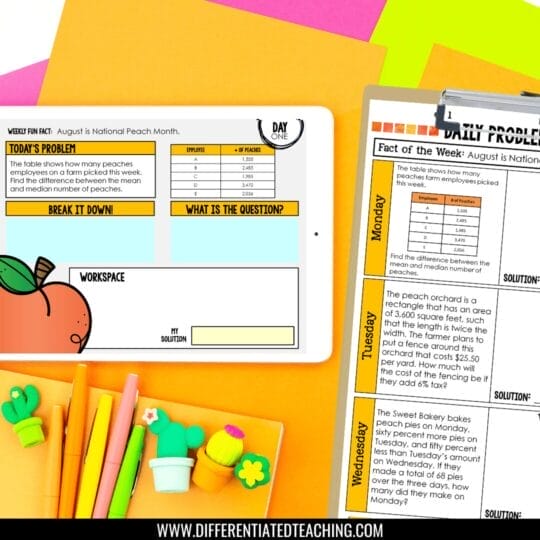
Some teachers design organizers for specific types of problems, like proportions or percent word problems.
But even something simple (like two highlighters, one for useful info and one for distractions) can completely change how students approach the task.
It doesn’t have to be fancy… it just has to help them slow down, organize information, and think before they calculate.
3. Build Consistency with a Daily Routine
If word problems only show up right before the test, they’re never going to feel comfortable.
Problem solving is a skill, and skills improve with consistent, low-stakes practice.
That’s where a short Problem of the Day routine can make a big difference.
It doesn’t have to take more than 10–15 minutes. One well-crafted word problem each day, paired with a quick discussion or think-pair-share, helps students build confidence over time.
And when the problems connect to something interesting (science facts, holidays, amusement parks) students are much more willing to engage.
Hook them with curiosity first, then give them a chance to apply the thinking routines you’ve been teaching.

Want to Build Real Problem-Solving Habits?
If you’re thinking, “I love this idea, but I don’t have time to write a year’s worth of wf you’re thinking, “I love this idea, but I don’t have time to write a year’s worth of word problems,” you’re not alone.
If your students need more than a random mix of practice problems, our Middle School Word Problem of the Day resources help you build that consistent routine without starting from scratch.

Designed specifically for grades 6–8, each month includes:
• One-page printable word problems with themed weekly topics
• Built-in progression from single-step to multi-step problems
• Weekly fun facts to keep engagement high and lower math anxiety
Teachers often use them as warm-ups, stations, bell-ringers, or homework.
👉 Explore the full Middle School Word Problem of the Day line here.
Final Thoughts: Strategies Over Shortcuts
Teaching middle schoolers to slow down and truly think through a problem isn’t always easy. But when students have a clear strategy and daily opportunities to practice it, something shifts.

They stop grabbing random numbers.
They start asking better questions.
And eventually they realize something important:
They actually can figure it out.
And that’s when the real learning begins.
If you want more classroom routines like this, visit the Math Teaching Ideas hub.
📐 Looking for more math differentiation support? Visit our complete guide: Math Differentiation: Accommodations, Word Problems, Fluency, and Intervention.