The Ultimate List of Math Accommodations for Struggling Learners
As a math teacher, you want every student to grow. But with wide-ranging needs in today’s classrooms, figuring out how to support everyone can feel complicated.
That’s where accommodations come in. Small shifts in how we present or structure learning can make a big difference for struggling and reluctant learners.
In this post, I’ll break down what math accommodations are (and aren’t) and share practical ideas you can use right away. These supports matter most for students with learning disabilities, IEPs, or 504 plans, but plenty of students without a formal plan benefit from them too. The great news is, none of them lower the bar on grade-level math.

Many of the math challenges we see in upper elementary and middle school are tied to reading demands (vocabulary, multi-step directions, and language-heavy word problems).
If you’re thinking about accommodations as part of a bigger support system, you may also find this guide to supporting struggling readers in grades 3–8 helpful. Strengthening reading support often strengthens math performance, too.
What are accommodations?
Accommodations are adjustments that make learning accessible without changing what students are expected to learn. They may support a disability, language need, or reading level, but the goal is the same: access to the grade-level work.
Accommodations aren’t a replacement for instruction, and they don’t guarantee success. They’re supports available to any student who needs them and should be used alongside targeted interventions when appropriate.
What is the difference between accommodations and modifications?
The difference is simple: accommodations change how students access learning, while modifications change what they’re expected to learn.
In math, accommodations might look like providing tools (rulers, compasses, graphic organizers), breaking problems into smaller steps, or clarifying directions.
Modifications go further. They adjust the content itself — for example, simplifying word problems or assigning alternate work.
Some students may need both. But many struggling learners benefit from accommodations alone, without changing the grade-level expectations.
How can math accommodations help struggling learners?
Math accommodations help struggling learners in two big ways. They give students practical tools and strategies to approach challenging tasks, and they create a more structured environment that reduces frustration and overwhelm.
Now that we’ve clarified what accommodations are, let’s look at the different types you might consider using in your math classroom.
The Four Key Types of Accommodations All Teachers Should Know
There are four types of accommodations you’re likely to use in your classroom. In fact, you may already be using many of them without even realizing they qualify as accommodations.
They generally fall into four categories:
- Adjustments in how students demonstrate their learning
- Adjustments to the learning environment
- Changes to pacing
- Shifts in the format of instruction
Each of these types of accommodations can be helpful for struggling learners in your math classroom. Now let’s take a closer look at each one.

Environmental or setting accommodations focus on where.
These are changes to the classroom’s physical environment. This could involve things like adjusting the lighting, providing a specific type of seating, or working in a different area of the classroom.
Not surprisingly, IEPs and 504 plans often include these to support students. However, you can provide them to any student based on need, as long as you document what you’re doing.
Here are a few more examples:
- preferential seating
- access to a quiet space to work
- small group instruction
- access to online learning space

Schedule or timing accommodations focus on when.
These accommodations are designed to allow students to work at a pace that is the right fit for them. The most common of these is extended time, offered to students with a variety of needs.

However, timing accommodations also include:
- offering breaks
- shortening assignments or using time limits to determine assignment length
- pausing and breaking down assignments into bite-sized pieces
Instructional or presentation accommodations answer how.
Instructional accommodations focus on how the student learns. These instructional changes are intended to provide students with more support as they learn new concepts.
This can include additional materials, like manipulatives or tools, to support learning.
Examples of instructional accommodations include:
- modified or simplified language
- visual aids and supports
- frequent check-ins to monitor understanding
- directions provided in multiple formats
- access to teacher or peer notes
- questions read aloud to the student
- pre-teaching vocabulary
Response accommodations answer what.
These are the different ways you allow students to demonstrate their understanding of the material. Response accommodations focus on assessing student learning and on what students will be asked to provide as evidence.
Examples include:
- the use of graphic organizers or concept maps
- multiple formats for showing learning (ie writing, video, physical product)
- multiple-choice questions instead of open-ended questions
- oral responses or a scribe for those who struggle with writing
- option to type any written work or record themselves answering

Hopefully, this gives you a little better understanding of what types of accommodations you might consider using or are already including in your math lessons.
Of course, there are more examples than those I’ve listed here, but keeping these four basic types in mind can help with your planning. It is always a good idea to talk with the student’s parents or teacher about their needs so you can create a plan that best meets their needs!
60+ Math Accommodations for Your Classroom
Math is an area many learners struggle. That’s why it is important to have a variety of accommodations available. You can implement any of the options below. However, you should note that it might take a bit to determine if they are working.
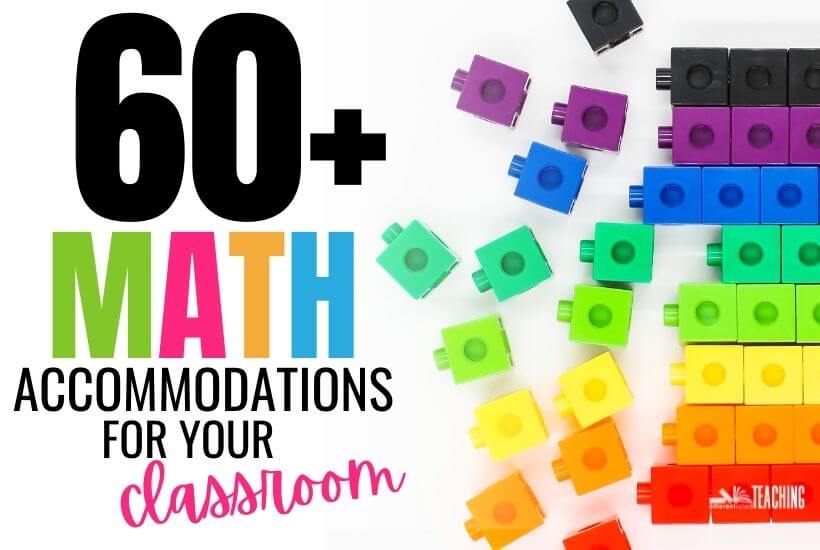
The lists of strategies below will help you differentiate in math so all of your students can achieve success.
During Instruction
- One-on-one instruction
- Provide small group review after lesson
- Provide an audio version of the textbook
- Use manipulatives and number lines
- Visual aids – like personal anchor charts or step-by-step directions
- Provide a copy of student notes
- Split class into small groups
- Introduce graphic organizers or concept maps to organize new knowledge
- Highlight or color code key vocabulary or concepts
- Provide copies of problems written on board during guided practice
- Pre-teach key vocabulary and concepts
- Provide scaffolded notes w/ areas for students to fill-in-the-blanks
- Use verbal cues that identify the most important information during lessons
- Prepare the student before calling on them to answer aloud
- Provide page numbers from the textbook that correlate to lesson & offer models
- Allow students to record lessons & take pictures of slides.
- Record & share lessons with students or families
- Incorporate breaks every 8-10 minutes of instruction
- Plan breaks in lesson to check for understanding
- Use proximity to gain attention & help students maintain focus
- Utilize songs or rhymes to boost memory for rote information
- Incorporate sensory tools & fidgets into lessons
Classroom assignments or tests
- Give directions both orally and in writing
- Simplify the wording of directions
- Orally read all word problems
- Provide a consistent annotation routine for word problems, like the CUBES strategy
- Provide extra workspace or large print
- Arrange problems from easiest to hardest
- Multiple-choice questions instead of open-ended questions
- Allow oral responses or use of speech-to-text technology
- Reduce the number of problems per page
- Rubrics to provide specific feedback
- Math software/apps to provide extra practice
- Extended time
- Allow use of manipulatives
- Break assignments into chunks or offer paper to cover additional questions to reduce visual overwhelm
- Offer frequent breaks for movement
- Calculator, math fact chart, or formulas to reduce demands on working memory
- Frequently check-in on student progress during independent work
- Provide models with clearly laid-out steps
- Use of graph paper for lining up numbers to compute
- Allow use of alternative writing tools – dry erase, slant boards, etc.
- Reduce assignment length
- Use highlighter strips to help students track when reading word problems
- Trade timed tasks for untimed tasks
- Offer sentence stems or frames for written explanations
- Provide one problem at a time using tools like Google Slides or task cards
- Scribe responses for student
- Provide checklist for reviewing work before turning it in
- Give prior notice for all assessments – no pop quizzes
Classroom environment
- Provide noise-canceling headphones to reduce distractions
- Offer frequent breaks for movement
- Use a study carrel or private seating to reduce distractions
- Offer a timer to help monitor how much longer they must work on a task
- Use preferential seating – near teacher or peers unlikely to engage
- During group, work give the student a specific task or responsibility
- Allow partial participation in groupwork
- Allow students to complete tasks or check in with a peer
- Teach student request to work in a separate space when distracted
- Consider adjustments to lighting for photosensitive students
Homework
- Communicate homework & expectations to parents
- Provide study guide or step-by-step directions for review
- Only provide homework that practices mastered or nearly mastered skills
- Reduce homework assignment length
- Reduce or remove penalties for late or incomplete homework
- Offer time parameters for homework like complete as much as you can in 20 minutes
That’s a lot of options, and you don’t need most of them for any one student. Start with three or four, and track what actually helps.
Tracking Whether Accommodations Are Working
A list of 60 ideas is only useful if you can tell which ones are doing the job. A simple routine keeps you from guessing:
- Start with one or two. If you add five at once, you won’t know which one made the difference.
- Note when you use it. A quick code in your grade book (like ET for extra time) is plenty.
- Compare the same kind of task over two or three weeks. Look at completion, accuracy, and how long it takes the student to get started.
- Bring what you see to the student’s team. If an accommodation isn’t helping, swap it out instead of stacking more on top.
Examples of Using Accommodations in the Math Classroom
While I’ve shared a number of ways you can help meet your learners’ needs in the space above, it can be helpful to get a sense of what this might look like in your classroom. That’s why I’ve shared three scenarios below. I’ve experienced each of these issues, and I want to share the tools I’ve used to address them. These may not be a perfect fit for your learner’s unique needs. However, I hope you’ll find this a helpful starting point.
Scenario 1: My student understands the concepts, but she struggles to finish assignments because she is often pulled out of class or works slowly.
This is a common issue that is often mentioned when considering how to meet the needs of struggling learners or those who receive services outside the classroom. Therefore, here are five accommodations you may consider when you’ve got a student in this situation:
- Modify assignments to reduce the number of repetitions required
- Give extended time for assignments
- Grade only completed problems
- Allow oral answers when possible.
- Create a system to help the student recall and prioritize unfinished work.
Scenario 2: My student does not understand the concepts being taught and quickly falls behind.
This student may need more repetitions and experience with the foundational parts of your instruction to master the skill. Fractions, for example, are a common unit for students to have difficulty with.
(If your screener data shows the same student scoring low across several skills, the gap likely started before this unit.)
Here are some accommodations that can be helpful:
- Use manipulatives or a number line & focus on mastery of skill at the concrete level.
- Provide small-group or one-on-one reteach after the whole group lesson.
- Use breaks in your lesson to check for understanding or have the student paraphrase the big ideas.
- Organize problems on the assignment from easiest to most difficult to better identify where understanding breaks down.
- Use proximity & chunking to break down assignments and catch misconceptions quickly.
Scenario 3: My student is capable. However, he is easily distracted. This has led to some gaps in understanding & other difficulties in class.
When students are easily distracted, they often miss important information during your lessons. Over time, these small gaps can add up to create larger issues. Here are some ways you can support students with attention issues.
- Purposefully incorporate movement & activity into lessons to boost engagement.
- Chunk the instruction into 8-10 minutes, with movement breaks in between.
- Use breaks in instruction to check for understanding
- Offer noise-canceling headphones or a private study space for assignments
Documenting Math Accommodations in the Classroom
As I finish this post, I want to emphasize the importance of documentation for any accommodations you provide your students – whether they are identified with special needs or not.
Even if the accommodations seem minor, it can be helpful to have a record of what worked (or didn’t) in case a student experiences difficulties in the future. Good documentation can support your decisions if you ever need to advocate for your student or share information with other educators working with them.

However, I know you’re busy! That’s why I’ve put together a free Math Accommodations Toolkit to help you track the accommodations you provide for Tier 1 & Tier 2 students.
Additionally, I’d also recommend creating a code to document these for your grade book. For example, ET might code extra time.
This can help parents better understand what is going on in the classroom, and it can be useful if you need to meet with the campus MTSS team.
Whenever possible, it’s also best to include parents in conversations about accommodations. First and foremost, they can provide critical information about what has worked in the past and be part of decisions about their child’s math education. This can also help them better communicate with you about how homework is going or other things that may impact the child’s needs.
Frequently Asked Questions About Math Accommodations
Is dyscalculia a disability?
Yes. Dyscalculia is a learning disability that affects number sense, math facts, and math reasoning. A student with dyscalculia can qualify for an IEP under the specific learning disability category, and students who don’t qualify may still get support through a 504 plan. Your school’s evaluation team makes that decision.
What’s the difference between dyscalculia and dysgraphia?
Dyscalculia affects how a student understands numbers. Dysgraphia affects handwriting and getting thinking onto paper. In math, dysgraphia often looks like misaligned columns or digits the student can’t read back, so the errors come from the writing, not the math. Graph paper, speech-to-text, and a scribe help with dysgraphia. Manipulatives, number lines, and fact charts help with dyscalculia.
Is a calculator an accommodation or a modification?
It depends on what you’re measuring. If the task is about solving a multi-step problem, a calculator is an accommodation because it removes a barrier without changing the skill. If the task is measuring computation itself, a calculator changes what’s being assessed, so it becomes a modification.
Conclusion
In conclusion, I hope these accommodations help you create a successful math classroom for all your students.
Remember, math is a process, and accommodations can help ALL students be successful in your class.
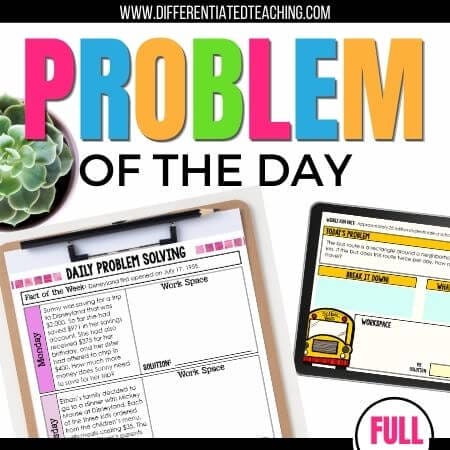
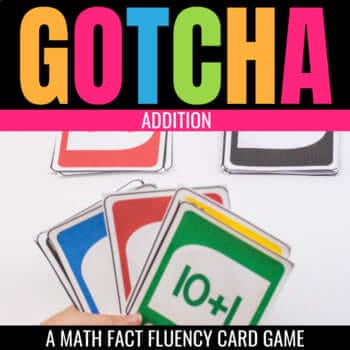
Check out these Great Resources for Building Math Skills
Finally, if you have questions about accommodations or want to share ideas, please leave a comment below! I’m always looking for new ways to support my students.
Looking for more math differentiation support?
This post is part of the Math Differentiation resource collection — accommodations, word problem strategies, fluency support, and intervention tools all in one place:
→ Math Differentiation: Accommodations, Word Problems, Fluency, and Intervention