Teaching Reading Comprehension with Pictures: A No-Decoding Way to Build Real Skills
Here’s a scenario every reading teacher knows: you’ve planned the perfect mini-lesson. Great text, clear modeling, a skill your students genuinely need. Then it’s time for independent practice, and you’re suddenly juggling twenty readers at wildly different levels – and a chunk of them can’t access the skill you just taught because their independent reading level doesn’t support it yet.
Some of your students may never even get to practice the comprehension skill you taught that day, simply because the only text they can decode independently is too simple to require it. That’s not a teaching problem. That’s a structural mismatch between the skill and the text – and it’s one of the most common, least talked-about obstacles in differentiated reading instruction.

Pictures solve this in a way that’s almost deceptively simple: take the words out of the equation, and the comprehension skill becomes accessible to every reader in the room, regardless of decoding level.
Why struggling readers often struggle with comprehension tasks – not comprehension itself
This is worth sitting with for a second, because it changes how you think about intervention: struggling readers often don’t actually struggle with the thinking part of reading. They struggle with the words on the page getting in the way of the thinking.
Comprehension isn’t something that only happens in text. We infer, summarize, and draw causal relationships constantly, in conversation, while watching something happen, while looking at an image. When we apply those same thinking skills to text, we add an entire additional layer of complexity: decoding, fluency, vocabulary recognition, all competing for the same limited working memory that comprehension itself needs to use.
For a struggling reader, that combination is often overwhelming enough that the comprehension practice never really happens. They’re too busy decoding to do the higher-level thinking the lesson was designed to build.
Take pictures, and you remove that competition entirely.

The Benefits of Teaching Comprehension Through Pictures
1. It equalizes the playing field for struggling readers
By taking reading level out of the equation, students don’t need to decode before they can apply a comprehension skill. This is the single biggest benefit, and it’s the one that solves the exact problem from the opening scenario.
I cannot tell you how many times I ran into the same wall: my lowest readers couldn’t practice the comprehension skill we were working on, because their leveled text simply didn’t support it. The moment I shifted to using photos as part of reading instruction, even my non-readers were able to understand and genuinely practice the comprehension skill itself. Instead of getting lost in vocabulary or having decoding accuracy block their ability to even understand what the text said, they could focus entirely on generating a strong main idea sentence, or identifying solid evidence for an inference.
That mental energy, freed up from decoding, goes entirely toward the actual skill and the strategies you’ve taught. And there’s a compounding benefit: students who get this kind of practice don’t fall as far behind on higher-level thinking while their decoding catches up. When they do reach a reading level that supports the skill in text, they already know how to do the thinking – they just need to transfer it.
2. Pictures encourage participation from reluctant readers
Every reading teacher has had the student who tries to disappear into the corner during reading time, avoiding eye contact, hoping not to get called on. No amount of scaffolding or praise fully solves this when the underlying issue is that the student doesn’t feel confident enough to risk being wrong out loud.
Pictures change the risk calculation. Students can build comprehension skills and participate fully without the exposure of having to read aloud or admit they didn’t understand a passage. The image is visible to everyone in the room at the same time – there’s no information gap creating that particular kind of anxiety.
3. Pictures break down language barriers
For students learning English, pictures are already one of the most effective tools for building vocabulary in context. As language skills develop, that same visual support becomes a bridge into comprehension work specifically.
Instead of getting tangled in translation or phonics demands, English language learners can focus their energy on the comprehension skill itself – inferring, summarizing, identifying cause and effect – using a shared visual reference everyone in the room can access equally.
4. Pictures make comprehension practice genuinely engaging
Many struggling readers have spent years finding reading difficult, and a meaningful number have become genuinely skilled at avoiding it. That avoidance compounds over time, because students who read improve, and students who avoid reading fall further behind – a gap that widens every year it goes unaddressed.
Picture-based comprehension work sidesteps a lot of that resistance. Students often don’t fully register that they’re doing serious reading skill work, because the format feels more like a quick, low-pressure task than a reading assignment. That’s not a trick – it’s a genuine reduction in the cognitive and emotional load that’s been attached to “reading” for that student, which makes the practice itself more sustainable.
How to Build a Weekly Routine for Teaching Comprehension Through Pictures
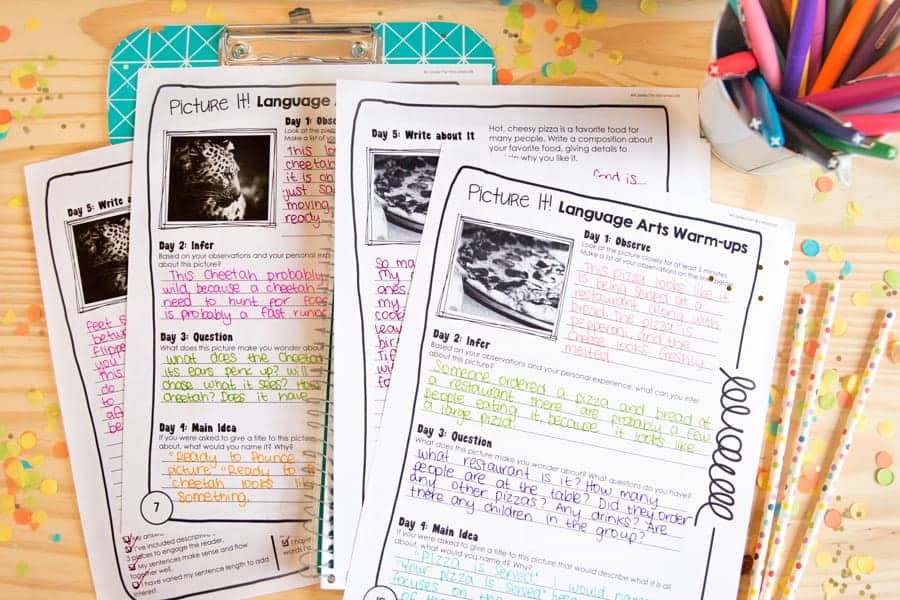
Routine matters enormously for struggling readers. A consistent structure that students can move through with minimal new directions each day saves instructional time and builds independence. Here’s the weekly structure I used in my own classroom, both as part of a morning routine and in literacy centers for differentiated practice.
Monday: Observe the Photo
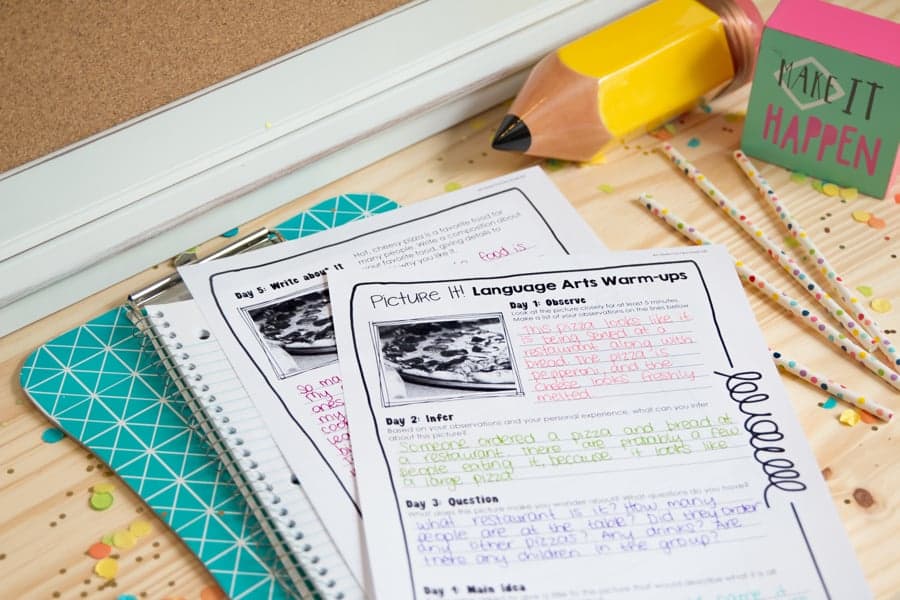
Students start by simply observing the photo and documenting what they notice – no inference or interpretation yet, just careful attention to detail. This is harder than it sounds for many struggling readers, who often skim past detail in any format, text or image.
This step does double duty: it builds the specific vocabulary students will need to interpret the photo later in the week, and it sets up the higher-level thinking that follows. Depending on the day, I’d have students discuss their observations in partners or small groups before moving on.
Tuesday Through Thursday: Daily Comprehension Skill Focus
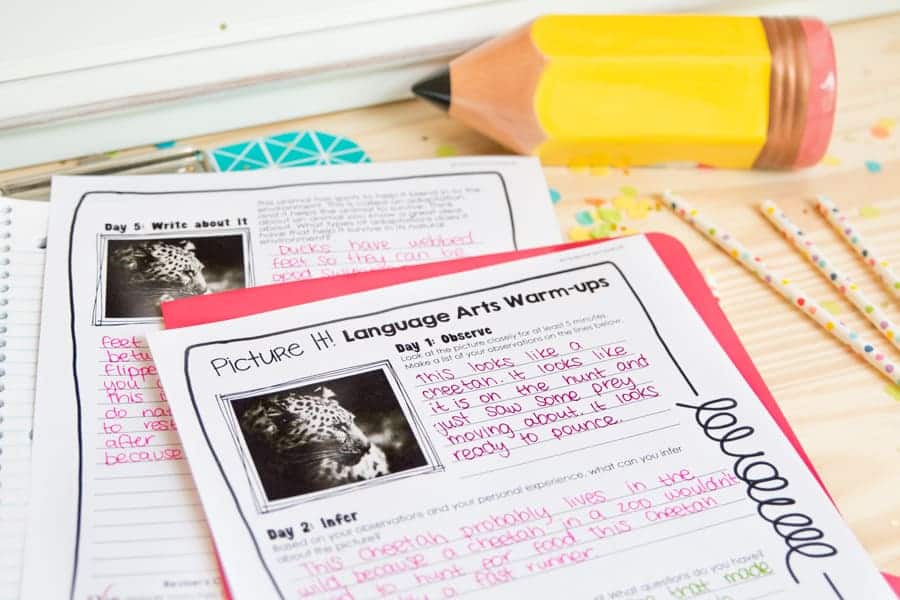
The image stays the same all week, but the comprehension skill in focus changes each day – inferring, questioning, identifying main idea, and so on. Keeping the photo constant while rotating the skill lets students dig deeper into the same content across multiple days, which builds a richer, more layered understanding than a new image every day would.
It also means your prep stays minimal. One image, multiple days of differentiated skill practice.
Friday: Quick Write and Edit
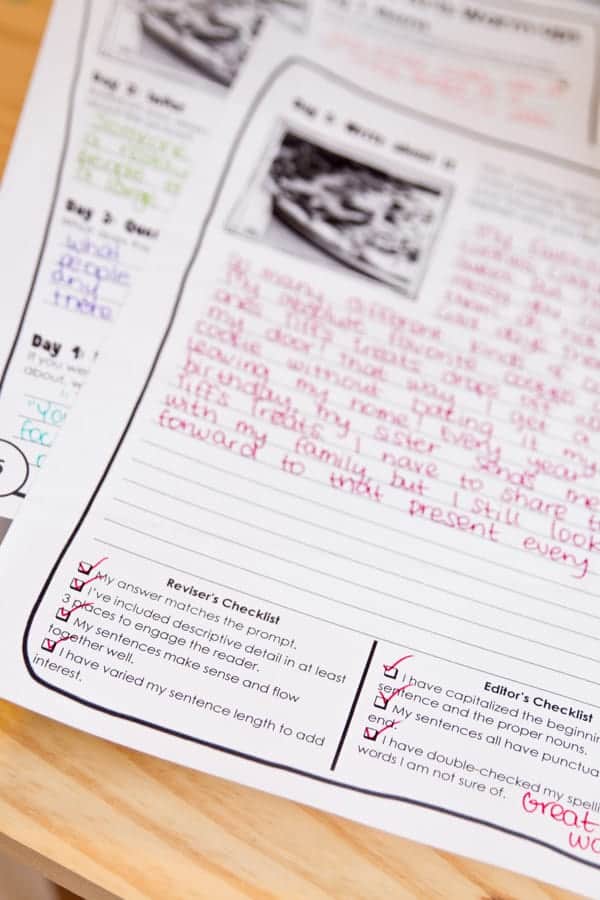
By Friday, students complete a writing prompt connected to the week’s image. Keep these genuinely varied and accessible – even struggling writers should be able to engage with the prompt. The genre can rotate regularly: personal narrative one week, descriptive or expository the next, opinion or creative writing another time. This keeps students practicing across genres without it ever feeling repetitive.
After writing, a short editing checklist gives students a chance to practice composition and editing as connected skills, rather than two entirely separate exercises. Save particularly strong pieces – they make excellent material for a final, polished draft later if a student is genuinely invested in a particular piece.
What Changes When You Use This Routine Consistently
After several weeks of this kind of practice, the shift in struggling readers is genuinely noticeable. Students develop a much clearer understanding of comprehension skills and, more importantly, how to actually apply them – not just in the picture-based format, but increasingly during read-alouds and other listening comprehension contexts too. Over time, that transfer extends into their independent text reading as well.
There’s also a meaningful stress reduction on both sides. Struggling readers aren’t trying to simultaneously learn to decode and master challenging comprehension skills in the same breath. And for you as the teacher, this routine creates space to work more intensively on decoding during small group reading time, without the worry that students are missing out on grade-level comprehension exposure while that foundational work happens. As decoding accuracy and fluency develop, students are better positioned to apply the comprehension skills they’ve already practiced extensively – just now in text.
Try It Yourself: Free Picture Comprehension Warm-Ups
Want to see how this works before committing to anything? I’d love to send you a two-week sample of picture comprehension warm-ups, perfect for morning work, a daily language arts center, or small group tutoring and intervention support targeting specific skill gaps.
Here’s what’s included:
- Teacher tips and directions for implementation
- 2 double-sided printable pages designed for students
- Larger color copies of the images, ideal for projecting
Grab your free sample here:
Ready for the Full Year?
If the free sample works well in your classroom, Photo of the Week gives you a full year of this exact routine, ready to go – picture prompts, comprehension skill rotations, and writing extensions built specifically with struggling and reluctant readers in mind.
Already using it? Don’t miss 7 Ways to Get More from Your Picture-Based ELA Bell Ringers for ideas on extending this routine into small groups, discussion, and progress monitoring.
More Support for Struggling Readers and Writers
Academic Vocabulary Activities That Work
Differentiation for Struggling Readers: Here’s What You Need to Know
5 Engaging Ways to Make Inferring Approachable to Struggling or Reluctant Readers
How to Build Writing Stamina with Struggling Writers
Totally Free Websites for Digital Reading in the Classroom
Looking for more support struggling readers or writers? Check out these related articles: