Front Desk Novel Study Activities
There’s a moment early in Front Desk when Mia Tang realizes that words matter. That her voice matters. That telling her story might actually change something.
That quiet shift is what makes this book so powerful in the classroom.
Kelly Yang’s Front Desk follows ten-year-old Mia as she helps her immigrant parents run a motel, navigates school in a new country, and begins to understand what it means to stand up for herself and others. Through humor, heartbreak, and small everyday victories, students encounter themes of identity, resilience, injustice, and the power of writing in a way that feels real and relatable.
It’s the kind of book that sparks conversation. The kind that sticks with students long after the last chapter.
And it’s a perfect fit for a novel study.
This Front Desk Novel Study Unit was designed to help students engage deeply with Mia’s story without overwhelming them with busywork or endless chapter questions. Instead of focusing on recall, each day centers on one meaningful comprehension skill and invites students to think, write, and talk about the text in purposeful ways.
Whether you’re teaching this as a whole-class novel, in book clubs, or as an independent study, this unit keeps the focus where it belongs: on thinking, not worksheets.
What’s included in this Front Desk Novel Study?
This unit includes 25 days of instruction and focuses on both comprehension and vocabulary in a way that feels manageable and student-friendly.
Your download includes:
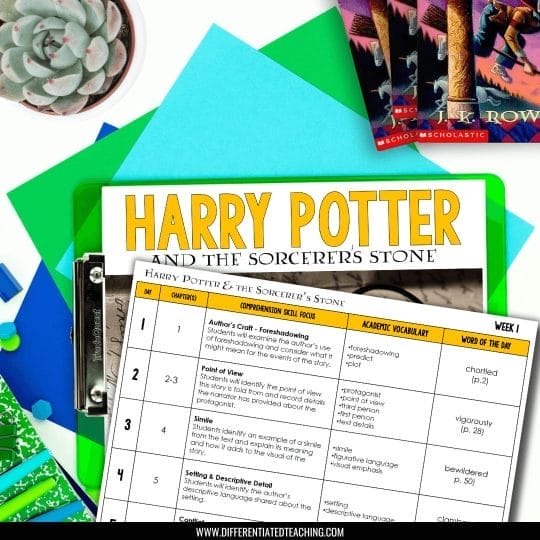
- An instructional planning guide with daily objectives, reading assignments, and vocabulary
- Weekly comprehension trifolds (color & black-and-white)
- Reader’s Notebook cut & paste prompts
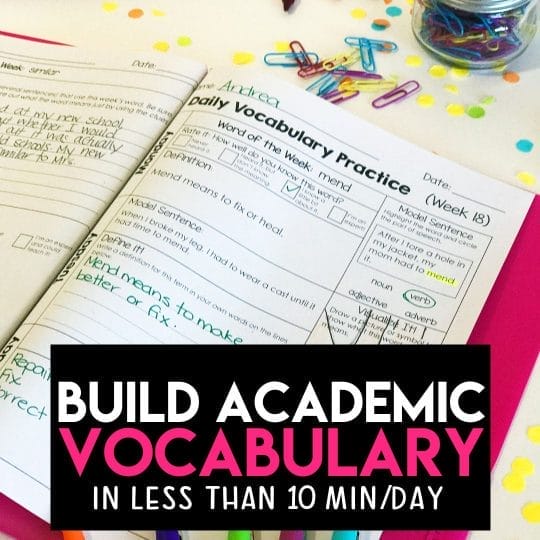
- Weekly vocabulary flip books
- Answer keys for easy grading
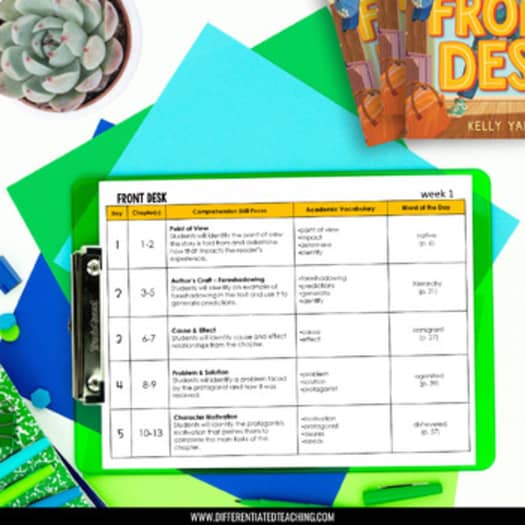
Each day targets one core reading skill, enabling students to delve deeper rather than merely skim the surface.
Comprehension skills addressed
The prompts in this Front Desk novel study are carefully aligned to the moments in the text where these skills naturally emerge. Students practice:
- Point of view
- Foreshadowing
- Cause and effect
- Problem and solution
- Character motivation
- Visualizing
- Conflict
- Perspective
- Theme
- Plot structure (rising action, climax, falling action, resolution)
- Summarizing
- Making inferences
- Text connections
- Compare and contrast
- Internal conflict
- Dialogue and author’s craft
- Figurative language
Each day’s prompt asks students to apply the skill directly to what they’ve read, using evidence from Front Desk. The result is deeper thinking and stronger transfer to other texts.
How do students respond?
The daily comprehension prompts are available in two formats:
Trifolds
The foldable trifolds cover a full week of reading on a single sheet of paper. Each day uses one section, which keeps the work approachable, especially for reluctant writers.

Many teachers love that trifolds double as bookmarks and are easy to collect and grade.
Reader’s Notebook Prompts
The cut & paste prompts are ideal for students who:
- Write longer responses
- Need more space
- Prefer keeping everything in one journal
Because the prompt is identical in both formats, you can mix and match within your classroom.
Built-in differentiation
One of the biggest strengths of these prompts is their flexibility.
Advanced learners can be asked to:
- Write multi-paragraph responses
- Use a RACE or CER structure
- Cite multiple pieces of text evidence
- Expand their thinking across chapters
Struggling writers can:
- Respond in shorter formats
- Use fewer examples
- Focus on one clear idea
- Build confidence without shutting down
Everyone is working on the same skill, from the same text, at a level that’s appropriate for them.
Vocabulary that matters
Each day includes:
- One text-based vocabulary word pulled directly from the reading
- Key academic language tied to the comprehension skill
Students record the daily word in a flip book designed for reading journals. Depending on your students, they can:
- Write a definition
- Use the word in a sentence
- Add a synonym or antonym
- Draw a visual representation

This approach keeps vocabulary instruction purposeful and connected to the story.
Why teachers love this format
- No fluff or filler
- One clear focus per day
- Less paper, less prep
- Supports reluctant readers and writers
- Encourages real thinking and discussion
- Works for whole-class, small groups, or independent study

Front Desk is a book about finding your voice. This novel study gives students the structure they need to practice using theirs.
Front Desk Novel Study Unit
This Front Desk novel study is available in my shop and on Teachers Pay Teachers.


If you’re looking for a way to help students think deeply, write with purpose, and connect with a story that truly matters, this unit is ready to go.