A Long Walk to Water: A Novel That Stays With Students Long After the Last Page
There’s a moment early in A Long Walk to Water when students realize just how much walking shapes this story. Not walking to school. Not walking the dog. Walking for water. Walking to survive. Walking because standing still is not an option.
Linda Sue Park’s novel follows two 11-year-olds living in Sudan, separated by decades but connected by hardship, resilience, and hope. Nya’s story takes place in 2008 as she makes a daily, dangerous journey to collect water for her family. Salva’s story begins in 1985, when war forces him to flee his village and walk hundreds of miles in search of safety. The chapters alternate between their experiences, quietly building connections that students don’t fully see until the end.
This structure is exactly what makes A Long Walk to Water such a powerful teaching text. Students aren’t just reading about survival… They’re piecing together two perspectives, two timelines, and two lives shaped by the same landscape and conflict.
A Quick Overview of A Long Walk to Water
A Long Walk to Water is based on the true story of Salva Dut, one of the “Lost Boys of Sudan.” Through short, accessible chapters, students follow Salva’s journey as he navigates war, displacement, loss, and ultimately purpose. Interwoven with his story is Nya’s daily routine of walking miles for water, a task that defines her childhood and limits her opportunities.
Because the chapters are brief and the language is approachable, the book feels accessible to reluctant readers while still offering deep opportunities for analysis. Themes of perseverance, hope, community, and the power of small steps surface naturally, making this novel a strong fit for upper elementary and middle school classrooms.
Why A Long Walk to Water Works So Well for a Novel Study
What makes this book especially effective for novel studies is how much thinking it invites without overwhelming students. The alternating points of view naturally support instruction on perspective, theme, and structure. The real-world context opens the door to meaningful cross-curricular connections with social studies and geography. Because the story is rooted in survival and human experience, students remain emotionally invested.
Rather than assigning pages of chapter questions that ask students to retell what just happened, this novel lends itself to deeper comprehension work… Asking why characters act the way they do, how their experiences shape them, and what the author wants readers to take away.
What’s included in this A Long Walk to Water novel study?
The 4-week A Long Walk to Water novel study unit includes up to 20 instructional days of structured comprehension practice and vocabulary instruction. The focus stays on text analysis and responding to literature, not on recalling details that students can easily skim.
Your download includes:
- Daily comprehension prompts in three formats for easy differentiation:
- Foldable trifold brochures
- Cut-and-paste Reader’s Notebook prompts
- Google Slides (one slide per day)
- Weekly Word of the Day flip books for text-based vocabulary
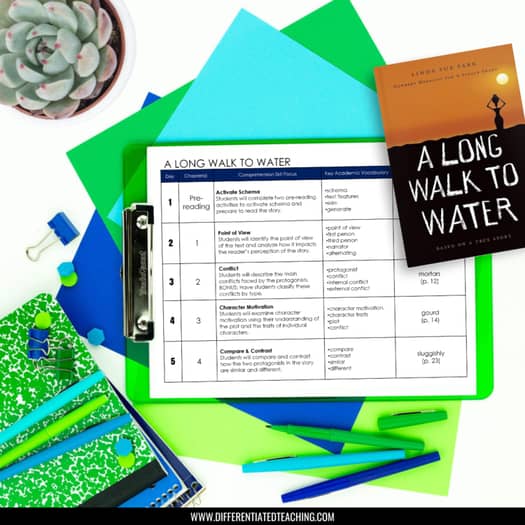
- Instructional planning guide with daily skill and vocabulary focus
- Easy-to-follow directions for printing and prep
- Answer keys for all comprehension activities
Comprehension skills addressed in this novel study
The comprehension skills in this unit were carefully selected to align with the text and the skills students need repeated practice with at this grade level.
Skills addressed include:
- Generating summaries of key events
- Exploring point of view and its impact on the reader
- Analyzing story elements and plot structure, including climax and setting
- Examining character development, traits, and motivation
- Synthesizing information to identify key themes
Each day focuses on one standards-based comprehension skill, allowing students to slow down and apply their thinking meaningfully rather than rushing through multiple disconnected tasks.

How do students practice the comprehension skills?
Daily comprehension prompts are provided in three student-friendly formats, making it easy to meet a range of learner needs.
The trifold format covers a full week of reading on a single sheet of paper. Students complete just one focused response per day, which helps prevent overwhelm and keeps reluctant writers engaged. Many teachers also use the trifolds as bookmarks, which helps keep materials organized.
The Reader’s Notebook prompts provide more space for students who need or prefer longer written responses. These work well for interactive notebooks or students who benefit from having all of their thinking in one place.
The Google Slides version mirrors the same daily prompts and makes the unit easy to use in digital or 1:1 classrooms.
Because the questions remain the same across all formats, you can differentiate without planning separate assignments.

Built-in differentiation for a wide range of learners
The comprehension prompts in this A Long Walk to Water novel study are intentionally flexible. Each question targets a single skill, making it easy to adjust expectations while keeping students focused on the same learning goal.
For students who need more challenge, responses can be extended by:
- Writing longer or multi-paragraph answers
- Supporting ideas with multiple pieces of text evidence
- Explaining why the evidence supports their thinking
For students who need additional support, expectations can be adjusted by:
- Writing shorter responses focused on the core idea
- Citing one strong piece of text evidence
- Using the built-in graphic organizers for structure
This approach keeps instruction cohesive while supporting both struggling and advanced learners.
What vocabulary is included with the A Long Walk to Water novel study?
Each day includes one target vocabulary word drawn directly from the text. Vocabulary is taught in context rather than as isolated lists, helping students build meaning as they read.
The weekly vocabulary flip books:
- Provide a flexible format for definitions and application
- Encourage connections to academic vocabulary used in comprehension skills
- Fit easily into reading journals or notebooks
Teacher support materials
To make planning and implementation simple, this novel study includes:
- A clear unit scope and sequence outlining daily comprehension and vocabulary goals
- Answer keys for all activities
- Tips for preparation and classroom use
This makes the unit easy to use for whole-class instruction, small groups, or independent reading.
How to use and purchase the A Long Walk to Water novel study
This novel study provides a structured, low-prep way to guide middle school students through a meaningful text while building transferable comprehension skills and fostering thoughtful discussion.

You can find this resource in my Teachers Pay Teachers store, along with nearly 200 additional novel studies designed to support deep reading without unnecessary overwhelm.