Behavior & Work Habits Report Card Comments: Showing Progress & Needs Improvement
Needs improvement comments are some of the hardest to write. You’re not just describing an academic gap… You’re telling a family that their child’s behavior, work habits, or attitude toward learning is getting in the way. That message needs to land clearly without feeling like an attack on the child or the family.
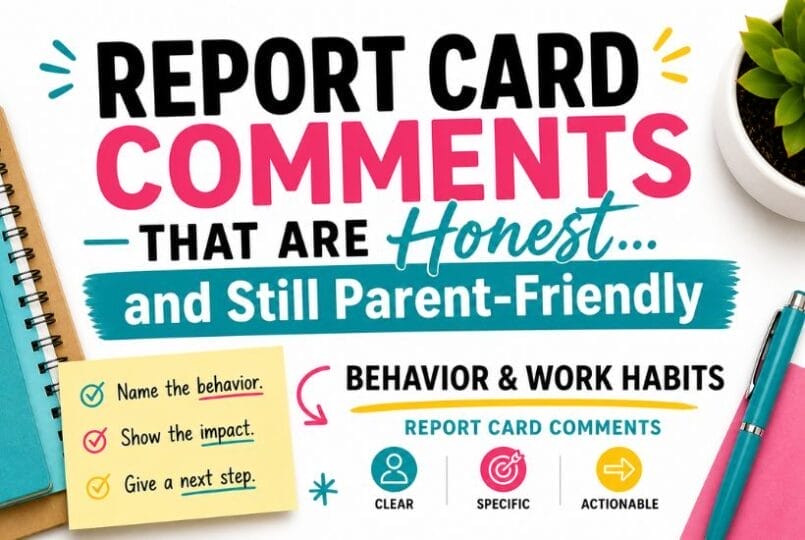
The good news: these comments follow a predictable structure once you know what you’re doing. Name the specific behavior, connect it to the impact on learning, and offer a concrete next step the family can actually use. That’s it. The comments below are organized to make that structure easy to apply.
For comments focused on academic struggles rather than behavior, see the full 200+ report card comments for struggling students. For the broader comment framework, visit the complete report card comments guide.
How to write needs improvement comments that don’t damage trust
Parents almost always know something is off. What they often don’t know is exactly what the behavior looks like in a classroom setting, why it matters academically, or what they can do at home. Your comment is the bridge between what you see every day and what they experience at home.
Three things make needs improvement comments work:
- Be specific about the behavior, not the character. “Has difficulty completing independent work without reminders” is specific and actionable. “Lacks motivation” is a character judgment that puts families on the defensive.
- Connect the behavior to the learning impact. Parents understand stakes better when they see consequences: “Because assignments are frequently incomplete, _____ is missing the practice needed to build fluency in these skills.”
- Give a doable next step. A homework planner, a morning check-in routine, a daily question to ask at dinner — the more specific and low-lift the suggestion, the more likely families will actually try it.
One more thing worth knowing: if a student’s behavior challenges are significant enough to appear repeatedly in report card comments, that pattern matters for documentation. Keeping clear records of the supports you’ve provided and the communications you’ve had with families is important — especially if the student may eventually be referred for additional services. The Tier 1 documentation guide covers exactly how to do this without adding hours to your week.
Focus and attention
Difficulty maintaining focus is one of the most common patterns teachers need to address — and one of the most sensitive, because families may wonder whether something more significant is going on. Keep the language behavioral and observable rather than diagnostic.
Showing Progress
- _____ has shown improvement in maintaining focus during independent work and requires fewer reminders to stay on task.
- _____ is becoming more consistent in staying engaged during lessons and completing assigned tasks.
- _____ has made progress in sustaining attention for longer periods of time.
- _____ is beginning to refocus more quickly after becoming distracted.
- _____ has improved in following along during instruction and is better able to stay engaged.
- _____ is showing growth in managing attention, especially when tasks are broken into smaller parts.
- _____ is working toward maintaining focus independently and has shown steady progress.
Needs Improvement
- _____ has difficulty sustaining attention during longer tasks and may lose focus partway through assignments.
- _____ begins tasks appropriately but has difficulty maintaining focus without reminders.
- _____ has a tendency to rush through assignments without checking work. Encouraging _____ to read directions carefully and review completed work before turning it in would make a noticeable difference.
- _____ is easily distracted by surroundings, which impacts the ability to complete work independently.
- _____ benefits from frequent check-ins to stay engaged with tasks.
- _____ may appear attentive during instruction but has difficulty following through during independent work.
- During independent work, _____ frequently moves off-task and needs redirection. Reducing distractions in the work environment — both at school and at home — would help _____ build this skill.
- _____ has difficulty returning to a task after becoming distracted.
- _____ is still developing the ability to manage attention across multi-step tasks.
- _____ benefits from breaking tasks into smaller, manageable parts to maintain focus.
- _____ may shift attention between tasks rather than completing one task at a time.
- _____ has difficulty staying focused during independent work time. Frequent reminders are needed to re-engage with tasks, which limits the amount of practice _____ is able to complete in class.
- _____ tends to become distracted during lessons and misses key instruction as a result. Building a consistent at-home routine for homework — a quiet space, a set time — would support the habit of sustained focus.
- _____ works effectively when working one-on-one or in a small group but struggles to maintain focus in a larger group setting. We are working on strategies to build this skill in class.
- Staying on task for the full duration of an activity is a growth area for _____. Setting a small, visible timer at home during homework time can help build the habit of sustained attention.
Work completion and organization
Incomplete work and disorganization are often related to executive functioning challenges rather than effort or attitude — which is worth keeping in mind as you write. Frame the need in terms of skills to build, not habits to break.
Showing Progress
- _____ has shown improvement in completing assignments during the allotted time.
- _____ is becoming more consistent in turning in completed work.
- _____ has made progress in organizing materials and keeping track of assignments.
- _____ is beginning to check work more carefully before submitting.
- _____ has improved in using class time productively to complete tasks.
- _____ is showing growth in managing assignments and following through on expectations.
- _____ is developing stronger organizational habits and is becoming more independent.
Needs Improvement
- _____ frequently does not complete assignments during the allotted class time, which creates gaps in practice and makes it harder to keep pace with new concepts. Establishing a consistent homework routine would help.
- Turning in completed work on time is an area for growth. _____ often submits assignments with portions unfinished. A simple assignment checklist at home could help _____ develop the habit of reviewing before submitting.
- _____ has difficulty managing time effectively during independent work.
- _____ often begins assignments but does not complete all parts of the task.
- _____ needs reminders to check work for completeness before turning it in.
- _____ benefits from explicit support in organizing materials and tracking assignments.
- _____ has missed several assignments this term. I’d love to connect with you about a system for staying on top of work — a planner, a shared checklist, or a regular check-in — that could work for your family.
- _____ may misplace completed work or forget to turn it in.
- _____ has difficulty prioritizing tasks when given multiple assignments.
- _____ would benefit from using a structured system (planner, checklist, or folder) to stay organized.
- _____ sometimes completes work quickly but misses important details.
- _____ is still developing independence in managing materials and assignments.
- _____ has difficulty keeping track of materials and assignments. A dedicated homework folder and a brief end-of-day check-in — “Do I have everything I need?” — would support better organization.
- Work quality is inconsistent for _____. When _____ takes time with assignments, the results show real understanding. Building the habit of slowing down and checking work would make a meaningful difference.
- _____ understands the material when we work together but often does not complete independent practice, which limits the consolidation of new skills. Regular, brief practice at home — even 10 minutes — would support continued progress.
Participation and engagement
Showing Progress
- _____ has shown increased participation in class discussions and activities.
- _____ is becoming more comfortable sharing ideas during class.
- _____ has made progress in engaging with lessons and contributing to group work.
- _____ is participating more consistently, especially when prompted.
- _____ is beginning to take a more active role in discussions and collaborative activities.
- _____ has shown growth in confidence when sharing thinking with others.
- _____ is becoming more engaged and involved during instructional time.
Needs Improvement
- _____ participates inconsistently in class discussions and group activities.
- _____ may appear disengaged during instruction and needs prompting to re-engage.
- _____ listens during discussions but does not often contribute ideas.
- _____ is still developing confidence in sharing thinking with peers.
- _____ tends to observe rather than actively participate during group work.
- _____ benefits from structured opportunities to participate (turn-and-talk, small group discussion).
- _____ may disengage when tasks feel challenging or less preferred.
- _____ is more engaged during hands-on or interactive activities than during whole-group instruction.
- _____ rarely volunteers to participate in class discussions, even when it’s clear they know the answer. Encouraging _____ to share their thinking at home — during dinner, during a read-aloud — can build the confidence to participate more in class.
- Active participation in group work is a growth area for _____. _____ tends to let others take the lead rather than contributing their own ideas. We are working on strategies to support this in class.
- _____ has begun to disengage during certain parts of the day. I’d welcome a conversation about what might be contributing to this and how we can support _____ in staying connected to learning.
- _____ participates well when called on directly but hesitates to engage voluntarily. Asking _____ to share something they learned each day can help build comfort with speaking up.
Behavior and classroom community
Behavior comments that involve impact on other students need to be handled carefully. Be clear about what the behavior looks like and why it matters, without labeling the child.
Showing Progress
- _____ has shown improvement in making choices that support a positive learning environment.
- _____ is responding more appropriately to redirection and feedback.
- _____ has made progress in managing behavior during class activities.
- _____ is working toward more consistent use of expected behaviors.
- _____ has improved in transitioning between activities with fewer disruptions.
- _____ is showing growth in managing impulses during instructional time.
- _____ is developing greater independence in maintaining appropriate behavior.
Needs Improvement
- _____ is working on making choices that support both personal learning and the learning of others.
- _____ has difficulty managing impulses during instructional time.
- _____ may call out or interrupt during lessons, which can disrupt the flow of instruction.
- _____ is learning to follow classroom expectations consistently across settings.
- _____ has difficulty maintaining appropriate behavior during less structured times.
- _____ benefits from reminders to use expected behaviors during group activities.
- _____ is working toward greater independence in managing behavior without adult support.
- _____ may become frustrated quickly, which can impact interactions with peers.
- _____ is working on making choices that support a positive learning environment for everyone. There have been instances this term where _____ has disrupted instruction for other students. We have strategies in place to support _____’s progress in this area.
- Responding respectfully to redirection is a growth area for _____. When redirected by an adult, _____ sometimes reacts in ways that escalate the situation. We are practicing calm responses together in class.
- _____ has difficulty transitioning smoothly between activities, which can disrupt the flow of the day. Practicing transition routines at home — signaling when one activity is ending and another is beginning — may help build this skill.
- _____ is kind and likeable, and is working on channeling their social energy toward times set aside for it. Keeping conversations and socializing for appropriate times is an area we are actively developing.
- _____ benefits from a great deal of one-on-one support to stay on track throughout the day. We are working together to build greater independence. If you have strategies that work at home, I’d love to hear them.
Effort and attitude toward learning
Be careful here. “Lacks effort” is one of the most damaging things to write on a report card, and it’s rarely accurate — what looks like low effort is usually anxiety, a skill gap, or a mismatch between the task and where the student is. Write what you observe, not the interpretation.
Showing Progress
- _____ has shown improvement in approaching challenging tasks with greater confidence.
- _____ is beginning to persist longer when work becomes difficult.
- _____ has made progress in starting tasks more independently.
- _____ is becoming more willing to attempt challenging work.
- _____ has shown growth in effort and is taking more ownership of learning.
- _____ is beginning to ask for help when needed rather than avoiding tasks.
- _____ is developing a more positive and consistent approach to learning.
Needs Improvement
- _____ is still developing the confidence to engage fully with challenging tasks.
- _____ may hesitate to begin work when unsure how to proceed.
- _____ benefits from encouragement to take academic risks.
- _____ is learning to persist through tasks that require sustained effort.
- _____ may rely on reassurance before attempting new or unfamiliar work.
- _____ sometimes completes work quickly to be finished rather than focusing on quality.
- _____ is building the ability to stay engaged even when work becomes more difficult.
- _____ benefits from clear expectations and structured support when approaching new tasks.
- _____ sometimes avoids beginning tasks that feel challenging. We are working on strategies to help _____ start even when the work feels hard. Praising effort — not just results — at home reinforces this message.
- When _____ encounters difficulty, the tendency is to give up quickly rather than persist. Building a “not yet” mindset — celebrating attempts, not just correct answers — is something we’re working on together.
- _____ has been reluctant to ask for help when stuck, which sometimes leads to incomplete or rushed work. Reinforcing at home that asking for help is a sign of strength, not weakness, would support this growth.
- _____ has the skills to do this work but does not always apply consistent effort. A brief daily check-in about one thing they worked hard on — regardless of whether they got it right — can help build that habit.
Executive functioning
Executive functioning skills include planning, organization, time management, and task initiation. These skills play a major role in how students manage their learning day-to-day.
Showing Progress
- _____ has shown improvement in getting started on tasks with less support.
- _____ is beginning to break tasks into smaller steps more independently.
- _____ has made progress in following multi-step directions.
- _____ is becoming more independent in managing assignments and responsibilities.
- _____ has improved in planning and completing tasks with support.
- _____ is showing growth in staying organized and managing materials.
Needs Improvement
- _____ has difficulty getting started on tasks without adult support.
- _____ needs support breaking larger assignments into smaller steps.
- _____ has difficulty managing multi-step directions independently.
- _____ may become overwhelmed when tasks feel complex or open-ended.
- _____ benefits from clear, step-by-step expectations.
- _____ is still developing independence in planning and completing tasks.
A note on documentation
If you’re writing needs improvement comments for the same student across multiple report periods, that pattern is worth documenting carefully — not just in report card language, but in a form families have signed and that can accompany a referral if needed.
The Tier 1 documentation guide includes a free parent communication kit with the assignment checklists and report card letters that make this process straightforward. If behavior concerns are more significant, the guides to planning behavior interventions and what to do before referring a student cover the next steps in detail.
← Back to the complete report card comments guide