Report Card Comments: The Complete Guide for Every Student and Subject
Report card comments are one of the most time-consuming parts of the year during the busy end-of-quarter seasons… but they are also one of the most important for communication. Done well, they give families a real picture of how their child is doing, what’s getting in the way, and what to do next. Done poorly, they’re either too vague to be useful or so blunt they damage the relationship before it starts.
This guide pulls together everything you need: a framework for writing comments that actually help families, ready-to-use comments organized by student type and subject area, and guidance for the situations that are hardest to put into words.
How to write report card comments that mean something
Most teachers have been given the same advice: start positive, identify an area for growth, and suggest a next step. That structure works — but only if each part is specific enough to be actionable.
A comment like “Jaylen is a pleasure to have in class and should continue to work on his reading skills” tells a family almost nothing. A comment like “Jaylen approaches every task with real persistence. His decoding is strong, but comprehension of longer texts is an area we’re working on together — having him retell what he read at home in a few sentences would make a big difference” gives them something to work with.
Three things separate useful comments from filler:
- Specificity. Name the skill, the pattern, or the behavior — not just the general subject area.
- Honesty. Parents of struggling students often don’t know how far behind their child is. The report card comment may be the clearest signal they get. Saying “working toward grade level expectations” is more honest — and more useful — than vague reassurance.
- A concrete next step. What can the family actually do? A specific, doable suggestion (10 minutes of math fact practice, retelling after reading, a homework planner) is worth far more than “encourage him at home.”
Report card comments by student type
The hardest comments to write aren’t the ones for your high flyers or your steadily-progressing middle — they’re the ones for students whose situations are complicated. The student who works hard but still isn’t making it. The student who could do the work but won’t. The student who’s bright in every way except on paper.
Struggling and below-grade-level students
This is the most common report card challenge — and the highest-stakes one. Families deserve to understand where their child actually stands, communicated with care. The goal is clarity without alarm, honesty without discouragement.
This includes comments for students who are working below grade level in academics, students whose grades don’t reflect their true performance without accommodations, and students who are showing growth but still need significant support.
→ 200+ Report Card Comments for Struggling Students

Students who need improvement in behavior or work habits
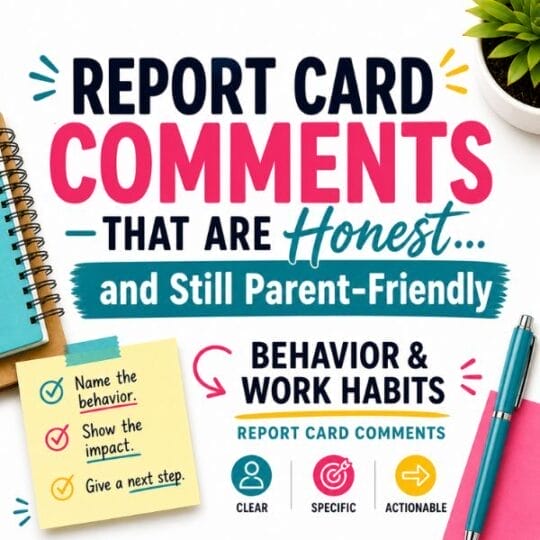
Some students have the academic skills, but the habits aren’t there yet — incomplete work, difficulty focusing, behavior that disrupts their own learning or their classmates’. These comments are delicate because you’re describing patterns that can feel personal to families. The key is to name the behavior specifically, separate it from the student’s character, and give a clear, supportable next step.
→ Behavior Report Card Comments: Needs Improvement & Showing Progress
Students with special needs or IEP/504 accommodations
For students receiving services, report card comments need to reflect both the student’s performance in the context of their accommodations and, when appropriate, their progress toward IEP goals. It’s also important to avoid language that inadvertently minimizes the significance of a student’s needs.
→ See the struggling students guide for comments that address academic gaps honestly while remaining supportive.
Report card comments by subject area
Subject-specific comments are often more useful than general ones because they give families a clear picture of where the gaps are and what they look like in practice. A student who is struggling in math has very different needs than one who is struggling in reading — and the comment should reflect that.
Reading and ELA comments
Reading comments cover a wide range depending on your grade level and the individual student. That can include decoding, fluency, comprehension, vocabulary, writing mechanics, and composition. The most useful reading comments name the specific skill that’s developing rather than just saying “reading is an area of growth.”
Common patterns to address: strong decoding but weak comprehension, good ideas in writing but struggles with organization or conventions, reluctant readers who disengage from independent reading.
→ Report Card Comments for Reading and ELA

Math comments
Math comments often need to address whether a student is working with or without manipulatives, whether fact fluency is a limiting factor for higher-level work, and where procedural understanding breaks down. Parents often don’t know that a child who “gets it with help” may not be able to transfer that understanding independently.
→ Report Card Comments for Math

Report card comments by grade level
The language and expectations you communicate shift significantly across grade bands. What reads as a developmentally appropriate growth area in kindergarten is a more significant concern in third grade. Parents in the early grades often need more context about what grade-level benchmarks look like — parents in upper elementary usually need more specificity about what the gap means for next year.

Kindergarten and primary grades (K–2)
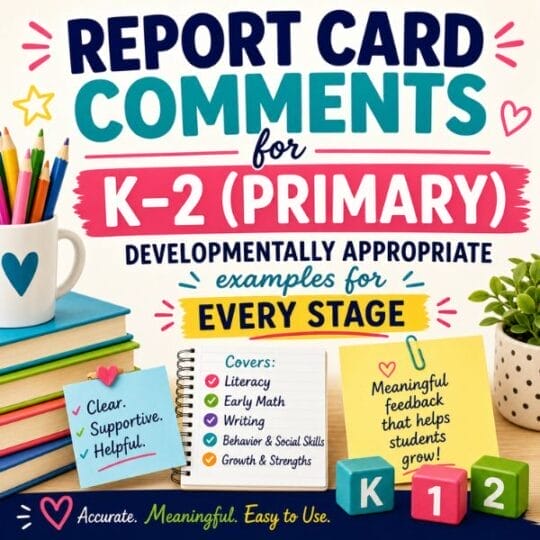
Early childhood report card comments require a different tone — more developmental, less evaluative. You’re often describing where a student is on a continuum of skills that are still emerging for many children at this age. The goal is to help families understand what to watch for and how to support early literacy and numeracy at home without creating unnecessary anxiety.
→ Report Card Comments for Kindergarten and Primary Grades

Upper elementary (grades 3–5)
By third grade, students are expected to be reading to learn rather than learning to read, which means reading gaps become much more visible across all subjects. Upper elementary comments often need to address the cumulative nature of skill gaps and, when appropriate, communicate urgency to families who may not realize how much support their child needs.
The struggling students guide covers grades 3–5 extensively and is the best starting point for upper elementary teachers.
What to avoid when writing report card comments
A few patterns come up repeatedly in comments that don’t serve students or families well:
- Over-softening to the point of dishonesty. “Has room to grow” and “working toward expectations” are fine — but if a student is significantly below grade level, that needs to be said clearly enough that families understand the urgency.
- Generic positives that say nothing. “A pleasure to have in class” is fine as a supporting detail but not as the substance of a comment. Every student deserves specific feedback.
- Next steps that aren’t actionable. “Continue to support your child at home” is not a next step. “Spend 10 minutes a night on XtraMath to build fact fluency” is.
- Jargon families won’t understand. Terms like “phonemic awareness,” “executive functioning,” or “self-regulation” mean something specific to educators but may confuse families. Either define them briefly or use plain language.
- Comparisons to other students. Comments should always be about the individual student’s progress and trajectory, never relative to peers.
Frequently asked questions
How long should report card comments be?
Most schools have a character or word limit — and if yours does, that’s your answer. If you have flexibility, two to four sentences is usually enough. One sentence of specific strength, one sentence describing the growth area with a concrete example, and one sentence with a next step. Longer comments often dilute the message rather than strengthen it.
Is it okay to use the same comment for multiple students?
Using a template as a starting point is completely reasonable — that’s what fill-in-the-blank style comments are designed for. What matters is that the blanks are filled in with specifics that actually reflect that individual student. A comment that could apply to any student in your class isn’t doing its job.
How do I write a comment for a student who is failing but their family doesn’t seem to understand the severity?
This is one of the most important situations to get right. Use clear, direct language — “is currently working below grade level expectations in reading” rather than “has some room for growth.” State specifically what that means: “At this point in the year, students are expected to read independently at a Level P. [Student] is currently reading at a Level K.” Include a concrete request for follow-up: “I’d welcome a conversation about what support might look like going forward.” Documentation in the comment also matters for the student’s academic record.
What’s the best way to write positive comments for students who are struggling?
Lead with something specific and genuine — not just generic praise. A struggling student’s persistence, curiosity, kindness, or growth in one particular area are all worth naming specifically. The goal isn’t to sugarcoat the academic reality but to make sure families also see what’s working and what’s worth building on. That framing also makes the harder feedback easier to receive.
Do I need different comments for progress reports vs. report cards?
Progress report comments tend to be shorter and more focused on current status. Report card comments, especially at the end of a semester or year, benefit from a broader arc — what the student accomplished over the period, where they still need to grow, and what comes next. The same framework applies, but the scope is larger for formal report cards.
🌟 Part of the Differentiated Teaching resource library. See our complete guide: Differentiated Teaching Strategies — covering reading, math, novel studies, sub plans, classroom management, and community.