Why Water Cycle Vocabulary Matters & How to Make Sure Your Students Really Know It
The water cycle is one of those science topics that seems simple at first. Students have heard the words before. They’ve seen the diagram with arrows moving from the ocean to the clouds and back again.
But when you ask them to actually explain what’s happening, things can fall apart pretty quickly.
Students might say things like:
- “The clouds fill up with water.”
- “Rain comes from the sky.”
- “Water disappears when it dries.”
What’s usually missing is the science vocabulary that helps students explain the process clearly.
Words like evaporation, condensation, precipitation, runoff, transpiration, and groundwater give students the language they need to describe what is really happening as water moves through Earth’s systems.
And once students understand those terms, the water cycle starts to make much more sense.

The Water Cycle Is Really a Vocabulary Lesson
In grades 4–6, students move from simply recognizing the water cycle to explaining how it works.
That shift requires vocabulary.
Students need to understand that:
- Evaporation happens when water heats up and turns into water vapor.
- Condensation forms clouds when water vapor cools.
- Precipitation happens when water falls back to Earth.
- Runoff and groundwater move water back toward rivers, lakes, and oceans.

Without those terms, students often describe the process in vague or incorrect ways.
When students do know the vocabulary, their explanations become much more precise.
Instead of saying:
“Water goes up and makes clouds.”
They can explain:
“Water evaporates from oceans and lakes. The water vapor cools and condenses to form clouds.”
That’s a big shift in scientific thinking.
If you want a deeper look at ways to strengthen science vocabulary across subjects, you might also like this post on building science vocabulary in upper elementary classrooms.
3 Ways to Help Students Really Understand the Water Cycle
Teaching vocabulary works best when students see the words used in multiple ways. These strategies help students move from memorizing terms to actually understanding the science behind them.

1. Start With a Visual Model
Water cycle diagrams help students connect vocabulary to the actual movement of water.
When students study a diagram, they can see how different processes work together:
- evaporation moving water into the air
- condensation forming clouds
- precipitation returning water to Earth
- runoff carrying water back toward rivers and oceans
Tracing the path of a drop of water through the diagram helps students understand that the water cycle is a continuous system, not just a list of terms.

2. Use Sorting Activities to Deepen Understanding
Vocabulary sorts encourage students to think about how concepts relate to one another.
Instead of simply matching definitions, students can categorize ideas and explain their reasoning.
For example:
Evaporation vs. Condensation
Students examine examples like steam on a mirror, drying clothes, or dew on grass and decide which process is occurring.
Water Cycle or Not?
Students sort terms that belong in the water cycle from unrelated concepts, such as magnetism or fossilization.
These activities push students to think about the meaning of the words rather than just memorizing them.

3. Reinforce Vocabulary Through Multiple Activities
Students learn vocabulary best when they encounter it repeatedly in different formats.
Activities like these help reinforce understanding:
- diagram analysis
- sentence scrambles
- word searches
- vocabulary matching
- writing explanations of the water cycle

Each activity gives students another opportunity to see how the vocabulary connects to the science.
Over time, the terms start to feel natural instead of confusing.
Water Cycle Vocabulary Activities for Grades 4–6
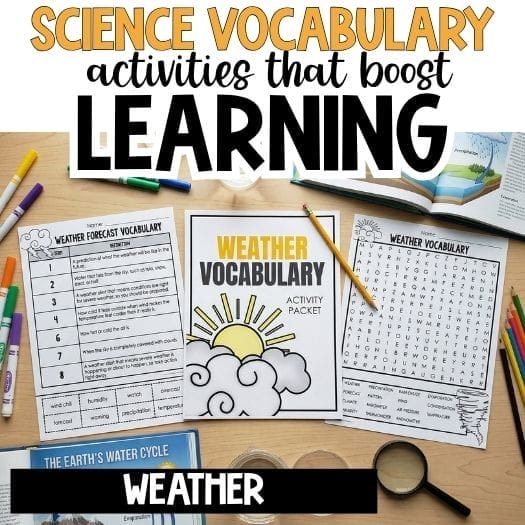
If you’re looking for an easy way to reinforce water cycle vocabulary during your science unit, I created a Water Cycle Vocabulary Worksheet Activity Packet designed specifically for upper elementary students.
This resource includes a variety of activities that help students practice key vocabulary while thinking about how the water cycle works.
Activities include:
✔ Water Cycle Vocabulary Matching
✔ Evaporation vs. Condensation Sorting
✔ Water Cycle or Not? Vocabulary Sort
✔ Observable vs. Not Easily Observable Processes
✔ Water Cycle Diagram Comprehension
✔ Sentence Scramble Activity
✔ Water Cycle Word Search
✔ Vocabulary Sorts for vowels, syllables, and consonants
✔ Answer keys for easy grading

These activities work well for:
- science centers
- review lessons
- early finishers
- homework
- sub plans
Most importantly, they help students build the vocabulary they need to explain the water cycle with confidence.
Teaching the Water Cycle Becomes Easier When Students Know the Words
The water cycle isn’t just a diagram students memorize for a test.
It’s a system that explains how water moves between the land, atmosphere, and oceans.
When students learn the vocabulary behind those processes, they can begin to understand how the entire system works together.
Instead of memorizing isolated facts, they start thinking like scientists.
Explore the Water Cycle Vocabulary Activity Packet
If you’d like ready-to-use activities to reinforce water cycle vocabulary in grades 4–6, you can find the full resource here:
👉 Water Cycle Vocabulary Worksheet: Science Word Search, Sorts, & Activities