Why Time and Money Are So Hard for Students (And How to Teach Them)
Every year, as I started teaching time and money, I would see the same thing happen.
Students who could add and subtract four-digit numbers without blinking suddenly look completely lost when I asked them to make change.
A student who just solved a multi-digit subtraction problem will stare you blankly when you ask them to make change for a purchase made with a $5 bill.
And elapsed time? That’s the moment when perfectly capable students start counting on their fingers and hoping no one notices.
If you’ve taught this unit, you’ve probably watched the same thing happen in your classroom.
What Makes Time and Money Difficult for Students
Students struggle with time and money because these units require several math skills at once:
• place value and decimals
• fractions and unit relationships
• flexible number sense
• real-world reasoning
When those ideas connect, time and money problems suddenly make much more sense.
Why Time and Money Are Surprisingly Difficult for Students
Students who can handle complex computation suddenly freeze when they have to make change. Kids who understand place value perfectly act as if they’ve never seen decimals before the moment a dollar sign appears.
And elapsed time?
That one can send otherwise capable students into a full spiral.
Time and money are supposed to be the relatable math units. The real-world ones.
But in practice, they often end up being some of the most confusing.
And there’s a good reason for that.
Underneath the coins and clock faces, students are actually juggling fractions, place value, unit relationships, and flexible number sense all at once.
Once you start seeing the math behind these units, a lot of student confusion suddenly makes sense.

The Hidden Math Inside Time and Money
Time and money feel like standalone topics, but they’re really familiar math ideas wearing new costumes.
When teachers make those connections explicit, students suddenly have something to hold onto.

Money Is Early Place Value (That Later Becomes Decimals)
Students usually learn about money before they formally study decimals.
But money quietly introduces the same ideas that decimals rely on.
Take $3.75.
Mathematically, that number represents:
- 3 ones
- 7 tenths
- 5 hundredths
It follows the same base-ten place value system that students will eventually see in decimals.
When students count money, they are already working with those relationships… they just aren’t using decimal language yet.
That’s why money can actually make the decimal unit easier later. Students already understand that:
- 10 dimes make a dollar
- 100 pennies make a dollar
- 25 cents is one quarter of a dollar
Those ideas translate naturally to decimal thinking once the notation is introduced.
The challenge is that money problems combine several skills at once:
- Making change involves subtraction
- Splitting money involves division
- Deciding if you have enough requires addition and comparison
When students struggle with money, it’s usually because one of these relationships hasn’t clicked yet.
Common trouble spots include:
• Weak understanding of how coin values relate to each other
• Treating dollars and cents as two separate numbers instead of one amount
• Not realizing that 25 cents, one quarter, and 0.25 represent the same value
Once those connections become clear, money problems feel much less mysterious.
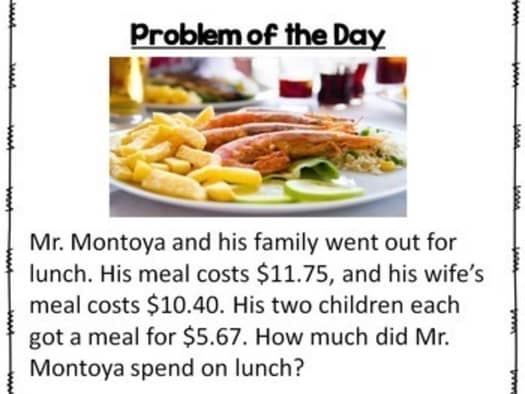
One of the best ways to build this understanding is through consistent exposure to real-world money situations. Short daily problems that ask students to reason through purchases, change, and comparisons help build that number sense over time.
If you want ready-to-use prompts for this, you can find them here:
Money Counting with Coins and Making Change Word Problems
Time Is Fractions of an Hour
Analog clocks work the same way.
An analog clock is essentially a circle divided into 60 equal parts.
Which means many familiar time phrases are actually fractions:
- 30 minutes = 1/2 hour
- 15 minutes = 1/4 hour
- 45 minutes = 3/4 hour
Elapsed time adds another layer of complexity.
Students are often adding or subtracting across different units (hours and minutes), which makes the math harder than it first appears.
Reading an analog clock also requires several ideas happening simultaneously:
• Tracking two hands moving at different speeds
• Skip counting by fives
• Understanding that the numbers represent both hours and minutes
• Recognizing that the hour hand moves gradually rather than jumping
That’s a lot of cognitive load.
So when students stare at the clock like it personally offended them… they’re not being careless.
The task is genuinely complex.
The Penny Situation: What Teachers Actually Need to Know
There’s also a new wrinkle teachers have started navigating.
In November 2025, the U.S. Mint produced its final penny. After more than 230 years, new pennies are no longer being minted.
That doesn’t mean pennies disappear from classrooms overnight.
Here’s what matters for teaching:
Pennies are still legal tender.
They can still be used in transactions and counted in math lessons.
Existing pennies will circulate for years.
There are billions already in circulation.
Some cash purchases may round to the nearest nickel.
Electronic payments still use exact amounts.
For teachers, the takeaway is simple:
Yes, you should still teach the penny.
In fact, the situation creates a great real-world discussion.
Ask students:
“If something costs $1.02 and we don’t have pennies, what happens?”
Should the price round up or down?
Is that fair to the customer?
Is it fair to the store?
Suddenly you’re teaching rounding, money math, and economic reasoning in the same conversation.
Not bad for a one-cent coin.
Why Students Struggle with Time and Money
Even when the underlying math skills are solid, time and money can still trip students up.
One reason is that teachers often assume students have more real-world exposure than they actually do.
Think about it for a moment.
When was the last time you paid for something with coins at a store?
Most transactions students see today are a card tap or a phone payment. Many kids rarely handle coins in everyday life.
Analog clocks are also disappearing from homes. Phones and digital displays have replaced them in many places.
For some students, the classroom may be the first place they really interact with these tools.
That means the hands-on work teachers provide is more important than ever.
Why Time and Money Reveal Weak Number Sense
Time and money units also expose something deeper.
They quietly test students’ number sense.
Students aren’t just calculating. They’re reasoning about quantities, relationships, and units.
When those foundations are shaky, time and money problems reveal it quickly.
For example, making change requires students to decompose numbers flexibly.
If something costs $1.37 and a student pays with $2.00, a student with strong number sense might think:
$1.37 → $1.40 → $1.50 → $2.00

Students with weaker number sense often try to apply a subtraction algorithm immediately, even when it doesn’t make sense to them.
Elapsed time works the same way.
A student solving this problem:
A movie starts at 7:48 and lasts 2 hours and 35 minutes.
might break the time apart like this:
7:48 → 8:00
8:00 → 10:00
10:00 → 10:23
That kind of flexible thinking reflects strong number sense.
Students who struggle often try to add everything at once, which quickly becomes confusing.
Time and money also test how well students understand units.
Students who truly understand the structure of time recognize that:
- 60 minutes make an hour
- 30 minutes is half an hour
- 15 minutes is a quarter hour
Those relationships are essentially fraction reasoning.
Money works the same way.
Students who understand that:
- 100 cents = 1 dollar
- 25 cents = 1/4 of a dollar
- 10 cents = 1/10 of a dollar
are already thinking in fractions and decimals, even if those terms haven’t been formally introduced.
When those relationships are clear, money and time problems feel logical.
When they aren’t, the entire system can feel arbitrary.
Instructional Moves For Teaching Time and Money That Help Older Students
Many time and money activities you see online are designed for very young students.
Sorting coins and coloring clocks are useful when students first encounter the concepts.
But many of the students who struggle later are not beginners.

They know what the coins are. They can read a clock when it’s exactly 3:00.
What they struggle with is reasoning.
So instead of repeating beginner activities, the goal is to give students opportunities to think about the structure behind the math.
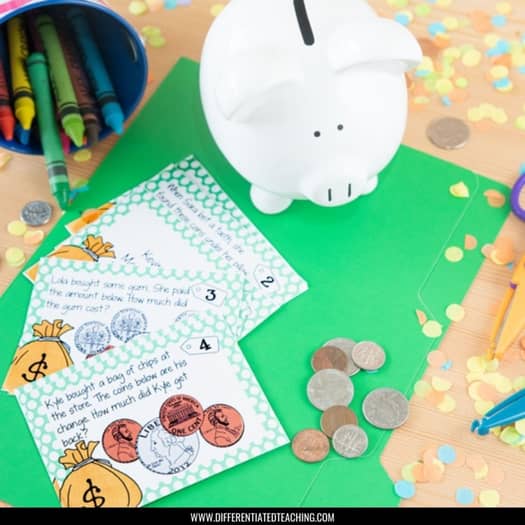
One of the easiest ways to build this reasoning is through short, consistent practice problems. I like using real-world scenarios that ask students to think through purchases, change, and elapsed time rather than just compute answers.
Task cards work especially well because students can move through multiple problems quickly while explaining their thinking.
If you want ready-to-use examples, these Elapsed Time and Money Word Problem Task Cards are designed exactly for that kind of practice.
Another approach that works well is using short real-world scenarios as daily warm-ups.
For example:
You have $2.50.
A snack costs $1.75.
Do you have enough money?
How much change will you receive?
Or:
Lunch starts at 11:15 and lasts 30 minutes.
What time does it end?
These kinds of problems build flexible thinking over time.
If you want a ready-to-use set of prompts that combine elapsed time and money scenarios, you can find them here:
Elapsed Time and Money Word Problems Do Now Math Prompts
Short daily problems like these help students practice reasoning without overwhelming them.
Teaching time and money effectively isn’t just about practicing clock reading or counting coins. It’s about helping students understand the relationships behind the numbers.
Final Thoughts
Time and money are harder than they look.
Not because the math is advanced, but because students have to coordinate several ideas at once: place value, fractions, units, and flexible number sense.
When teachers make those relationships visible and give students opportunities to reason through real situations, the confusion often starts to clear.
And when that happens, students don’t just get better at time and money.
They become better mathematical thinkers overall.
Looking for more math strategies for your classroom? Head over to the Math Hub for hands-on approaches, intervention ideas, and resources that work for every learner.