Why Vocabulary Lists Don’t Work (& What To Do Instead)
(And yes… this might explain your vocabulary problem.)
If you’ve ever handed out a vocabulary list on Monday, given a quiz on Friday, and still gotten student writing that looks like this:
“Stuff happened.”
“It was bad.”
“They did things.”
You are not alone.
And you are not failing.
But traditional vocabulary instruction? It probably is.

The Problem With Weekly Vocabulary Word Lists
Here’s what usually happens:
- Students copy definitions.
- They match words to meanings.
- Maybe they fill in a sentence or two.
- They study the night before the quiz.
- They pass.
- They forget.
The words never make it into their writing.
They never show up in discussions.
They don’t transfer to reading comprehension.
So when test questions use words like analyze, contrast, justify, evaluate, or infer… students freeze.
Not because they can’t think.
Because they don’t own the language.
This is exactly why academic vocabulary gaps show up so clearly on standardized tests… and why they quietly sabotage comprehension across subjects.
If you’re thinking about vocabulary as part of a larger reading support system, you may also want to explore this guide to supporting struggling readers in grades 3–8. Vocabulary is one strand of the rope. When it strengthens, comprehension strengthens with it.
Vocabulary Isn’t About Memorizing Words
It’s about building academic language.
Students need repeated exposure.
They need context.
They need to apply words.
They need to write with them.
They need to reflect on their understanding.
One exposure isn’t enough.
One matching worksheet isn’t enough.
One Friday quiz definitely isn’t enough.
If we want vocabulary to stick… it has to become part of a routine.
What Actually Works for Vocabulary
Instead of random word lists, students need a structured weekly system that:
✔ Introduces the word clearly
✔ Provides a student-friendly definition
✔ Shows the word in context
✔ Builds synonyms and deeper meaning
✔ Requires sentence-level application
✔ Moves into paragraph writing
✔ Encourages reflection and self-assessment
When vocabulary moves from:
definition → sentence → paragraph → reflection
That’s when it transfers.
That’s when it shows up in essays.
That’s when reading comprehension strengthens.
That’s when test questions stop feeling intimidating.
What a REAL Academic Vocabulary Routine Looks Like
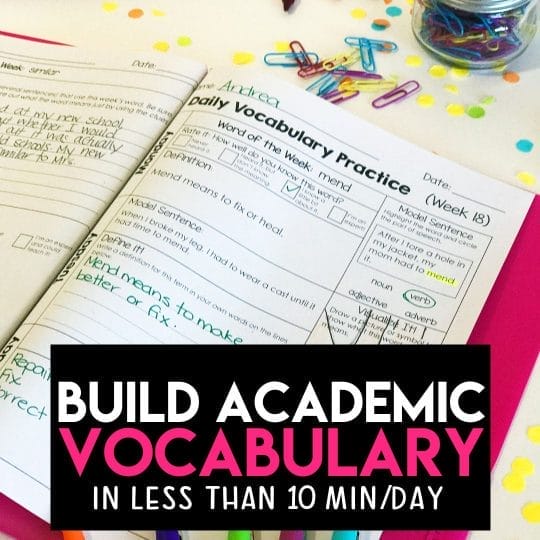
In my Academic Vocabulary resources for grades 2–8, the routine is simple and repeatable:
Day 1: Introduce the word and meaning
Day 2: Explore context and usage
Day 3: Apply it in sentences
Day 4: Use it in paragraph writing
Day 5: Reflect, evaluate, and assess

No guessing.
No reinventing the wheel.
No scrambling for vocabulary practice that actually builds something.
Just consistent, intentional language development.
And here’s the part that matters most…
Students begin to notice academic language.
They start using it.
They start recognizing it in reading.
They begin to feel more confident explaining their thinking.
That’s the shift.
If You’re Tired of Teaching Words That Disappear…
You don’t need more lists.
You need a system.
A short, structured daily routine that builds academic language over time… without taking over your block.
If you’re curious what that looks like in real classrooms, I’ll break it down in the next post and show you exactly how teachers are using it in under 10 minutes a day.
Because vocabulary should build confidence.
Not collect dust.
Ready to learn more about Academic Vocabulary?
Check my Ultimate Guide to Teaching Academic Vocabulary to learn more about best practices, identifying students who may need a vocabulary intervention, and more!