10 Meaningful Thanksgiving Activities for Upper Elementary
Thanksgiving week has a way of making even the best classroom routines feel a little wobbly. Students are excited, schedules get interrupted, attendance may be uneven, and launching an important new unit is usually not the best use of anyone’s energy.
That is why the best 3rd grade Thanksgiving activities, along with options for 4th and 5th grade, do more than fill time before break. They give students meaningful practice with skills they already know while keeping the work engaging enough to hold their attention.
In this post, I’m sharing Thanksgiving activities for upper elementary that cover reading, writing, history, math, gratitude, and research. Some work as a quick warm-up or center, while others can carry a full lesson or help you plan the entire week.
You can choose the ideas that fit the time and energy your class actually has, with simple ways to support struggling learners, extend the thinking, and keep the week productive without making it feel like business as usual.
Find the Right Thanksgiving Activity for Your Week
Some days before break, you need a full lesson. Other days, you need something meaningful that students can finish in 15 minutes without a long explanation.
Use the chart below to compare each activity by subject, grade level, and time. Then keep reading for teaching tips, differentiation ideas, and resources for each one.
| Activity | Subject | Grades | Time |
|---|---|---|---|
| Compare Thanksgiving perspectives | Reading and social studies | 4–6 | 30–45 minutes |
| Read about wild and domestic turkeys | Reading and science | 3–5 | 20–30 minutes |
| Thanksgiving nonfiction practice | ELA and social studies | 3–5 | Flexible |
| How to cook a turkey | Writing | 2–4 | 45–60 minutes |
| Thankful writing display | Writing | 2–5 | 30–45 minutes |
| Gratitude journal | Writing and SEL | 3–6 | 5 minutes daily |
| Thanksgiving Would You Rather | Opinion writing | 3–6 | 10–20 minutes |
| Thanksgiving math review | Math | 3–5 | 15–30 minutes |
| Pair fiction and nonfiction | Reading and social studies | 2–4 | Multi-day |
| Native American biography research | Research and writing | 3–6 | Multi-day |
The chart gives you a quick overview. Now let’s look at what each activity actually looks like in the classroom, why it works, and how you can make it fit the students in front of you.
First, let’s talk about teaching the history of Thanksgiving with more than one perspective.
1. Compare Perspectives on the First Thanksgiving
Many students come to us with a very simplified version of the First Thanksgiving. By upper elementary, they are ready to look more closely at how the story changes depending on whose perspective is being shared.
Begin with two short accounts of the same events, such as one written from the perspective of the English colonists and another that includes a Wampanoag perspective. As students read, have them notice:
- Which details appear in both accounts
- Which details appear in only one
- How the language and focus differ
- What each account helps the reader understand
- What questions are still left unanswered

This works especially well as a paired reading lesson. Students can annotate each passage, complete a comparison organizer, and then respond to a question such as:
Why is it important to read more than one perspective when learning about a historical event?
For students who need more support, read the passages together and complete the first comparison as a class. Stronger readers can go a step further by identifying what each source emphasizes and explaining how that shapes the reader’s understanding.
My First Thanksgiving paired passages are designed for exactly this type of lesson, with both perspectives, text-dependent questions, and space for students to compare the accounts.

The Scholastic Thanksgiving materials can also be used as an additional source if you want students to explore daily life, housing, food, and traditions more deeply.
2. Learn about Wild and Domestic Turkeys
Turkeys are one of those Thanksgiving topics that immediately gets students interested, but there is also plenty of real science and informational reading to explore.
Instead of focusing only on the turkey as part of a holiday meal, have students learn about the animal itself. They can compare wild and domestic turkeys, study their physical and behavioral characteristics, and use details from the text to explain how each type is adapted to its environment.

This is a natural way to bring science into your reading block. As students read, they can practice:
- Identifying the main idea and supporting details
- Using context to understand unfamiliar vocabulary
- Comparing and contrasting information
- Returning to the text to support an answer
- Organizing information in a Venn diagram
My turkey reading passage includes an informational article, vocabulary practice, standards-based comprehension questions, and a wild-versus-domestic turkey comparison activity for students in grades 3-5.
Make It Work for Different Readers
For students who need more support, preview a few important vocabulary words before reading and complete the first section of the comparison diagram together. You can also read the passage aloud while students follow along, then have partners return to the text to find the evidence they need.

Students who are ready for more challenge can use the information to write a short explanatory response:
How are wild turkeys better suited for survival than domestic turkeys?
They might also research another domesticated animal and compare it with its wild relative.
This activity works well when you need something seasonal enough to hold students’ attention but still want the lesson to include meaningful reading, vocabulary, and science practice.
3. Build Reading Skills with Thanksgiving Nonfiction
Thanksgiving week is a good time to review reading skills students have already learned without starting a brand-new unit you will have to reteach after break.
A short nonfiction passage gives students meaningful practice with main idea, supporting details, vocabulary, and text evidence while still fitting the season. Depending on the time you have, students can read independently, work with a partner, or use the passage during centers.
You can also keep the response work simple. Instead of assigning every question, choose the two or three that best match the skills your class needs to review.

This type of activity works especially well for:
- Independent reading practice
- Homework
- Literacy centers
- Early finishers
- A shortened class period
- Sub plans
- Reviewing comprehension skills before break

My Thanksgiving activities packet includes reading passages, vocabulary work, comprehension questions, and social studies practice connected to the Pilgrims and Wampanoag people.
Make It Work for Different Readers
For students who need more support, preview the vocabulary before reading and break the passage into shorter sections. You can also read the text aloud while students follow along, then have them return to the passage to find evidence for their answers.

Students who are ready for more challenge can compare two passages, explain how the author organized the information, or write a short response using evidence from the text.
The goal is not to pack the week with more work. It is to give students focused practice with skills they already know in a format that feels timely and manageable.

4. Write Instructions for Cooking a Turkey
This is one of my favorite Thanksgiving writing activities because students already think they know how to cook a turkey.
They usually do not.
That is what makes it such a good procedural writing lesson.
Ask students to write step-by-step directions explaining how to cook a turkey. You will quickly see who understands sequence, who leaves out important details, and who assumes the reader already knows what they mean.
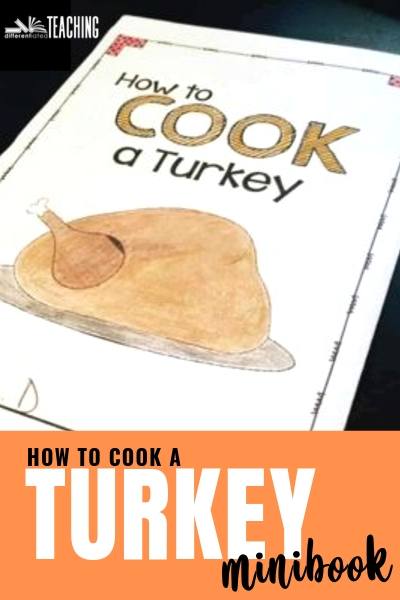
You may get directions like:
Put the turkey in the oven. Cook it for 20 minutes. Take it out and eat it.
Or:
Add salt, butter, pepper, ketchup, and three cups of sugar.
The funny answers keep students engaged, but the real value is in the revision. Once students reread their directions, they begin noticing where the steps are unclear, incomplete, or out of order.
Students practice:
- Organizing steps in a logical sequence
- Using transition words
- Adding specific details
- Writing clear directions
- Revising for clarity
- Thinking about what the reader needs to know
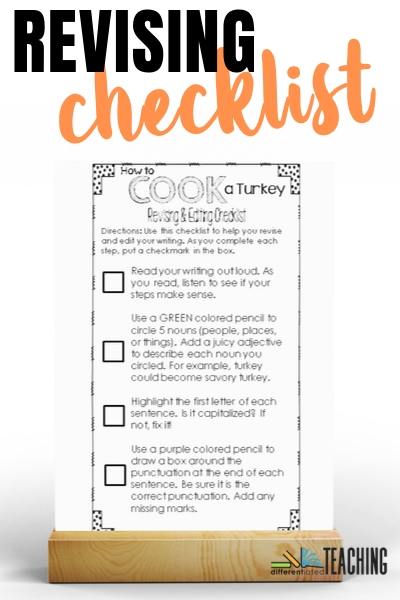
You can complete the activity in one longer writing block or spread it across several shorter lessons. Students might plan on the first day, draft on the second, and revise and publish on the third.
Support Struggling Writers
Give students a list of transition words such as first, next, then, and finally. Let them rehearse the steps aloud with a partner before writing, or provide picture cards they can place in order.
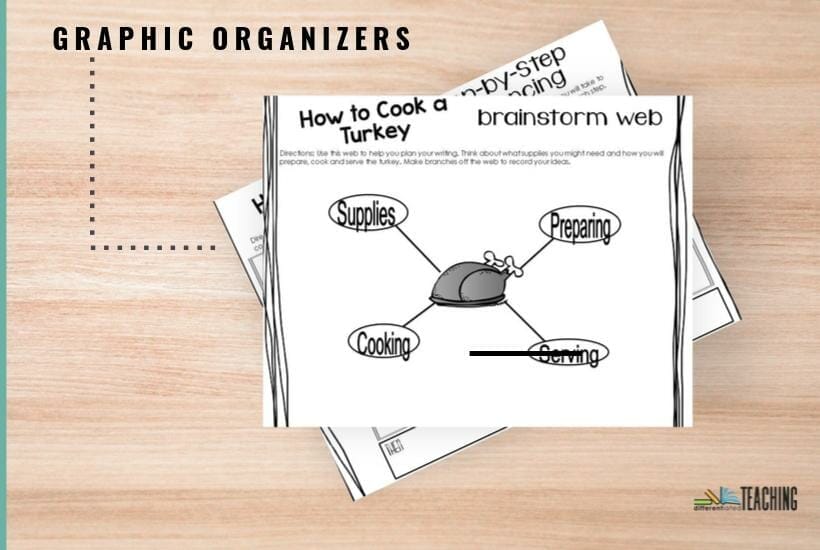
A partially completed organizer can also help students focus on adding details instead of worrying about how to structure the entire response.
Add More Challenge
Ask stronger writers to include:
- Exact measurements
- Cooking times and temperatures
- Safety warnings
- A list of ingredients and materials
- A troubleshooting section
- Tips for someone cooking a turkey for the first time
You can also have partners read each other’s directions and point out any step that would confuse someone trying to follow them.

3. Create a Thanksgiving Writing Display
Gratitude activities can get shallow fast when students are asked to write a list of things they are thankful for and move on.
A stronger version asks students to choose one person, place, experience, or part of their life and explain why it matters.
That small shift turns the activity into real writing practice.
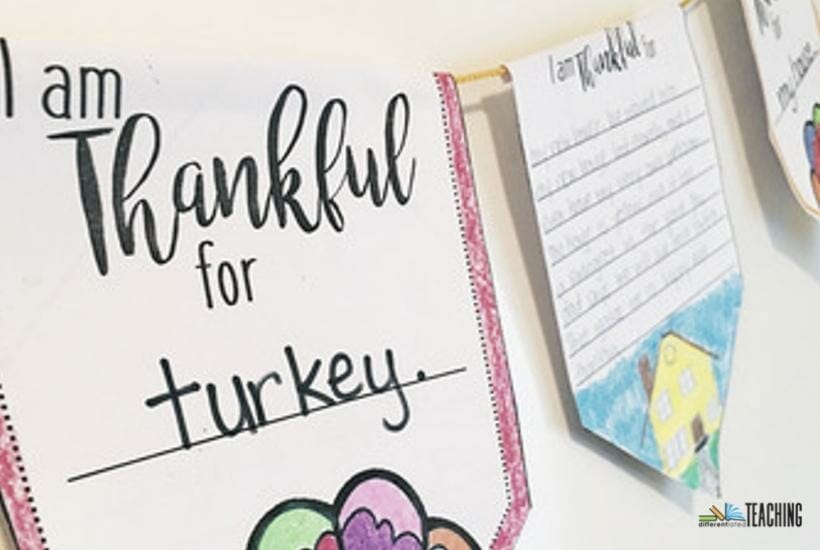
Students can:
- Name what they are thankful for
- Explain why it is important to them
- Include a specific memory or example
- Add details that help the reader understand
- Revise the response before creating the final display
This works especially well before Thanksgiving because students still get the seasonal craft element they enjoy, but the finished project has enough substance to make the time worthwhile.
You can display the completed pieces on a bulletin board, classroom door, or hallway wall. Because every student writes about something different, the final display feels personal rather than repetitive.
Support Students Who Get Stuck
Some students can name what they are thankful for but struggle to explain why.
Try giving them sentence starters such as:
- I am thankful for ___ because ___.
- One reason this matters to me is ___.
- I remember when ___.
- This person helps me by ___.
- My life would be different without ___.

You can also let students talk through their ideas with a partner before writing. Often, the explanation comes out clearly in conversation before they are ready to put it on paper.
Add More Depth
For students who are ready for a challenge, ask them to include a specific moment that shows why their choice matters.
Instead of writing, “I am thankful for my grandmother because she is nice,” they might explain how she calls every Sunday, teaches them family recipes, or came to every soccer game last year.
That specific detail is what moves the piece from a general statement to meaningful writing.
My thankful writing activity includes planning support and a finished banner students can use to create a classroom or hallway display.

6. Start a 5-minute Gratitude Routine
Not every gratitude activity needs to become a polished project.
A short gratitude journal can work well during Thanksgiving week because it gives students a calm, predictable way to begin the day or transition into writing.
The prompts should be specific enough to help students move beyond the same three answers every time.

Students might reflect on:
- A small moment that made them smile
- Someone who helped them recently
- A place where they feel comfortable
- Something they can do now that used to be difficult
- A classroom item they use every day
- A mistake that helped them learn something
- Something ordinary they would miss if it disappeared
These kinds of prompts help students notice that gratitude is not limited to big events or material things.
Keep the Writing Low Pressure
This routine works best when it does not feel like another formal writing assignment.
Give students five minutes to write, sketch, or make a short list. They do not need to revise every response or share it with the class.
You might invite a few volunteers to share, but students should also be allowed to keep personal reflections private.
For reluctant writers, let them begin with a drawing and add one or two sentences. Students can also talk through their answer with a partner before writing.

Use It Beyond Thanksgiving
Although gratitude journals fit naturally in November, the routine can continue throughout the year.
It works well:
- As morning work
- At the beginning of a Monday
- After a difficult week
- Before a school break
- During classroom community meetings
- As a quiet transition after lunch
The goal is not to force students to feel cheerful. It is to help them slow down long enough to notice something positive, meaningful, or supportive in their lives.
My gratitude journal includes short, structured prompts and space for both writing and sketching, which makes it manageable for students who tend to shut down when they see a full blank page.

7. Use Thanksgiving Would You Rather Prompts for Opinion Writing
Would You Rather questions are easy to dismiss as a time-filler, but with the right follow-up, they can become a strong opinion-writing routine.
The choice gives students an immediate entry point. They already have an opinion. The real work is helping them explain it clearly and support it with reasons.

A Thanksgiving prompt might ask:
- Would you rather cook the entire meal or clean up afterward?
- Would you rather eat only side dishes or only dessert?
- Would you rather watch a parade or play in a football game?
- Would you rather host a large gathering or spend the day with a small group?
- Would you rather travel for Thanksgiving or stay home?
After students choose a side, have them discuss their thinking with a partner before writing. That quick conversation helps students rehearse their ideas and often leads to stronger reasons.
A simple writing routine might look like this:
- Choose a side.
- State your opinion clearly.
- Give two reasons.
- Add an example or explanation.
- End with a concluding sentence.
This can be a ten-minute warm-up, a writing center, or a longer paragraph lesson depending on what your class needs.
Support Students Who Need More Structure
Give students a paragraph frame such as:
I would rather ___ because ___. One reason is ___. For example, ___. Another reason is ___. That is why I would choose ___.
Students can also sort possible reasons before writing or work with a partner to decide which reasons are strongest.
For reluctant writers, let them begin by recording their response orally or sharing it with a partner. Once they know what they want to say, the writing usually feels much more manageable.

Add More Challenge
Ask students to include a counterargument:
Some people might choose ___ because ___. However, I still think ___ because ___.
You can also have students switch sides and write from the opposite point of view. That small change pushes them to think beyond their first response and consider another perspective.
My November Would You Rather writing prompts are designed to move students from a quick seasonal choice into a complete opinion paragraph with reasons and support.

8. Review Previously Taught Math Skills
The week before Thanksgiving is usually not the best time to introduce a complicated new math concept.
Students are excited, schedules are interrupted, and attendance may be less predictable. It is, however, a useful time to revisit skills students have already learned.

Thanksgiving math review can include:
- Place value
- Addition and subtraction
- Multiplication and division
- Rounding and estimation
- Fractions
- Area and perimeter
- Multi-step word problems
- Previously taught problem-solving strategies

Click here to learn more about this Thanksgiving Math Center.
The seasonal theme keeps the practice feeling timely, but the real goal is to strengthen skills students will need again after the break.
Choose the Skills Your Students Actually Need
You do not have to assign an entire packet.
Choose a few problems connected to patterns you have already noticed in class. If students are still struggling with rounding, use the turkey rounding activity. If computation is becoming shaky, focus on mixed addition, subtraction, multiplication, or division practice.
For fourth and fifth graders, Thanksgiving word problems can also provide useful practice with choosing operations and explaining reasoning.
This is a good time to ask students to show how they know, not just write an answer.

Questions such as these make the review more useful:
- What operation did you choose?
- Which information mattered?
- How do you know your answer is reasonable?
- Can you solve it another way?
- What mistake might someone make?
Keep the Review Manageable
A few well-chosen problems are usually enough.
You might use the activity as:
- Morning work
- A math center
- A bell ringer
- Partner practice
- An early-finisher activity
- A short assessment of previously taught skills
If students are working independently, plan a quick answer check. The discussion about why a problem was difficult is often more valuable than completing another page.
Adjust the Level Without Creating More Work
For students who need support:
- Reduce the number of problems
- Highlight important information
- Provide a multiplication chart or number line
- Read word problems aloud
- Let students solve with a partner
- Use smaller numbers while keeping the same skill
For students who need more challenge:
- Add a written explanation
- Ask them to create a similar problem
- Require two solution strategies
- Have them identify and correct an incorrect example
- Ask them to estimate before solving
My Thanksgiving math resources include options for rounding, estimation, computation, mixed review, and word problems across upper-elementary grade levels.
9. Pair Historical Fiction with Informational Reading
A Thanksgiving novel can be a helpful way to bring students into the time period, but historical fiction should not carry the entire lesson by itself.
Fiction helps students picture the setting, follow a character, and connect emotionally with the events. Informational text gives them the facts, background knowledge, and vocabulary they need to understand what the story is showing.

When students read both, they can begin asking better questions:
- Which parts of the story are based on history?
- Which details may have been simplified?
- What did the nonfiction text explain more clearly?
- What did the novel help them imagine?
- Whose perspective is centered?
- What information is missing?
For younger upper-elementary readers, Thanksgiving on Thursday works well because it is short, familiar, and easy to pair with nonfiction about the Pilgrims and the Wampanoag people.
Keep the Comparison Simple
Students do not need a complicated literary analysis assignment.
A basic organizer can ask them to record:
| Historical fiction | Informational text |
|---|---|
| What happened in the story? | What facts did the text teach? |
| What did the characters experience? | What background information helped explain the event? |
| What may have been imagined? | What information can be verified? |
Then ask students to respond to a question such as:
How did the informational text change or deepen your understanding of the story?
That keeps the focus on how the two texts work together.
Support Students Who Need More Help
For students who struggle with longer text, use audio support for the novel and read the nonfiction in shorter sections.
You can also:
- Preview important vocabulary
- Provide a partially completed comparison chart
- Let students discuss before writing
- Assign one chapter or section at a time
- Model the first comparison together
Add More Challenge
Ask stronger readers to identify a place where the fiction and nonfiction emphasize different details.
They can also explain why an author of historical fiction might simplify, combine, or imagine parts of an event while still trying to remain historically accurate.
My Thanksgiving on Thursday novel study pairs the Magic Tree House book with the Pilgrims Fact Tracker so students can practice comprehension while building the background knowledge they need.

10. Extend the Learning Beyond the First Thanksgiving
One of the biggest problems with Thanksgiving instruction is that Native history is often reduced to a single event.
Students may learn about the Wampanoag people for one lesson in November and then hear very little about Native nations, history, or contributions for the rest of the year.
That is why Thanksgiving can be a starting point, but it should not be the only place Indigenous people appear in the curriculum.
A biography research project gives students the opportunity to learn about Native leaders, artists, scientists, writers, athletes, activists, and other influential figures from different time periods and nations.
Students might research:
- The person’s tribal nation or community
- Their childhood and education
- The challenges they faced
- Their major accomplishments
- The impact of their work
- Why their story still matters

Be Specific About Identity
Encourage students to name the individual’s nation or tribal affiliation whenever that information is available.
“Native American” is a broad label. It does not tell students whether a person is Cherokee, Diné, Lakota, Chickasaw, Wampanoag, or part of another nation.
That specificity helps students understand that Indigenous people are not one single group with one shared culture or history.
Avoid Framing the Project as a Thanksgiving Craft
This work fits naturally in November because it is Native American Heritage Month, but the focus should remain on the person’s life and contributions.
Students should not be asked to decorate biographies with generic feathers, headdresses, or symbols that do not belong to the person’s culture.
Instead, they can include:
- A portrait
- A map
- A timeline
- Important quotations
- Images connected to the person’s work
- Facts about the nation or community they belong to
Support the Research Process
For students who need more structure, provide:
- A short list of approved figures
- Safe research links
- A note-taking organizer
- Sentence starters
- A model biography
- A shorter final product
Students who are ready for more challenge can compare two people, explain how historical context shaped their work, or evaluate the long-term impact of their contributions.
My Native American biography research activities include organizers and final-project options that help students move from research notes to a finished biography.

BONUS: Design a Thanksgiving Parade Float
If you need a creative activity for the end of the week, pair Balloons Over Broadway with a simple parade-balloon design challenge.
The book introduces students to Tony Sarg and the development of the large balloons used in the Macy’s Thanksgiving Day Parade.
After reading, students can design their own parade balloon or float.
Ask them to include:
- A labeled sketch
- The character or theme
- The materials they would use
- How the balloon or float would move
- Any problems the designers might need to solve
- A short written pitch explaining why their design belongs in the parade
If you’ve got time, you can even have them create miniature models of their float using shoe boxes or balloons. Students love Thanksgiving activities that involve creativity! There are also several good Youtube videos about the history of the parade. You can preview them to see which might be best for your students.
- History of Thanksgiving Day Parade – History Channel
- History of Macy’s Thanksgiving Parade – Reading Through History
- The Technology Behind Macy’s Thanksgiving Parade – History Channel
- Video of the 1927-1929 Macy’s Parades – Speed Graphic Film & Video
A Simple Plan for the Week Before Thanksgiving
You do not have to use every activity in the post.
A few well-chosen lessons can create a balanced week without requiring you to launch a new unit or fill every minute with holiday worksheets.
Here is one possible plan.
Monday: Compare Historical Perspectives
Read two short accounts connected to the First Thanksgiving.
Have students identify similarities, differences, and missing information.
End with a short written response about why perspective matters.
Tuesday: Read Thanksgiving Nonfiction
Use a turkey article or another Thanksgiving nonfiction passage.
Review main idea, supporting details, vocabulary, or text evidence.
Wednesday: Begin Procedural Writing
Introduce the How to Cook a Turkey prompt.
Let students orally rehearse their steps, plan, and begin drafting.
Thursday: Review Math and Revise Writing
Use a short set of Thanksgiving math problems based on skills students have already learned.
Then give students time to revise and publish their turkey directions.
Friday: Choose a Low-Pressure Finish
Depending on your schedule, students can:
- Complete a gratitude journal response
- Create a thankful writing display
- Respond to a Thanksgiving Would You Rather prompt
- Design a parade balloon
- Finish a reading or research project
The goal is not to cram ten seasonal activities into one week.
Choose the ideas that match the time, skills, and energy level of your class.
Frequently Asked Questions
What are the best Thanksgiving activities for third grade?
Third graders usually do well with activities that combine a clear structure with enough choice to keep the work engaging.
Good options include:
- Turkey nonfiction reading
- How to Cook a Turkey procedural writing
- Thankful writing displays
- Would You Rather opinion prompts
- Grade-level math review
- Gratitude journaling
The best choice depends on whether you need a full lesson, a short warm-up, or independent work.
How can I teach Thanksgiving more accurately?
Start by using more than one perspective.
Include Wampanoag voices, compare different accounts, and help students notice what each source includes or leaves out.
Avoid presenting the event as a simple friendship story. Students can handle a more complete explanation when the language and sources are appropriate for their age.
What can I do the day before Thanksgiving break?
Choose something short, familiar, and flexible.
Good options include:
- A reading passage
- A gratitude response
- A Would You Rather paragraph
- A few math review problems
- A sentence-editing activity
- A parade-balloon design
This is usually not the best day to introduce a major new concept.
How can I support struggling readers and writers?
Try:
- Reading the text aloud
- Pairing audio with print
- Previewing vocabulary
- Reducing the number of questions
- Providing sentence starters
- Letting students discuss before writing
- Using partially completed organizers
- Allowing drawing or oral responses before written work
The goal is to keep students working with the same ideas while adjusting the amount of support they need.
How do I keep Thanksgiving activities from feeling like filler?
Start with the skill.
Decide whether students are practicing:
- Main idea
- Text evidence
- Comparing perspectives
- Procedural writing
- Opinion writing
- Math review
- Research
- Revision
Then choose a seasonal activity that gives them a meaningful way to use that skill.
The Thanksgiving theme should support the learning, not replace it.
What do you teach as Thanksgiving approaches?
It was so fun sharing my favorite holiday activities with you. Now it is your turn! How do you spice up your classroom the last few days before the break?
Leave me a comment and let me know…I am always looking for great ideas.
Looking for more great articles with lesson ideas for the holiday season? Check out the ones below.