How to Teach Multiplication Concepts Before Jumping to Facts
You’ve been there.
A student who could count to 100 by ones, twos, and fives without blinking. Who crushed addition and subtraction. Who finally felt like a real math kid.
Then multiplication shows up on the scene and…nothing. Blank stares. Tears at the kitchen table. Notes from parents wondering what happened.
Here’s what happened: we short-changed the concept and went straight to the facts.

And honestly?
The curriculum, the pacing guides, the pressure to move on.
They basically push us toward it.
Flash cards, timed tests, and apps that drill 6×7 until students either know it or deeply hate math.
One of those two outcomes is a lot more common than we’d like to admit.
But multiplication facts without an understanding of multiplication is like teaching kids to sound out words before they know what the words mean. They can do the thing. They just don’t know why they’re doing it, which means the moment anything changes, everything falls apart.
So let’s talk about how to build conceptual understanding of multiplication first, so that when you do get to the facts, they actually stick.
What Is Conceptual Understanding in Multiplication?
Conceptual understanding means students understand what multiplication represents before memorizing facts. Instead of seeing multiplication as a rule to follow, students understand it as equal groups, arrays, and relationships between numbers.
Why Conceptual Understanding Comes First
Most students arrive in your classroom having already heard that multiplication is “just repeated addition.” And sure, technically it is. But if that’s the only frame we give them, they’re missing so much.
Multiplication is about equal groups and arrays. When students understand that 4 × 3 represents four groups of three objects, the numbers stop being abstract symbols and start representing something they can see and build.
Real things. Countable, organizable, visual things.

When students understand the structure of multiplication before they memorize the facts, a few really important things happen:
- They can reason through problems they haven’t memorized yet.
- They catch their own mistakes because the answer “feels wrong” based on their understanding of the groups.
- Skip counting, arrays, and area models stop being random steps and start making actual sense.
- The jump to multi-digit multiplication, fractions, and division is dramatically less painful later on.
The National Council of Teachers of Mathematics has consistently emphasized that conceptual understanding must precede procedural fluency — not replace it, but come first. And for struggling learners, especially, this order matters enormously.
Start With Equal Groups (And Make Them Concrete)
Before any numbers hit a page, students need to physically build equal groups.
And I mean physically. Counters, cubes, snack foods, if you want them to care about it — it doesn’t matter what you use. What matters is that students are making the groups themselves, not just looking at a number sentence and nodding.

How to introduce it:
Start with the language first. “Four groups of three.” Say it out loud. Have students say it out loud. Ask them to build it.
Then introduce the notation: 4 x 3.
Notice we didn’t start with the equation. We started with the meaning. The equation is just shorthand for something students already understand. That sequence matters.
A few things that help this land:
- Keep group sizes small at first. 2s, 3s, and 5s before anything else. Students feel success quickly, and the patterns emerge fast.
- Make it a sorting activity. Give students a pile of 12 counters. Ask them to make equal groups. How many ways can they do it? Let them discover that 3 groups of 4 and 4 groups of 3 both use 12. That’s the commutative property, and you didn’t have to name it yet for it to click.
- Draw what they built. Have students sketch their groups. This is the bridge between concrete and representational. Don’t skip it.
For many struggling learners or students with math anxiety, physically building groups reduces cognitive load and makes abstract thinking concrete. It is helpful to give students structured practice with equal groups before moving to formal multiplication problems.
If you’re looking for ready-to-use activities to introduce multiplication concepts, this Introducing Multiplication with Equal Groups, Repeated Addition, and Skip Counting task card set gives students practice in building the meaning of multiplication before moving into fact memorization.

Bring In Arrays Early and Often
If equal groups are the heart of multiplication, arrays are the visual proof that the heart is beating.
An array is just objects arranged in rows and columns — and it is incredibly powerful for struggling learners because it makes the structure of multiplication visible in a way that a number sentence never will.
Here’s the moment that always gets students: show them a 3 x 4 array of dots. Ask how many there are. Then rotate it 90 degrees. Ask again.
Same dots. Same array. But now it’s a 4 x 3.
Watch the lightbulbs. That’s the commutative property of multiplication — lived and experienced, not memorized from a poster.

Array activities that work:
- Grid drawings. Have students color arrays on graph paper. Label the rows and columns. Write the multiplication sentence for each one.
- Array scavenger hunt. Send students around the room (or outside) to find real-world arrays. Egg cartons, window panes, floor tiles, cubbies. Multiplication is everywhere once they start looking.
- Build-and-record. Students build arrays with tiles or cubes, record the dimensions, write both multiplication sentences. “This is 2 x 6 AND 6 x 2. They’re twins.”
Arrays also serve as a natural bridge to area later on, which means time spent here pays dividends in future units. Arrays also become the foundation for area models used in later multiplication and algebra work.
In other words, array practice is one of the easiest ways to reinforce the structure of multiplication. Activities that ask students to build, rotate, and analyze arrays help them see the relationship between factors instead of just memorizing answers.
For example, these Pumpkin Multiplication Array Task Cards have students analyze arrays, connect them to multiplication sentences, and apply the concept in word problems.

Skip Counting Is a Bridge, Not a Destination
Skip counting gets used as a multiplication strategy all the time. And it works — sort of.
The problem is that skip counting without understanding groups can become just another memorized sequence.
Students count by 3s: 3, 6, 9, 12
…and when you ask them what 4 x 3 means, they start from the beginning and count to the fourth stop. Every single time. That’s not multiplication understanding. That’s really just counting dressed up as multiplication.
But connected to equal groups and arrays? Skip counting becomes a powerful tool for developing number sense around multiplication.
How to make skip counting meaningful:
- Tie skip counts explicitly to groups: “We’re counting by 4s because each group has 4. The third number we land on is how many are in 3 groups of 4.”
- Use number lines. Mark every jump. Make the groups visible on the line.
- Have students predict before they count. “If we have 5 groups of 2, where do you think we’ll land?” Getting them reasoning before counting builds the mental math muscles that matter.
The goal is for students to eventually not need to skip count all the way from 1. That happens naturally when the concept is solid and facts start to build on understanding.
The Word Problem Connection: Don’t Wait
One of the biggest mistakes I see with multiplication instruction is saving word problems for the end of the unit, as the “application” piece.
The result? Students who can recite 7 x 8 but have absolutely no idea what to do when a problem asks them how many legs are on 7 spiders.
Word problems shouldn’t be a reward for mastering facts. They should be part of building the concept from day one because multiplication word problems help students see why multiplication matters in the first place. When students draw groups or arrays to represent real situations, the math becomes far less abstract.
If you’re looking for structured practice, these Multiplication and Division Story Problem Journals give students consistent opportunities to model and explain multiplication thinking.

Here are a few more tips for supporting learners with multiplication in word problems from the beginning.
Keep early multiplication word problems simple and visual:
- “There are 3 bags. Each bag has 5 apples. How many apples in all?”
- “4 kids each brought 2 snacks. How many snacks total?”
Have students draw the groups before they write any numbers. If a student can sketch 3 bags with 5 dots in each one and count or skip count to 15, they understand multiplication, even if they haven’t memorized 3 x 5 = 15 yet.
That understanding is what makes the memorization meaningful when it comes. This is especially important for multilingual learners and students receiving intervention support, who benefit from visual models and concrete representations before abstract notation.
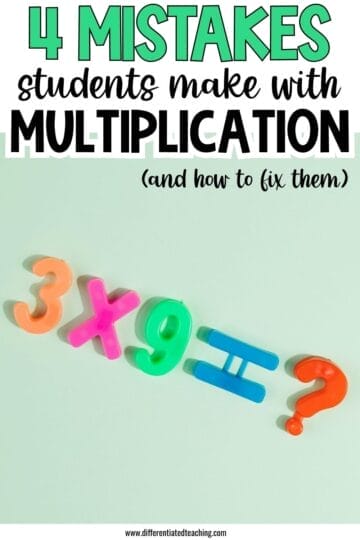
4 Common Mistakes Students Make (And What They’re Telling You)
If you know what to look for, multiplication errors are like little windows into exactly where understanding broke down.
Mistake #1: Treating Multiplication Like Addition
Student writes:
4 × 3 = 7
What it tells you:
The meaning of multiplication hasn’t landed yet.
What to do: Return to building equal groups.
Mistake #2: Getting the Right Answer for the Wrong Reason
Student behavior:
Correctly answers 5 × 2 = 10, but skip counts from the beginning every single time.
What it tells you:
The student understands that multiplication involves groups, but fluency isn’t developing yet. They are relying on counting rather than recognizing relationships between facts.
What to do: Connect skip counting directly to groups and arrays. Have students identify what each number represents as they count.
Practice related facts together so students begin to recognize patterns instead of restarting from one every time.
Mistake #3: Confusing the Factors
Student behavior:
Believes 3 × 4 and 4 × 3 are completely different problems and gives different answers for each.
What it tells you:
The commutative property hasn’t become meaningful yet. Students may see multiplication as a rule to memorize rather than a relationship between groups.
What to do: Return to arrays immediately. Have students build or draw arrays and physically rotate them.
Seeing that the total stays the same helps students understand that the order changes the arrangement, not the amount.
Mistake #4: Falling Apart With Unfamiliar Facts
Student behavior:
Knows memorized facts but shuts down when encountering an unfamiliar one like 7 × 6.
What it tells you:
The student has memorized isolated facts without strategies to derive new ones. Without conceptual understanding, every unknown fact feels like starting over.
What to do: Teach derived fact strategies. Help students connect known facts to unknown ones.
For example, if they know 6 × 6 = 36, they can add one more group of six to find 7 × 6 = 42. These reasoning strategies build confidence and flexibility.
What a Conceptual Multiplication Routine Looks Like
You don’t need a whole extra math block to build multiplication understanding. A consistent 10–15 minute routine worked into your day for one month can do a lot of the heavy lifting.
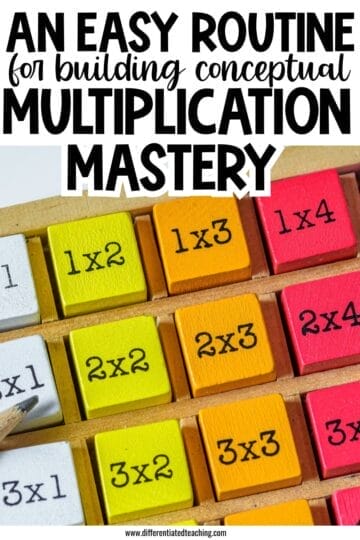
Here’s a simple structure that works:
- Build it (2–3 minutes): Students use manipulatives or quick sketches to represent a multiplication fact. “Show me 4 groups of 6.”
- Say it (1–2 minutes): Students verbalize what they built. “Four groups of six equals twenty-four.” Say the full sentence every time. Language builds understanding.
- Connect it (3–5 minutes): Link to a related fact, array, or word problem. “If 4 x 6 = 24, what’s 5 x 6? What’s 4 x 7?”
- Record it (2–3 minutes): Students write the fact and draw the array or groups in a math journal. This creates a reference they actually understand.
This kind of routine, done consistently, builds both conceptual understanding and the early stages of fact fluency, without the pressure and anxiety that timed tests often create before understanding is ready. Even five minutes daily can dramatically improve multiplication confidence over time.
When Should Students Start Memorizing Multiplication Facts?
Many teachers wonder when it’s appropriate to begin memorizing multiplication facts. The answer is once students can reliably represent multiplication with groups, arrays, and number lines.
When students understand what multiplication means, fact practice becomes reinforcement instead of guesswork.
Final Thoughts
Here’s the truth: students who understand multiplication before they memorize it become math students who can think. They can derive facts they’ve forgotten. They can estimate whether an answer makes sense. They can apply their understanding to division, fractions, algebra…all of it.
Students who memorize without understanding can recite facts perfectly… right up until the moment the context changes. Then they’re lost.
The extra time you spend building deep conceptual understanding through groups, arrays, word problems, and meaningful skip counting is not slowing you down. It’s what makes everything else faster.
Your struggling learners, especially, will thank you for it. Maybe not out loud. But in the way, they stop shutting down when math gets hard.

And honestly? That’s worth every minute.
Want more math strategies for your classroom? Head over to the Math Hub for more posts on building math understanding in ways that actually work for every learner.