First Chapter Friday for Reluctant Readers: Why the Response Sheet Matters More Than the Book
If you’ve spent any time in teacher corners of the internet, you’ve seen First Chapter Friday: every week, you read the first chapter of a book your students don’t know — just the first chapter, no matter how much they beg — and then you put the book on the shelf and walk away.

It might be the single best reading engagement routine ever invented for reluctant readers. It costs nothing, it takes twenty minutes, and it works because it flips the usual arrangement on its head. Nobody has to finish anything. Nobody gets quizzed. The book has to earn them.
So why do most First Chapter Fridays fizzle out by October?
The problem isn’t the books — it’s the system
I’ve watched this happen in classroom after classroom. A teacher starts First Chapter Friday in September, full of enthusiasm. The first few weeks are magic. And then it quietly falls apart, for one of three completely predictable reasons:
There’s no plan for next Friday. Picking a book Thursday night, every week, forever, is a real cognitive load. Miss two Thursdays and the routine is gone.
There’s nothing for students to do. Listening is lovely, but twenty-six kids sitting passively for ten minutes drifts fast — especially the kids this routine was designed to reach. And the fix most teachers reach for makes it worse…

Or there’s too much for students to do. This is the one that breaks my heart. The teacher adds a response sheet — a full page of comprehension questions and written reflection. And just like that, First Chapter Friday becomes the thing your reluctant readers already hate: a worksheet about a book. The magic dies the moment it gets graded.
The routine survives on a knife’s edge: structure enough to sustain it, but never so much that it starts feeling like an assignment. That’s why I’d argue the response sheet — not the book — is the highest-stakes decision you’ll make.
What a reluctant-reader response sheet actually looks like
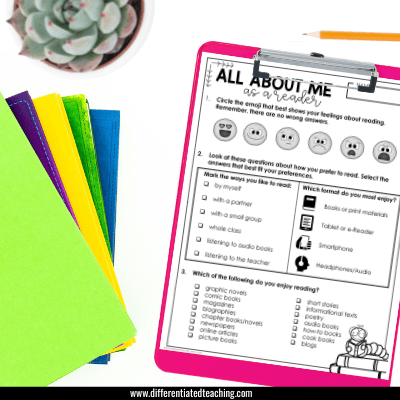
After years of building resources for struggling and reluctant learners, here’s my rule: the response should take less effort than the listening did. Under ten minutes, one page, and — this is the part most response sheets get wrong — more than one legal way to answer.
Here’s the structure I use:
1. Judge the cover. Before you read a word, students rate the cover and predict what the book’s about. Yes, we’re allowing — encouraging — judging a book by its cover. That’s what covers are for, and it buys you thirty seconds of investment before chapter one even starts.
2. Respond while listening — their way. This is where differentiation makes or breaks the routine. On my sheet, students choose one: Sketch It (draw a scene, character, or feeling), Collect It (jot three words or a line they liked), or Track It (write what they know so far). Your artist, your list-maker, and your writer all complete the same page — and all of them count. No leveled versions, no separate copies, nobody singled out.

3. Give an honest verdict. Rate the first chapter — not the cover! — and circle it: keep reading, not for me, or not sure yet. And here’s the sentence that changes everything for reluctant readers: “not for me” is a full-credit answer. A confident thumbs-down with a reason is real reading work. The first time a disengaged reader realizes you actually mean that, you’ve won something no comprehension packet ever wins: their honesty.
4. Do something with the verdict. Hooked? The book goes on their personal to-be-read list — I call it My Bookshelf — which grows all year into visible proof of a reading identity. Not for them? They answer one question: “Who would love this book?” That little line quietly turns every kid in your room into a book recommender, and peer recommendation is how reading culture actually spreads in upper elementary.
Choosing books: hook variety beats book quality
Teachers agonize over picking the “right” books. After watching a lot of Fridays, I think that’s the wrong worry. Any decent book with a strong first chapter works — what matters across the year is variety of hooks, because different hooks catch different kids.
I plan Fridays across hook types:
- laugh-out-loud openings (humor catches your most reluctant listener first),
- cliffhangers (the groan when you close the book is the point),
- characters like your students (mirrors make readers),
- true stories (proof that “real” doesn’t mean boring),
- graphic novels under the document camera, a series starter (the best to-be-read fuel — one hooked reader gets a whole year of next books),
- and at least one book you love, because your enthusiasm is impossible to fake.

Two more that surprised me with how well they work: a brand-new release nobody’s read yet — every opinion is a first opinion, instant book buzz — and a student-requested pick, introduced by the student. Ownership turns listeners into recommenders.
And when a book flops? Celebrate it. “Wow — three flames total from the whole class. Tell me why.” A room full of kids confidently defending a thumbs-down is a room full of kids having opinions about books. That was the goal the whole time.
The one rule that protects everything
No grades. No quiz. No follow-up assignment. Ever.
First Chapter Friday should be the one reading activity all year with no right answers. The response sheet exists to focus attention and capture honest opinions — not to generate scores. If you need documentation, the My Bookshelf tracker is your artifact: it shows reading identity growth across the year better than any grade could.
Want the whole system, done for you?
Everything in this post — the differentiated response sheet, a Week One version that teaches students the routine itself, My Bookshelf trackers, class verdict cards for your bulletin board, a monthly book planner with a hook-variety tally, and book recommendation lists for grades 3–5 and 6–8 sorted by hook type — is in my First Chapter Friday Response Sheets & Graphic Organizers →

One page per student, every Friday, zero prep. The read-aloud stays the magic. The system makes it stick.
Looking for more ways to hook reluctant readers? You might also like 10 Low-Prep Alternatives to the Dreaded Book Report and my novel study library — the natural next step when a first chapter turns into “please can we keep reading.”