The One and Only Ivan Novel Study: Activities, Lesson Plans & Resources
There was a real gorilla named Ivan.
He lived in a shopping mall in Tacoma, Washington for 27 years. Not a zoo. A mall. With shoppers, bright lights, a Sears on one side, and a JCPenney on the other.
People stopped to watch him. He painted pictures. He became part of the mall.
And for a long time, almost no one seemed to stop and ask what that kind of life felt like for him.
That is what makes The One and Only Ivan such a powerful book for grades 3-5. On the surface, it is a story about a gorilla, an elephant, a stray dog, and a promise. But underneath that, it asks students to think about captivity, friendship, perspective, responsibility, and what it means to really see another living thing.
It is also one of those rare books that feels accessible to students while still giving you so much to work with as a teacher. The chapters are short. The language is simple. The emotional depth is not.

In this post, I’ll share pre-reading activities, post-reading project ideas, and a full look at the The One and Only Ivan novel study unit I use with grades 3-5.
Fair warning: the author’s note at the end may hit your students harder than almost anything else in the book.
The One and Only Ivan: Book Summary
Ivan is a gorilla. He lives in a domain at the Exit 8 Big Top Mall and Entertainment Center, where he performs in a show alongside Stella the elephant and Bob the dog. He’s been there so long he barely remembers the jungle. He spends his days watching the humans who come to look at him and making art with crayons when Mack, his owner, isn’t watching.
When a baby elephant named Ruby arrives at the mall, Ivan makes her a promise. And keeping that promise will require Ivan to do something he’s never done before: use his art not just to express himself, but to reach the human world.

The One and Only Ivan is based on a true story — the real Ivan was a gorilla who lived in a Tacoma, Washington shopping mall for 27 years before advocacy led to his relocation to Zoo Atlanta. The author’s note at the end of the novel is worth reading aloud to students; it makes everything in the book hit harder.
This story is told entirely from Ivan’s point of view, in short chapters and sparse prose — which makes it deceptively accessible even for students who struggle with longer texts, while still rewarding the close readers who catch every subtle detail.
The One and Only Ivan Novel Study: Pre-Reading Activities
1. The “What Do You Notice?” Image Walk
Before students know anything about Ivan, show them a small set of images: a gorilla in the wild, a gorilla in a zoo habitat, an empty animal enclosure, a shopping mall, and a piece of abstract animal art.
Have students walk around the room or view the images digitally and jot down what they notice, wonder, and feel. The goal is not to tell them what to think yet. It is to get them looking closely.
Afterward, ask:
- Which image made you the most curious?
- Which image made you uncomfortable?
- What do you think animals notice about the places humans create for them?
- What questions do these images make you want to ask?
This is a great way to prepare students for one of the biggest ideas in the book: seeing something familiar in a new way.
2. Home, Habitat, or Cage?
Give students three words: home, habitat, and cage.
Ask them to create a quick sketch, word web, or three-column chart showing what each word makes them think of. Then give them a few short scenarios and have them decide which word fits best.
For example:
- A dog sleeps on a couch with its family.
- A bird lives in a large aviary with trees, space, and other birds.
- A tiger lives in a small concrete enclosure where people pass by all day.
The conversation will get interesting fast because students will realize the answer is not always simple.
This activity helps students start thinking about Ivan’s “domain” before they ever meet him. It also builds the background knowledge they need to understand the emotional weight of the setting.
3. The Object That Tells a Story
Ivan’s memories and observations are often tied to small details, so this pre-reading activity helps students practice that kind of thinking.
Ask each student to choose an ordinary object from the classroom, their backpack, or home. It could be a pencil, keychain, shoe, snack wrapper, stuffed animal, or water bottle.
Then ask:
- What might this object say about the person who owns it?
- What memories could be connected to it?
- What might someone misunderstand if they only looked at the object quickly?
Students can write a few sentences, sketch, or share with a partner.
This prepares students for the way Ivan tells his story through small moments instead of long explanations. It also helps them understand that objects in a story can carry meaning.
4. Point of View Switch: Human vs. Animal
Give students a simple scene, such as a child visiting an animal at a zoo or a family walking past a pet store window.
First, have them describe the scene from the human’s point of view.
Then have them describe the same scene from the animal’s point of view.
Keep it short and low-pressure. The goal is to help students notice how much changes when the narrator changes.
Afterward, discuss:
- What did the human notice?
- What did the animal notice?
- What changed between the two versions?
- Which version felt more emotional? Why?
This gives students a concrete way to understand why Ivan’s narration matters so much. They are not just reading about a gorilla. They are reading from his view of the world.
5. Should Animals Perform for People?
Before reading, give students a simple agree/disagree statement:
Animals should be used to entertain people if they are treated well.
Have students stand on a line across the room from “strongly agree” to “strongly disagree,” or respond digitally with a quick poll.
Then ask students to explain their thinking without trying to change anyone’s mind yet.
You can follow up with questions like:
- What does “treated well” actually mean?
- Is there a difference between learning from animals and being entertained by them?
- Who gets to decide what is fair for an animal?
- Can something be normal and still worth questioning?
This activity hooks students into the ethical questions underneath the novel without turning the book into a lecture before it begins.
The One and Only Ivan Post-Reading Activities
1. Ivan’s Art Gallery
Ivan uses art to communicate what he cannot always say directly. For this project, students create an “art gallery” inspired by the novel.
Each student chooses one important moment, relationship, symbol, or theme from the book and creates a piece of artwork to represent it. This could be a drawing, painting, collage, digital design, or mixed-media piece.
Then students write a short gallery card explaining:
- What moment or idea their artwork represents
- Why they chose certain colors, images, or symbols
- How the piece connects to Ivan’s growth or the theme of the novel
Display the pieces around the room and let students do a gallery walk. This turns theme analysis into something visual, creative, and much more memorable than a standard paragraph response.
2. The Mall Exhibit Redesign
Students become exhibit designers with a problem to solve.
Their task is to redesign the Exit 8 Big Top Mall and Video Arcade into a space that educates visitors about Ivan’s story in a respectful way.
They can create:
- A floor plan
- A museum-style exhibit
- A digital slideshow
- A poster series
- A 3D model
- A Canva-style display board
The exhibit should include information about Ivan, Ruby, Stella, animal welfare, and what humans can learn from the story.
This project pushes students to synthesize setting, character, theme, and real-world context. It also gives them a chance to think about how stories should be remembered.
3. Ruby’s Future
At the end of the novel, Ruby’s life has changed, but her story is not over.
Students create a project imagining Ruby’s future after the events of the book. This could be written as a picture book, comic strip, diary entry series, short video script, or illustrated timeline.
The key is that students need to base Ruby’s future on what they know from the novel.
They should consider:
- What Ruby has already experienced
- What she needs to feel safe
- What Ivan and Stella taught her
- How her new environment might help her heal
This is a creative way to extend the book while still requiring students to use evidence from the text.
4. One Promise Can Change a Story
Ivan’s promise to Stella becomes one of the most important turning points in the novel.
For this project, students trace the impact of that promise across the story. They can create a chain reaction display, comic strip, digital timeline, or cause-and-effect map showing how one promise leads to action.
Students should include:
- The promise Ivan makes
- Why it matters
- What changes because of it
- How Ivan changes as he tries to keep it
- What the promise reveals about friendship and responsibility
This works especially well because it helps students see plot, character development, and theme as connected instead of separate reading skills.
5. Seen and Unseen: A Perspective Project
This project asks students to think about one of the deepest ideas in the book: what it means to really see someone.
Students choose one character from the novel and create a two-part project.
Part 1: How others see this character
Part 2: Who this character really is
They can show this through a split portrait, digital poster, flip book, poem-and-art combination, or short multimedia presentation.
For example:
- Ivan may be seen as an attraction, but he is really an artist, protector, and friend.
- Stella may be seen as old and tired, but she is wise, loving, and brave.
- Ruby may be seen as cute entertainment, but she is also scared, grieving, and learning who to trust.
This project helps students move beyond basic character traits and into deeper interpretation. It is also a beautiful way to bring the emotional heart of the book into the final project.
The One and Only Ivan Literature Study Unit
My One and Only Ivan Novel Study covers the full book with structured daily instruction built for grades 3–5. The short chapter format of the original makes this an especially good unit for readers who need quick wins — every chapter is brief, every day’s task is contained, and the cumulative skill-building across the unit is significant.

What’s included in the One and Only Ivan Novel Study?
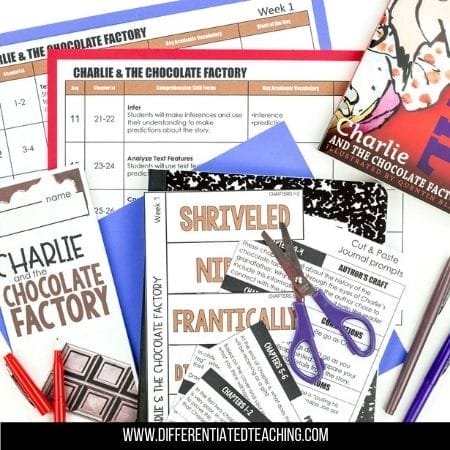
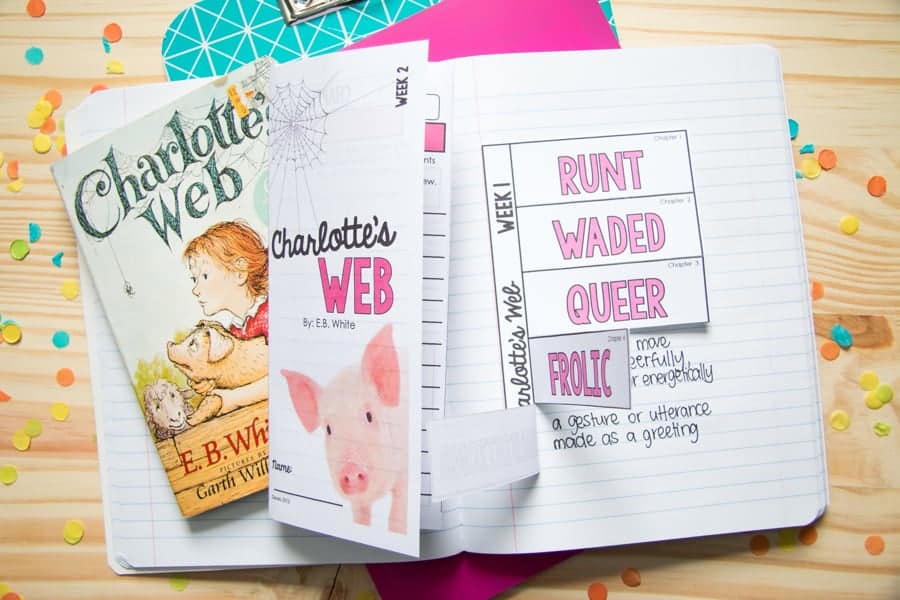
Foldable trifold novel studies — weekly trifolds covering the full book chapter by chapter. One skill per day, one vocabulary word per day — structured so students are never overwhelmed by what’s being asked of them.
Weekly vocabulary flip books — text-based vocabulary selected for both plot relevance and academic value. Ivan’s sparse, precise language makes vocabulary study particularly powerful with this book.
Instructional pacing guide — daily reading assignments, comprehension focus, Tier 2 academic vocabulary, and text-based word of the day. Everything you need to plan a full unit in one document.
Reading journal cut-and-paste prompts — an alternate response format for students who need more writing space or prefer a journal-based approach.
Google Slides digital version — for 1:1 or Chromebook classrooms.
Comprehension skills covered
The One and Only Ivan’s first-person gorilla narrator creates natural opportunities for deep reading work:
- Point of view — first-person animal narrator and its effect on the reader
- Making and defending inferences with text evidence
- Compare and contrast — setting and character development focus
- Character trait analysis
- Identifying theme and supporting with text evidence
- Author’s purpose — fiction based on a true story
- Figurative language — Ivan’s observations are full of unexpected metaphors
- Problem and solution
- Text-to-world connections with the author’s note
- Summarizing

About the book
Grades: 3–5
- Guided Reading Level: Q
- Lexile Level: 570L
- Accelerated Reader Level: 3.6
Pages/Chapters: 304 pages, but chapters are extremely short (1–2 pages each)
Genre: Fantasy (but based on a true story)
Awards: Newbery Medal, 2013
Content notes: The book addresses animal captivity and includes one moment of significant loss… Stella the elephant dies. This is handled with gentleness and is not graphic, but it is emotionally affecting. Some students may have strong reactions. The ending is hopeful. This book is widely used in grades 3–5 and considered appropriate for that range. The author’s note discusses real-world animal advocacy, which some teachers use as a launch point for a broader social studies discussion.
Looking for More Novel Studies?
If your students connected with The One and Only Ivan, Because of Winn-Dixie covers similar themes of unlikely connection and belonging. The One and Only Bob (the sequel, told from the dog’s perspective) is a strong continuation for students who aren’t ready to leave these characters. Wishtree by Katherine Applegate is another beautiful book in her voice that works well with grades 3–5.
For guidance on structuring your novel study unit from pre-reading to post-reading, see: How to Plan a Novel Study