
How to Teach the 5-Paragraph Essay in Middle School (Without Making Everyone… Including You… Miserable)
Somewhere along the way, the 5 paragraph essay got a bad reputation.
You’ve probably heard the takes: it’s too formulaic, it kills student voice, real writers don’t write like this, we should be teaching authentic genres, not rigid structures.
And look…there’s a real conversation to be had there. But here’s what I know from years in the classroom: a student who cannot write a coherent 5-paragraph essay cannot write a research paper, a literary analysis, or an argument either. Structure isn’t the enemy of good writing. It’s the scaffold that lets good writing happen.
The 5-paragraph essay is a foundation. And you have to build foundations before you get to architecture. If you’re wondering how to teach the 5-paragraph essay in middle school without turning writing into a formula students hate, the key is treating the structure as a scaffold, not the final goal.
So let’s talk about how to actually teach it in a way that doesn’t make your students shut down, or make you dread writing block.

Why Middle School Students Struggle with Essay Writing (It’s Not What You Think)
Before we get into strategy, I want to name something I see a lot: teachers assume students struggle with the 5-paragraph essay because they don’t understand the structure.
That’s often not the real problem.
Most middle schoolers can recite “introduction, three body paragraphs, conclusion” without blinking. They’ve been told this since 4th grade. What they can’t do is execute it under pressure,with a real prompt, in real time, because no one has walked them through what each piece actually looks
They know the map. They’ve never driven the route.
That’s the gap you’re closing.

What Is the 5-Paragraph Essay Structure?
The classic 5-paragraph essay structure is simple:
• Introduction with a clear thesis
• Three body paragraphs, each focused on one supporting idea
• A conclusion that restates the thesis and explains why the argument matters
On paper, this structure looks straightforward. In practice, most middle school students struggle not with the outline but with executing each part clearly.
That’s where explicit teaching and modeling come in.

Step 1: Start with the Introduction…And Really Stay There
Rushing past the introduction is one of the most common instructional mistakes I see in essay writing units. Teachers spend one day on “how to write a hook” and then move on, assuming students have it.
They don’t.
The introduction does three jobs in a 5-paragraph essay, and students need to know all three:
- Hook the reader — give them a reason to keep reading
- Provide context — set up the topic so a stranger could understand it
- State the thesis — tell the reader exactly what the essay will argue
Each of these is its own skill. Treat them that way.
For the hook specifically: middle schoolers tend to write one of two things
- a question (“Have you ever wondered about…?”)
- a “since the beginning of time” sweeping statement
because those are the only two moves they’ve been shown.
Expand their toolkit beyond those two moves. Show them:
- The bold claim: “Social media is making teenagers lonelier, not more connected.”
- The surprising statistic or fact: “The average teenager spends over 7 hours a day looking at a screen, and most of it isn’t schoolwork.”
- The anecdote: A two-sentence story that drops the reader right into a scene.
- The quote: A relevant line from the text they’re analyzing, used to open rather than as evidence.
Show examples of each. Let students sort them by strength. Then practice writing one of each before they ever start a full draft.
This investment of time on the introduction pays off in every future essay they write. Worth it.

Step 2: Teach the Body Paragraph as a Formula First
The word “formula” gets a bad rap in writing instruction, but I’m going to defend it here: a formula is a scaffold, not a cage. You use it until the structure becomes instinct, and then you move beyond it.
For middle schoolers, I love the Claim → Evidence → Reasoning (CER) framework for body paragraphs:
- Claim: The topic sentence. What is this paragraph arguing?
- Evidence: A direct quote or specific detail from the text.
- Reasoning: This is the hard part — the “so what.” Why does this evidence support the claim? What does it mean?
The reasoning is where most students fall off.
They’ll write a claim, drop in a quote, and then… move on.
They assume the quote speaks for itself. It doesn’t.
You have to explicitly teach that evidence without reasoning is just a quote floating in space.
Color-coding is your friend here.
Give students a paragraph with the three elements color-coded (claim in blue, evidence in green, reasoning in yellow) and ask them to identify which is which before they ever try to write one.
Then have them color-code their own paragraphs during drafting.
You’ll catch missing reasoning before it makes it into a final draft, and students start to see the pattern visually.

Step 3: Don’t Skip the Thesis…Spend Two Full Days on It
Two days. I know. It seems like a lot. Do it anyway.
The thesis is the hinge the entire essay swings on.
Many teachers use a structured essay unit or graphic organizers at this stage so students can focus on improving their thesis rather than staring at a blank page.
Why?
A weak thesis — “This essay is about the theme of courage in Hatchet” — produces weak essays.
A strong thesis — “In Hatchet, Brian’s survival depends not on the tools he builds but on the mental resilience he develops through failure” — gives students a claim they can actually argue and organize around.
Teach the difference between:
- A topic (“courage in Hatchet”)
- A fact (“Brian survives a plane crash”)
- A thesis (“Brian’s mental growth is more essential to his survival than any physical skill he develops”)
Have students take weak thesis statements and revise them.
Have them evaluate peer thesis statements. Make this a conversation, not a lecture.
When students have a strong thesis, the rest of the essay gets significantly easier to write and to teach. It’s worth the time.

Step 4: Give the Conclusion the Attention It Deserves
“Restate your thesis and summarize your points” is the most common conclusion advice students get, and it produces the most boring conclusions you’ve ever had to read.
A strong conclusion does something slightly different: it restates the thesis in fresh language, briefly echoes (not repeats) the main points, and then lands on a “so what.”
Why does this argument matter?
What should the reader think, feel, or do now?
For a literary analysis, the “so what” might be a connection to a broader theme in life or literature.
For an argument essay, it might be a call to action or a look at what happens if the argument is ignored.
Middle schoolers can absolutely write this. They just need to be shown what it looks like before being asked to do it on their own.

Step 5: Let Them Write a Lot of Bad First Drafts
I know this one feels counterintuitive, but hear me out: the students who are most afraid of writing are the ones who believe the first draft needs to be good.
Disabuse them of this notion as loudly and as often as you can.
Model your own messy first draft.
Read it to them.
Point out the weak thesis, the dropped evidence, the clunky conclusion.
Then show them the revised version. Show them that writing is thinking, and first drafts are thinking out loud… Not performing for a grade.
When students feel safe to write badly, they write more. And volume is how writing improves.

The Right Tools Make This Way Easier
Teaching a full essay writing unit from scratch (especially one that scaffolds correctly from hook to conclusion, differentiates for your struggling writers, and gives students enough practice without burning you out) takes a lot of prep.
If you want a jump start, The Essay Writing Process: 5-Paragraph Middle School Writing is built for exactly this sequence.
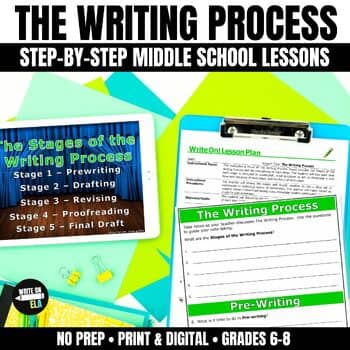
It walks students through each component of the essay with modeling, guided practice, and structured templates. That means you spend your energy on the teaching conversations, not on creating materials at 10pm.
For the introduction specifically, the Writing Leads and Endings series covers multiple hook types and conclusion strategies with examples students can actually use.

What Comes After the 5-Paragraph Essay
Here’s the thing I always tell teachers who worry they’re being too formulaic: the 5-paragraph essay is a stage, not a destination. Once students can reliably execute this structure — strong thesis, evidence with reasoning, purposeful conclusion — you can start loosening the form.
A 4-paragraph essay. A 6-paragraph essay. A piece that opens with an anecdote instead of a hook. A conclusion that circles back to the opening image.
But you can’t teach structure-breaking until you’ve taught structure. Give your students the scaffold, let them use it until they don’t need it, and then show them what’s possible on the other side of it.
That’s when writing starts to get really interesting.

Want to build this into a full unit your students will actually stay engaged with? Check out How to Introduce the Writing Process in Middle School (Without Losing Their Attention) and Differentiating Writing Instruction in Middle School— they pair perfectly with this post.
✍️ Looking for more writing instruction strategies? Visit our complete guide: Writing Instruction Strategies — covering grammar, narrative writing, reluctant writers, and middle school writing support.


